
Spend half a day in Quanzhou | Understanding the ancient city through lanterns, hairpins, and marionettes
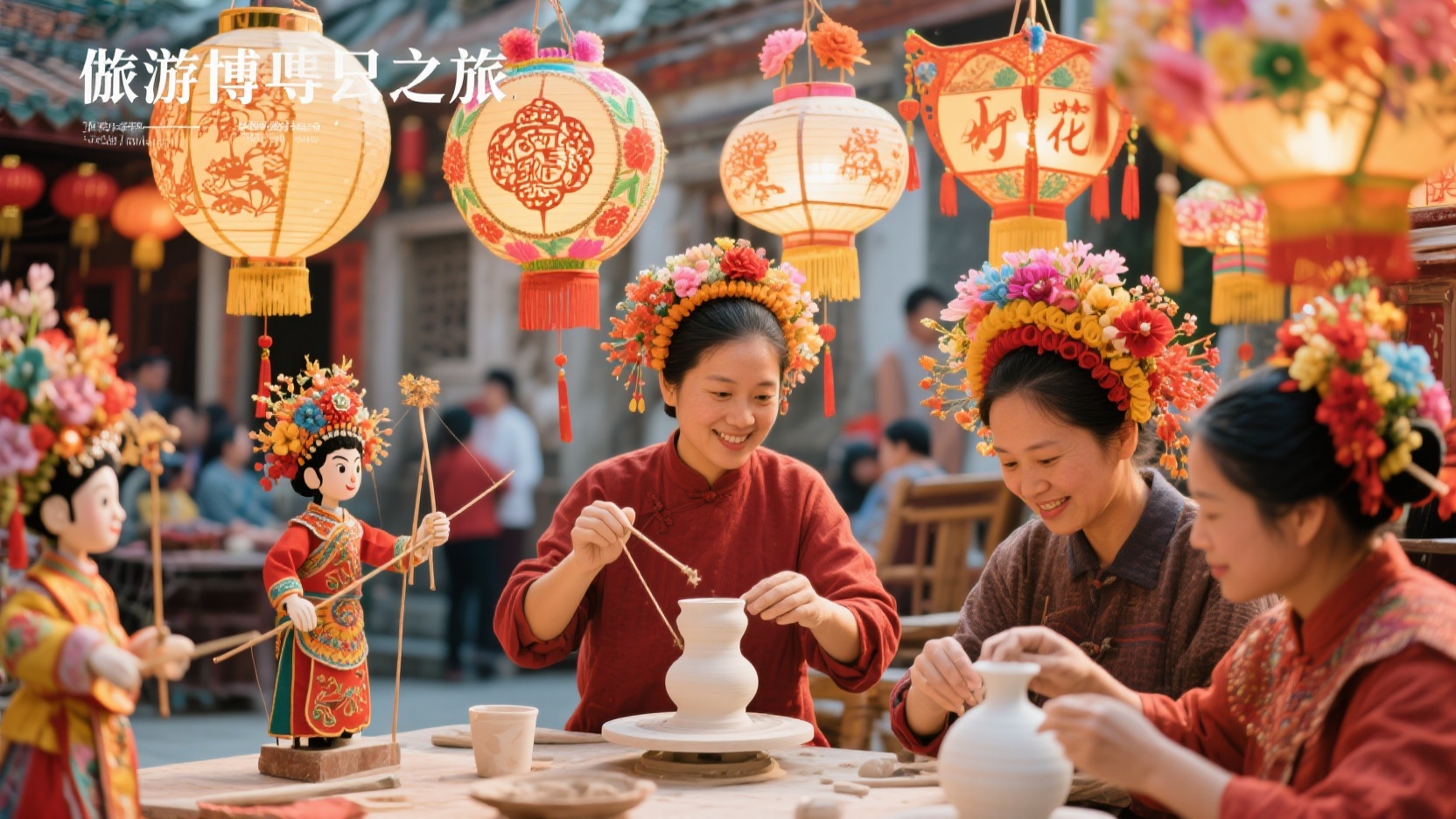
Quanzhou's festivals and folk customs are never confined to glass display cases; they are scattered throughout the lantern shops under the arcades, the hairpins in the Xunpu fishing village, the ends of the silk threads on the old opera stage, and the porcelain clay in the Dehua kilns. The most direct way to truly understand this "World Heritage City" is to choose a specific spot and sit down and be a local for half a day.
Lantern viewing and paper cutting: Make your own lantern on Zhongshan Road
Quanzhou's Lantern Festival is not a single-day celebration, but a city-wide lantern festival that lasts from the 13th to the 16th day of the first lunar month. The arcades along Zhongshan Road, the Confucian Temple Square, and Xinmen Street are adorned with colorful lanterns; needle-pierced lanterns, silk lanterns, and paper-cut lanterns glow warmly in the night. Quanzhou lanterns are a national intangible cultural heritage, with the "boneless paper-cut lantern" being a representative example—it uses no bamboo frame, relying solely on paper cutting to create a three-dimensional lantern body, with patterns often depicting traditional Minnan houses with their floral windows, opera figures, and auspicious flowers.
The experience isn't about taking photos in front of lanterns, but about finding a lantern or paper-cutting workshop and spending two hours there. First, you use a carving knife to carve intricate patterns on red paper, then you piece the paper together, apply sizing, and finally attach the lantern. Your fingers will memorize the paper's resilience before your brain does; only when you carve dragon scales or intertwined branches do you understand how many cuts are needed to create a single lantern. Culturally, Quanzhou paper-cutting was originally used for New Year's window decorations and sacrificial offerings, later combining with lanterns to become the most important visual symbol of the Lantern Festival. During the Lantern Festival, street parades featuring "Fire Cauldron Goddess and Goddess" and "Chest-Slapping Dance" will appear, making the festival a tangible ritual amidst the lantern lights and crowds.
Xunpu women wear flower-adorned hair ornaments: a garden on their heads.
Xunpu Village is located on the coast of Donghai in Fengze District, Quanzhou. The women here still retain the custom of "wearing flower garlands," a tradition that has been listed as a national intangible cultural heritage. Whether picking oysters in the morning, mending fishing nets in the afternoon, or participating in the Mazu pilgrimage, Xunpu women always wear their hair in a round bun at the back of their heads, surrounded by layers of flower garlands, and then adorned with bone hairpins and silk flowers. The colors of the flowers change with the seasons, with jasmine, magnolia, and Michelia champaca being particularly common.
Experiencing Xunpu customs doesn't require specific festivals; it can be done almost every morning. Change into a traditional long-sleeved shirt and wide-legged trousers, sit down and let a local grandmother comb your hair and adorn it with flowers, then stroll along the village's oyster shell houses. These houses offer another layer of cultural experience: during the Song and Yuan dynasties, Quanzhou traded frequently with Southeast Asia, and returning ships used oyster shells as ballast. These shells became building materials after landing, leaving traces of maritime trade on the walls. If you happen to visit during the 29th day of the first lunar month (a traditional festival) or the 23rd day of the third lunar month (the birthday of Mazu), the fishing village becomes even more vibrant, with women wearing flower headbands and carrying colorful baskets marching along the coast—custom and daily life blend seamlessly. Spending half a day as a Xunpu resident isn't just about changing clothes; it's about understanding how "wearing flowers as headbands" has continued for centuries in this fishing village.
Marionettes and Nanyin Music: Witnessing a "Living Song and Yuan Dynasty" Performance on an Old Stage
Quanzhou string puppet show, formerly known as "suspended silk puppet," preserves a large number of traditional plays and "puppet tunes," with puppet head carving and string manipulation performance complementing each other. Nanyin, on the other hand, is called a "living fossil of Chinese music history," with melodies retaining the charm of the Han and Tang dynasties, and sung in the Quanzhou city dialect. Both are national intangible cultural heritages, and Nanyin is also listed in UNESCO's Representative List of the Intangible Cultural Heritage of Humanity.
The most common experiential settings are the Quanzhou Puppet Theater or teahouses in the old town. When watching marionettes, don't just focus on the puppets themselves; observe how the performers control the puppets' fingers, eyebrows, eyes, and clothing with twenty or thirty strings. Classic excerpts like "Zhong Kui's Drunkenness" and "The Little Monk Descending the Mountain" feature puppets either drawing their swords and drinking alone or stumbling while chanting scriptures, the movements of the strings conveying a sense of strength and power. If the workshop is open, try holding a small lion puppet and making it take three steps and then shake its head. After a few minutes, your arm will be sore, and you'll understand the significance of "one minute on stage." The Nanyin experience is quieter: a combination of a pipa, xiao, erhu, sanxian, and clappers is played, with the singer holding the clappers as they sing. Listening to a piece of "Plum Blossom Melody" or "Eight Steeds" in a teahouse near the Confucian Temple is a much easier way to immerse yourself in Quanzhou's elegant musical tradition than reading any sheet music.
Dehua white porcelain hand-thrown: Keeping the "Chinese white" of the Song and Yuan dynasties in the palm of your hand.
The firing technique of Dehua white porcelain is also a national intangible cultural heritage, renowned for its "whiteness like snow, smoothness like jade, and translucency like silk." During the Song and Yuan dynasties, Dehua white porcelain was exported in large quantities through Quanzhou Port, and Europe called it "Chinese white." Today, the kilns and workshops in Dehua still continue the ancient methods of hand-throwing, molding, and sculpting.
This experience is best reserved for the latter half of the trip. With hands resting on a rotating potter's wheel, slowly lift, open, and seal a lump of clay to create a simple cup or small bowl. Dehua clay is highly viscous and has a fine texture, making it easy for beginners to slip when sealing the rim, but this also allows for a deeper appreciation of the delicate touch of a potter's fingers. A warm ivory white glaze is available, and the finished product will be mailed to you. If time is limited, you can also try sculpting a plum blossom or a small Buddha statue. Dehua porcelain sculptures, especially Guanyin, Bodhidharma, and plum blossom cups, are classic examples, reflecting the realistic and elegant style established by Ming Dynasty masters like He Chaozong. Taking home your own hand-thrown vessel is like packing away the memories of Quanzhou's maritime trade and the rhythm of its artisans.
The essence of Quanzhou's festival customs and intangible cultural heritage experiences lies not in "seeing" but in "hands-on experience." From carving lanterns to combing hairpins, from lifting puppets to pulling clay, physical participation truly brings to life the historical narratives about Quanzhou, Song and Yuan dynasty China, and maritime trade.