
A Wuhan Festival Diary: Spending Half a Day as a Wuhan Local at the Guiyuan Temple Fair, Han Embroidery Stands, and Backstage of Chu Opera
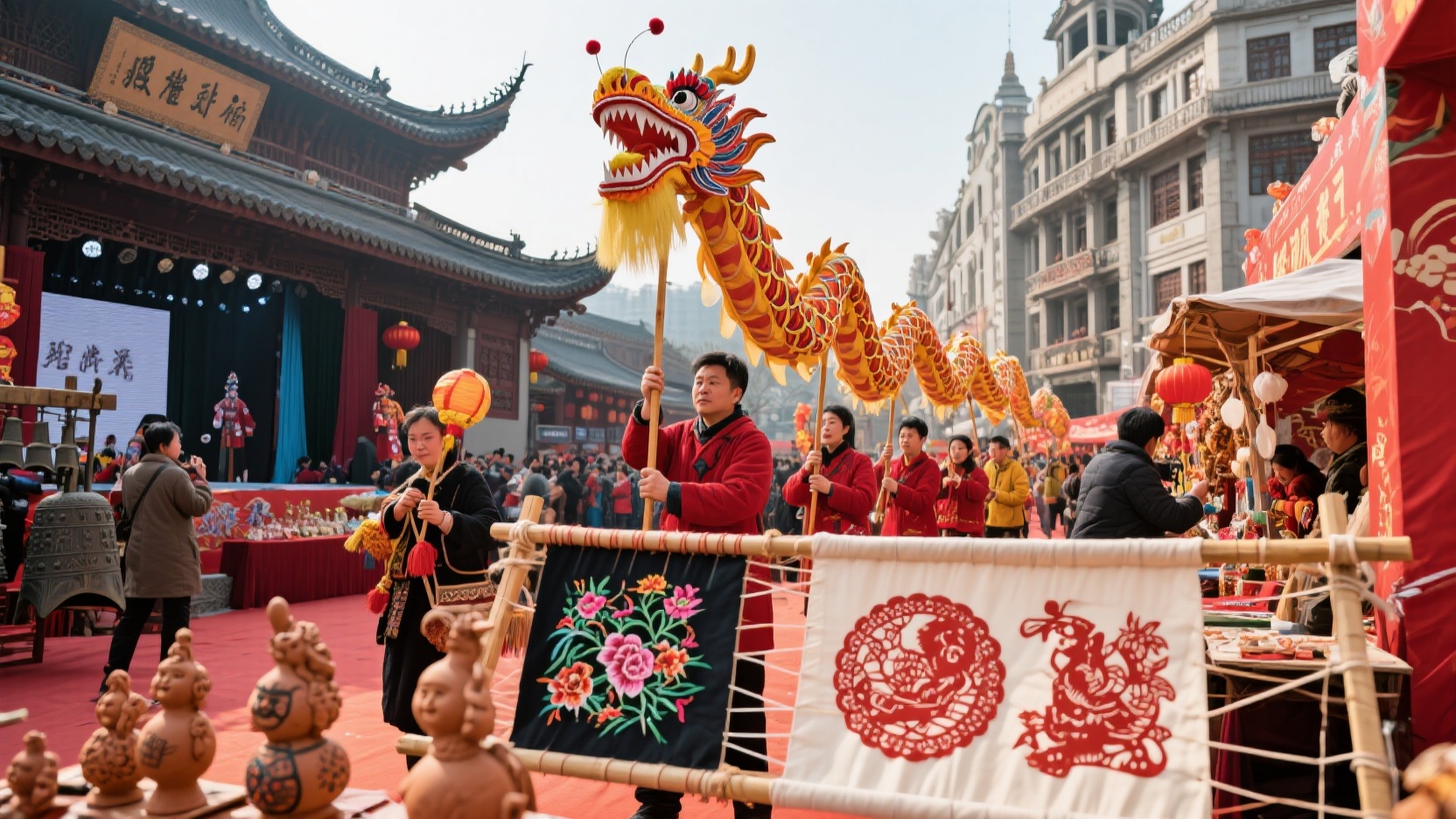
Wuhan's culture and art are not only found in the chime bells of the Provincial Museum and the exhibition walls of the Art Museum, but also in the festive gongs and drums, embroidery frames, and the side curtains of the opera stage. To quickly experience the "vitality" of Wuhan's culture, you can start by visiting the Guiyuan Temple Fair, Han Embroidery Workshop, the backstage of Chu Opera, and the Hankouli Intangible Cultural Heritage Market, and sit down and experience life as a local for half a day.
Guiyuan Temple Fair: A scene of traditional Jiangcheng New Year customs from the first to the fifteenth day of the first lunar month.
From the first to the fifteenth day of the first lunar month each year, the area around Guiyuan Temple in Hanyang becomes the most densely packed temple fair in Wuhan. Unlike typical scenic area temple fairs, the core here isn't food stalls, but rather a fixed route of "offering incense—touching the ruyi (a symbol of good fortune)—watching the Gaolong (a type of dragon dance)." Gaolong is a traditional dragon dance in the Hanyang area. The dragon's body is segmented, and the dragon head weighs tens of kilograms, lifted by strong men in turns. During the dance, the dragon's head is held high, and its tail sways, emphasizing "the dragon head bowing to the four directions." Visitors don't need to squeeze into the main incense path crowds; they can stand in the square outside the mountain gate to watch the Gaolong procession, or learn to make mini bamboo dragon lanterns from experienced craftsmen. The underlying cultural logic is straightforward: since Guiyuan Temple was built in the early Qing Dynasty, the temple fair gradually evolved from a religious activity into a folk custom; Gaolong, on the other hand, retains the ritualistic sense of praying for good weather and a bountiful harvest in agrarian society. Watching Gaolong "bowing to the four directions" in the crowd is a more profound experience of the Wuhan New Year's spirit than strolling through ten commercial streets.
In front of the Han embroidery frame: Learn a few stitches in Tan Hualin or Hankou – "Live for the crowds."
Han embroidery workshops in historical districts like Tanhualin and Hankouli are available year-round, with each session typically starting with stretching the fabric and splitting the silk. Unlike the understated realism of Suzhou embroidery, Han embroidery emphasizes vibrancy over elaborate designs, favoring bright red, royal blue, and bright yellow in its color palette. Common stitches include straight stitch, mixed stitch, and gold thread stitch. During the workshop, you don't need to complete a full piece; you can start by drawing a "福" (fortune) character or a phoenix pattern on the cotton fabric, then learn three to five basic stitches. By the second hour, you'll naturally understand why Han embroidery is widely used in theatrical costumes, curtains, and religious ornaments: thick threads, rich colors, and full compositions, achieving their full effect from a distance. This aesthetic stems from the culture of Hankou's docks and commercial port. In the past, embroidery shops were concentrated around Wanshou Palace, supplying costumes for Han opera and curtains for wealthy merchants, emphasizing striking visuals from afar and detailed close-up shots. Don't worry about making a few mistakes while you're at it; simply unravel the thread and start over—this process itself helps you understand the "vibrancy first" principle.
Backstage at Chu Opera: Arrive half an hour early to understand the Hankou character within the "sorrowful welcoming tune".
Chu Opera performances in Wuhan are mostly held on weekends or during traditional festivals, often at public parks, the Wuhan Chu Opera Theatre, and some community stages. It's recommended to arrive half an hour before the performance to watch the actors apply makeup, head coverings, and hair ornaments from the wings, and to listen to the musicians test their instruments. Chu Opera originated from Huangxiao Flower Drum, and its most distinctive feature is the "Sad Yaqiang" (悲迓腔), a high-pitched, mournful tune that often depicts the joys and sorrows of ordinary people and family ethics. Sit in the first three rows to watch a scene from "Da Jinzhi" (打金枝) or "Bai Shan Ji" (白扇记), focusing on the movement of the water sleeves and the subtle shifts in the female lead's eyes, rather than just looking at the subtitles. Half an hour backstage plus a scene from another play allows you to understand the theatrical spirit nurtured by Hankou as a port city: unpretentious, narrative-driven, and directly emotional. If you're still in the mood after the performance, chat with some of the older audience members; they'll tell you which word in the "Yaqiang" should bring tears to your eyes.
Hankouli Intangible Cultural Heritage Market: Symbols of Jingchu in Paper Cutting and Clay Sculpture
The intangible cultural heritage market in Hankou is open during holidays and weekends, with paper cutting and Huangpi clay sculpture being the two easiest to learn. Wuhan paper cutting often features auspicious themes such as "Phoenix amidst Peonies," "Immediate Promotion to High Rank," and "Three Abundances of Fortune, Longevity, and Prosperity." When cutting, the instructor will remind you to "cut the small holes first, then the outline," and to keep the lines clean. Huangpi clay sculpture originates from temple statues and folk toys from the Ming and Qing dynasties. Sculpting a small lion or zodiac animal is not about resemblance, but about capturing the exaggerated proportions of "large eyes, wide mouth, and short body." Each activity takes about an hour, and you can take your finished work home. More noteworthy are the traces of Chu shamanism in the paper cutting patterns and the folk iconographic logic in the clay sculpture: the phoenix in the paper cutting is related to phoenix worship in Chu, while the "three parts sculpting, seven parts coloring" technique in the clay sculpture retains the old methods of folk painted imagery. These symbols are closer to the cultural strata of Wuhan than the souvenirs themselves.
By stringing these four scenes together into a one- or two-day itinerary, there's no need to rush or chase after a certain number of check-ins. What festival customs and intangible cultural heritage experiences have in common is that hands and ears must be involved in order to transition from "having seen Wuhan" to "having lived like a Wuhan resident for half a day."