
Avoid the pitfalls of nighttime tourism in Wuhan | From the riverside lights to listening to Han opera in old teahouses, a local's guide to a less-traveled route (personally tested)
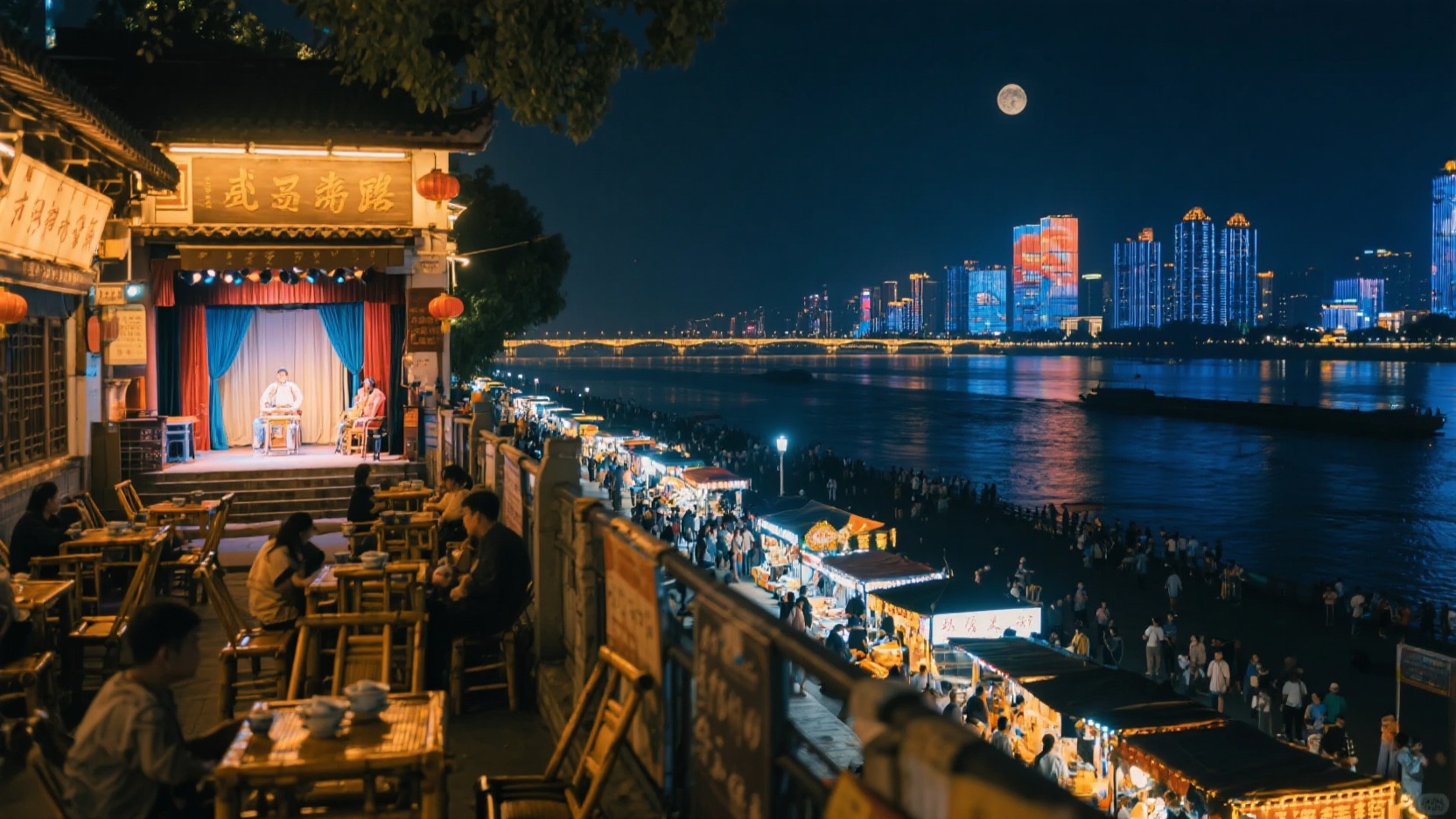
18:00-19:00 Hanyang River Beach, Parrot Island Section: View the lights but no crowds.
At exactly 6 PM, I cycled directly to the Parrot Island Yangtze River Bridge on the Hanyang riverfront. The biggest difference between here and the Hankou riverfront is that you can see the entire Parrot Island Bridge gradually transform from orange-red to a ribbon of lights, making the river surface look like it's covered with a layer of scattered gold. At this time, most of the people are locals strolling or jogging, while there are relatively few tourists, and you can sit anywhere on the stone steps along the riverbank.
The pitfalls I learned are: don't arrive too early; in summer, around 6:40 PM is the best time for sunset photos; in winter, arrive as early as 6:10 PM, otherwise the reflection on the river will be too strong after it gets completely dark. From the subway or taxi, take a three-minute walk to the entrance of "Hanyang River Beach Park" and you'll see the bridge; you almost don't need to look for a good spot.
19:10-20:30 Rose Street Night Market: Locals' late-night eatery, not in Hubu Alley
After leaving the riverbank, rent a shared bike and ride west along Lanjiang Road for about ten minutes to reach Rose Street. This route doesn't require navigation; just follow the locals wearing slippers after get off work. Rose Street isn't long, but the late-night food stalls on both sides start smoking from 7 pm, offering barbecue, beef offal, lotus root soup, and potstickers. I ate dinner here for two consecutive nights, and it was very comfortable for just a few dozen yuan per person.
Here's a pitfall to avoid: don't be fooled by the chain store signs at the street corners; the truly delicious food is found in the smaller shops in the middle. Walk around first and see which place is most crowded with locals and has the most empty skewers on the table before you sit down. I recommend starting with a bowl of lotus root soup to warm your stomach, followed by a few skewers of grilled lotus root and a serving of dried bean curd strips—this is my favorite late-night snack combination in Wuhan.
20:40-22:00 Moon Lakeside Teahouse: Enjoy a short excerpt from a Han opera while sipping tea.
After eating, I continued riding a shared bicycle, which took about fifteen minutes from Rose Street to Moon Lake Park. Around 8:40 pm, the lights along the lake were already on. Near the Qintai (a traditional Chinese opera platform), there was an old teahouse with an inconspicuous storefront, but it often hosted excerpts from Han Opera or Chu Opera in the evenings. On the Wednesday night I went, they were performing a selection from "The Universe's Edge," and the elderly opera fans in the audience closed their eyes and clapped along.
This teahouse is very affordable; a cup of covered-bowl tea is enough to sit until the evening ends. If you're not familiar with traditional opera singing, don't worry, we recommend sitting towards the back to experience the atmosphere of tea drinkers in the old alleys of Hankou. The tea itself isn't the main point; it's the contrast between the "streetwise vibe by day and the refined opera style by night" that's what makes Wuhan's nightlife so unique.
22:10-23:30 From Moon Lake to Qintai: Night photography session concludes with a stroll along the waterfront.
Around 10:10 PM, the teahouse closes, but don't rush back. After leaving the teahouse, walk along the path by Moon Lake towards the Qintai Grand Theatre. This path is about two kilometers long and will take about half an hour to walk slowly. By this time, most of the tourists have left, and the outline of the Qintai Grand Theatre is perfectly reflected in the lake. Occasionally, joggers pass by, and it's very quiet.
My favorite spot is standing in the middle of the Moon Lake boardwalk, looking north to capture the theater, the lake, and the distant city skyline in a single frame. If it's windy, the ripples on the lake's surface actually add depth and dimension compared to a completely calm scene. I reach the foot of the Qintai Grand Theater around 11:30 PM, which concludes my nighttime tour.
The blogger concludes: When exploring Wuhan's nightlife, don't just believe in the light shows; follow the locals' pace.
The best thing about this route is that it's not rushed, there are no queues, and you won't be pushed around by crowds on the riverbank. From 6 PM to 11:30 PM, it's connected by shared bikes and walking. The entire route takes about 25 minutes by bike in two sections, and the rest is walking. It's suitable for people who want to get some fresh air on weekends or business trips, as well as those who enjoy urban culture and photography.
Five good spots for night photography: First, directly under the Parrot Island Bridge on the Hanyang River Beach, take a low-angle shot of the bridge's light strips; second, on the side of the stone steps on the river beach, use the reflection in the river to capture silhouettes of people; third, in the middle section of the Rose Street night market, stand diagonally behind the stalls and use a telephoto lens to capture the lively atmosphere; fourth, under the lanterns at the entrance of the old teahouse, suitable for taking half-body portraits; fifth, in the middle section of the Moon Lake boardwalk, take a shot of the Qintai Grand Theatre and its reflection in the water.
Four safety tips: First, when riding a shared bicycle at night, be sure to check the brakes and lights, as streetlights are dim in some old alleys in Hanyang at night; Second, the Rose Street night market is crowded, so keep your phone and bag in front of you, not hanging them on your back; Third, do not use flash photography when watching operas in old teahouses, to respect the actors and tea drinkers; Fourth, the Yuehu Trail is close to the water and has no guardrails, so watch your step when taking pictures of reflections, and do not stand on damp stones for a better spot.