
Ningbo Folk Customs and Hourly Lessons: Four Half-Day Explorations of Intangible Cultural Heritage – Qiantong Guild Hall, Xiangshan Fishing Season Opening, Yue Kiln Pottery Throwing, and Gold-Painted
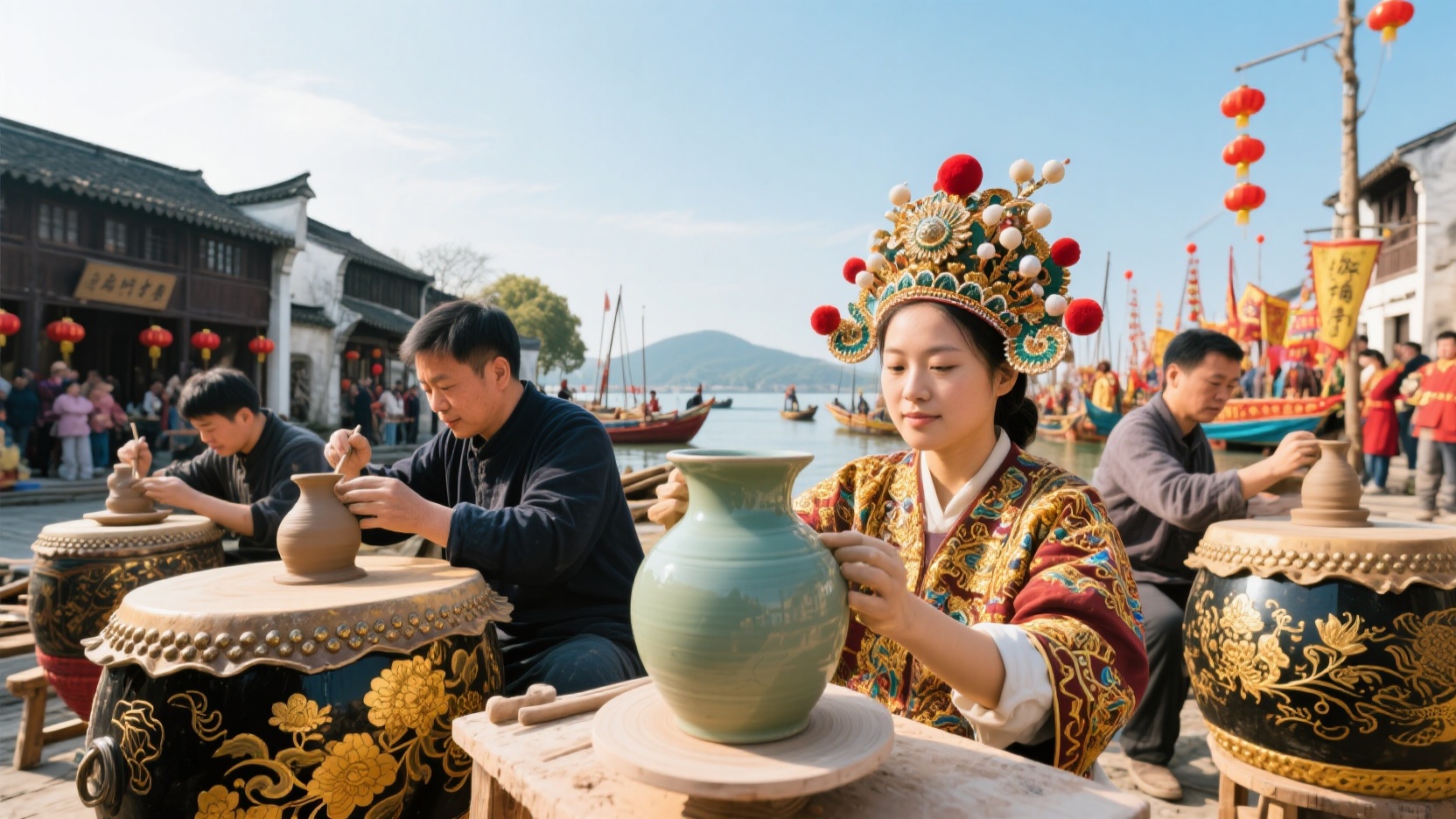
The true essence of Ningbo's culture isn't hidden in glass display cases, but rather in the rhythmic drumbeats of festivals and the warmth of handcrafted goods. To truly understand this port city, set aside at least four half-days to immerse yourself in the guild processions of Qiantong, the sea-worshiping formations of Shipu, the kiln fires of Shanglin Lake, or simply sit before a lacquer table. The following four points are all based on the principle of "sitting down and experiencing half a day as a local," without rushing or checking off tourist attractions.
Qiantong Lantern Festival Parade: The Ancient Town Parade on the Fourteenth Day of the First Lunar Month
Set the date for the Lantern Festival on the 14th and 15th of the first lunar month in Qiantong Ancient Town, Ninghai. Here, the Lantern Festival arrives a day earlier than elsewhere, and the core event isn't eating tangyuan (sweet rice balls), but rather the "Guanghui" (a traditional folk festival). During the day, centered around the Tong Clan Ancestral Hall, dozens of drum pavilions and palanquins are carried in succession, with clan members parading along the old street. Children dressed as opera characters fill the pavilions, and the procession features alternating drumming, folk dancing, and lion dances. The procession route follows the old street and the stream. As the drum pavilions pass, neighboring houses set up offering tables. Visitors can first stand by the stream to watch the procession cross the bridge before following the flow into the main street. But don't just take photos—during the procession, many courtyards will display lantern frames. You can sit down and learn to make a simple lantern, then join the lantern-carrying procession at night, being careful of the stone slabs under your feet. The procession commemorates the history of the Tong clan ancestors who diverted water and built canals to protect the village. The drum pavilion parade serves both to entertain the gods and to unite the clan, and for over 500 years, it has been the "spiritual alarm clock" for the people of Qiantong.
Xiangshan Fishing Festival: Sea Worship and Fishermen's Handicrafts at Shipu Port
Around the start of the fishing season in September each year, Shipu Port in Xiangshan enters its most vibrant period. The highlights include the sea-worship ceremony, the Mazu pilgrimage, and the race of thousands of boats. However, as a guide, it's recommended to arrive at the fishing village a day in advance. Fishermen don't refuse to watch as they mend nets and repair buoys; many fishing village cultural sites offer short experiences such as net weaving, fish lantern making, and learning fishermen's chants. Net weaving has a fixed weaving method; what a skilled worker can do in a few minutes takes a novice half an hour. Fish lanterns use bamboo strips as the frame and cotton paper as the outer layer. When painting the scales, the focus is on "blue back and white belly." Experienced fishermen will teach you how to tie the bamboo frame with thin hemp rope; tying it at the wrong angle will cause the fish tail to be crooked. Behind these handicrafts lies the fishing area's reverence for the ocean: the fishing moratorium allows the sea to rest, and the opening of the fishing season is celebrated with songs and dances—not as a celebration or a demand, but as a reaffirmation of the boundary between humanity and the sea.
Shanglin Lake Yue Kiln Workshop: Listen to Ou music while pulling a celadon bowl
The Shanglin Lake area in Cixi was the center of Yue ware kilns during the Tang and Song dynasties, and broken porcelain shards on the shore were once used as "stepping stones" by local children. Today, several celadon workshops are scattered along the lake, where you can experience the craft starting with throwing: sit on the potter's wheel, step on the turntable, wet your hands and hold the clay, find the center in the centrifugal force, then use your thumb to make a hole and your hand to lift the side. The most important thing to avoid when throwing is to keep your hands dry, so you should wet them frequently; Yue ware clay is delicate and suitable for making bowls, cups, and small pots. In the carving stage, you can use a bamboo stick to draw lotus patterns or water ripples, and the cuts should be shallow. Yue ware patterns emphasize half a cut of clay, and after putting it in the kiln, wait for the glaze to develop. If you have the time, you can listen to a celadon bowl music performance—using porcelain bowls and shards as percussion instruments, the sound is clear and melodious, a "porcelain band" that existed in the Tang Dynasty. The cultural clue behind this is "secret-color porcelain": Shanglin Lake once fired secret-color Yue ware for the imperial court, the glaze color of which is like the moon reflected in the lake water, and the Ningbo celadon route went overseas from here.
Gold-painted lacquer and gold and silver embroidery: leaving a mark on red cosmetic objects for a day
Ningbo's "Three Golds and One Inlay"—vermilion-lacquered wood carving, gold-painted lacquer, gold and silver embroidery, and bone and wood inlay—are important decorative elements in the traditional wedding procession. Workshops are often open to the public in the city's intangible cultural heritage venues and the Nantang Old Street area. Gold-painted lacquer involves piling lacquer, applying gold leaf, and painting on a wooden base—a very slow process. A small comb or a fruit box's partial design, from sketching and piling lacquer to applying gold leaf, often takes half a day. Gold leaf application must begin when the lacquer is almost dry; too early and it won't stick, too late and it won't shine. Gold and silver embroidery uses gold and silver threads to embroider dragons, phoenixes, pomegranates, and peonies on dark silk. The gold thread cannot be pulled too tight, otherwise the fabric will wrinkle, and the stitches must be "hidden from the beginning and not exposed at the end." Participants don't need to pursue a perfect finished product; the key is to understand the Ningbo wedding customs behind the "red makeup"—in old Ningbo, brides would display their family's craftsmanship with red lacquered furniture and colorful embroidered quilts. These items were not just decorations, but rather "dowry poems" written by women on wood and silk.
Four and a half days, from strolling through the ancient town to handicrafts in the fishing port, from kiln-fired pottery to lacquerware application, Ningbo's festivals and intangible cultural heritage offer more than just objects to watch; they provide a place to sit and relax. Choose a time to immerse yourself in the rhythm of the local seasons, and you'll get closer to the city's essence than visiting ten tourist attractions.