
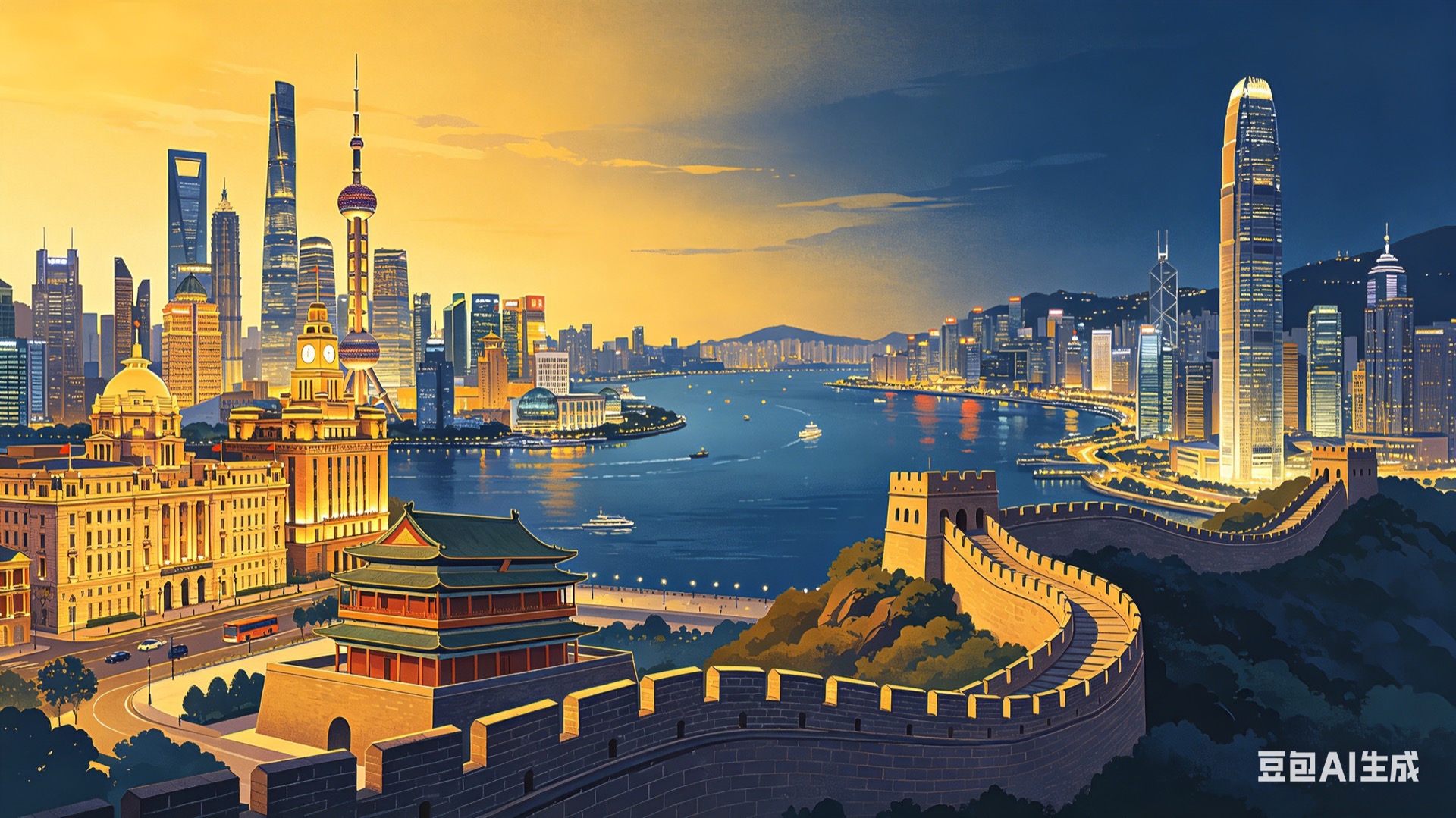
Overseas social media are abuzz with discussions about the picture of China, with positive emotions prominent in the comments section.
Nowadays, at major ports of entry in China, this scene can be seen every day: tourists from all over the world dragging their suitcases, holding up their mobile phones, excitedly taking pictures of the first Chinese road sign they see after entering the country.
As the visa-free transit "circle of friends" expands, "Go to China and see" has transformed from a slogan into action for more and more people. In the first half of 2026, visa-free entry for foreigners reached 17.815 million, accounting for 77.7% of all foreign arrivals, a 30.6% increase compared to the same period last year.
China through the eyes of overseas bloggers
Searching for "China Travel" on overseas social media reveals that the top 100 most-viewed videos from April 2024 to April 2026 paint a vivid picture of China.
China's diverse and unique cities are a favorite subject for overseas bloggers. Of these 100 videos, 62% focus on the characteristics of large and medium-sized cities, including Beijing's magnificent cultural heritage, Shanghai's modern street architecture, and Chongqing's magical multi-level transportation system; 24% delve into county towns and rural areas; and 14% focus on the journey itself, mainly showcasing the scenery and people encountered while cycling or hitchhiking.
The scenes captured on camera are equally diverse. 48% of the videos show modern city skylines and convenient infrastructure, 37% record various "Chinese flavors" from hot pot to morning tea, 36% focus on classic cultural symbols such as the Terracotta Warriors, and the warm hospitality of Chinese people towards visitors from other places also appears in 32% of the videos.
These images piece together a China without filters, full of everyday life. There are no fancy narrations, no exquisite photographic compositions, and no deliberate conversations. The bloggers simply walk and shoot as they go, yet unknowingly, they are showing the world a more authentic China.
In the video "This is One of the World's Largest Countries," which has garnered 23 million views, a Mexican netizen living in Chongqing enthusiastically introduces the city's dramatic changes, discussing everything from travel tips to "Is it suitable for settling down?" and "Is it easy to find a job?" Overseas netizens' interest in China has long since moved beyond superficial impressions like "So beautiful!" and "So cool!"; they are beginning to seriously consider: Can I go and see for myself, or even stay? This shift from limited knowledge to a desire to participate is precisely the most valuable achievement of China Travel.
China in the comments section
Of the more than 250,000 comments, over half were filled with positive emotions, with words like "thanks," "love," and "great" appearing frequently. One netizen wrote after watching the video: "China is amazing! It's so clean and safe, and the food is both delicious and cheap. It has amazing infrastructure like railways and highways, making it easy to travel to another city even from a small town." In the eyes of these overseas netizens, the China depicted in the video has become a blueprint for their ideal life.
Many foreigners, long misled by some Western media outlets, have, after seeing the real China, directly criticized the "dark filter" itself. Many overseas netizens questioned in the comments section: "Why have I never seen this side of China before?"
Every valuable comment in the comment section of China Travel videos creates a ripple effect, with a very high rate of secondary comment replies. Entering these conversations, keywords such as "people" (33,140 times), "Chinese" (27,022 times), "city" (22,426 times), "food" (14,029 times), "culture" (4,461 times), and "car" (2,242 times) repeatedly appear. From warm encounters between people to firsthand experiences of urban spaces; from the diverse flavors of China to the exploration and understanding of its cultural depths; from amazing technological applications to the convenience and comfort of daily travel… these frequently used words outline the collective interest of overseas netizens in the face of Chinese society and life.
In the comments section of a video showcasing the Liangshan Yi Autonomous Prefecture in Sichuan, netizens shared their experiences of local residents leaving the mountains, moving into government-provided housing, and learning new skills. A cross-cultural dialogue unfolded around this topic with 601 comments. An Indian netizen exclaimed, "I hope our country has such foresight." An American netizen reflected, "China uses education to solve social problems, but we haven't done the same." When netizens from different countries exchanged views on their respective countries' development paths under the same video, the comments section transcended mere emotional exchange, becoming a miniature "global governance discussion space." This in-depth international dialogue is a key force in breaking down information silos and promoting a more objective global understanding of China.
China in people's hearts
Studying these videos reveals that the phrase "reality is different from what the media says" frequently appears in the titles, and an increasing number of China Travel videos are using real footage to tear down those labels that attempt to stigmatize China.
A video titled "The China the Media Won't Show You," which has been viewed 13.5 million times, documents a foreign blogger's hitchhiking journey from Gansu to Beijing. In the video, traffic police officers responsibly help this stranger, taking him to a highway service area, giving him lunch, and even helping him flag down a ride. The blogger's expression changes from initial wariness and unease to later feeling at ease, eating and laughing with the officers.
In the comments section of this video, one comment sparked 550 discussions: "No one attacked you, stole your things, insulted you, lied to you, or murdered you. No one called the police, and the police didn't arrest you. Everyone was kind to you, and the police even tried to help you, giving you several rides and a meal."
In the minds of many overseas netizens, the police are often associated with violence. But when they saw a Chinese policeman delivering food on the highway, their old perceptions began to crumble. This is the power of China Travel, and the power of authenticity: in the face of concrete acts of kindness, prejudice often crumbles on its own.
Another video, "I Ignored the Media and Visited China," also sparked heated discussion. The blogger arrived in China with trepidation and skepticism, riding the Maglev train, touring the Bund, and immersing himself in everyday life. He concluded by candidly stating on camera, "This trip dispelled a lot of prejudice." In the comments section, netizens criticized inaccurate reporting by certain Western media outlets and biased perspectives from some bloggers. Here, "anti-stigma" is far more than just self-defense by Chinese netizens; it has become a spontaneous consensus among overseas netizens.
From the ever-growing list of visa-free travel destinations to China Travel videos repeatedly garnering over ten million views, and the increasingly objective and rational voices in the comments sections, China's efforts to promote high-level opening-up are yielding tangible results. The genuine appreciation and spontaneous skepticism towards any perceived "dark filters" expressed in the comments are a testament to the power of seeing is believing.
Of course, being seen inevitably means being scrutinized, and being liked inevitably means being expected. Those insightful suggestions about how to improve the travel experience reflect a self that can be refined and improved.
Openness is a mirror that allows us to see our own shortcomings; it is also a bridge that enables China and the world to move forward together through genuine exchanges. By using a credible, endearing, and respectable image to dispel prejudice, and by accepting suggestions with an open mind, every encounter will become a shared journey of growth.
(Source: Economic Daily; Authors: Wang Tianzheng, Yue Xiaoqi; Author's Affiliation: China University of Political Science and Law)