
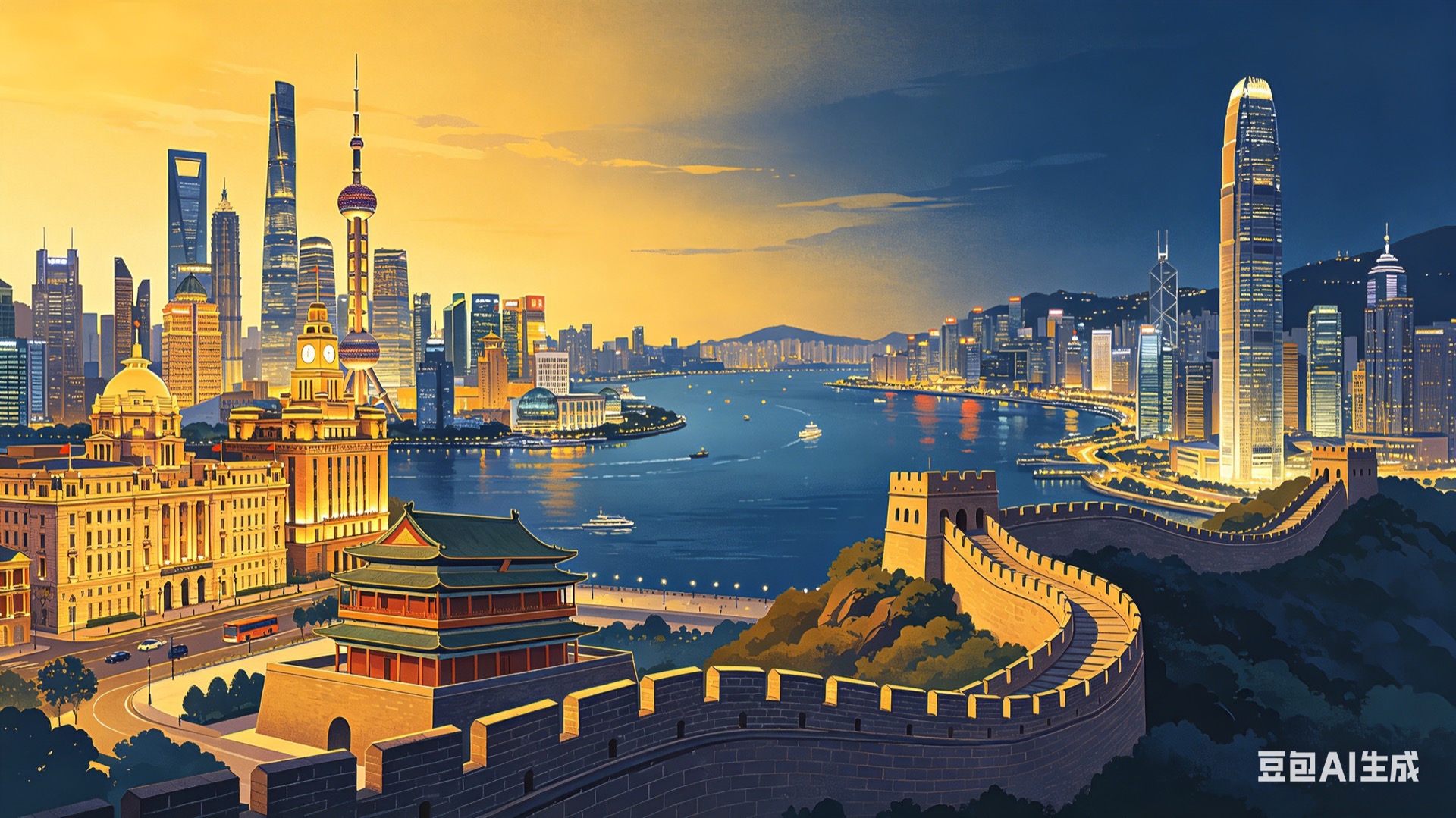
Understanding the New and Changing Aspects of "China Tourism": China is Worth Exploring Repeatedly
"China is amazing! I highly recommend everyone to visit China," American entrepreneur Elon Musk recently wrote on social media. His mother then reposted the post, adding, "Every city in China is unique and has its own distinct cultural attractions. The streets and buildings are clean, beautiful, and well-maintained. I felt very safe there, so I really enjoyed my trip to China."
In less than a day, Musk's post garnered over 2.5 million views, and the comments section was flooded with foreign netizens who had visited China, sharing their impressions: "China is worth exploring again and again!"
Recently, hashtags related to China such as "China Cool," "China Shopping," and "Chinamaxxing" have been trending on overseas social media platforms, while "China Travel" has sparked a global craze. In the first half of this year, China received 22.914 million foreign visitors, a year-on-year increase of 20.4%.
Climbing the Great Wall, visiting the Forbidden City, and seeing pandas used to be the "old three things" for foreign tourists visiting China. Now, the ways to experience China are becoming more and more diverse—visiting intelligent production lines, exploring ancient towns and villages, and learning Chinese Tai Chi, all of which leave them exclaiming "excited!" The newness and changes in "China tourism" allow foreign tourists to see not only scenery, but also a vibrant and dynamic China.
A New Experience: Touching "Made in China 2025"
"This is even cooler than I imagined."
"Coming to China is like entering a future world!" This is a common exclamation from many foreign tourists when sharing their experiences in China.
On a high-speed train traveling at over 300 kilometers per hour, the scenery outside the window flashes by, yet the carriage remains so stable that a coin could stand upright on its own; ordering takeout at a hotel, a delivery robot takes the elevator upstairs by itself and delivers it steadily to the room; ordering a cup of milk tea in a park, a drone delivers the drink precisely to a smart locker a dozen minutes later… From the moment you arrive in China, “Made in China” permeates your entire journey, allowing every foreign tourist from afar to embark on a surprising and delightful “journey into the future.”
China's technological development is advancing rapidly, and its level of intelligent manufacturing is among the world's leading. "Made in China 2025" is becoming a new attraction for foreign tourists, and "technology tourism" and "industrial tourism" are gaining popularity.
"This is even cooler than I imagined!" exclaimed Philippe, a Brazilian tourist, standing in the visitor corridor of Leapmotor's smart factory in Hangzhou, Zhejiang. Inside the factory, robotic arms moved up and down, car bodies moved slowly on conveyor belts, and new cars rolled off the production line one after another. "I never knew production could be so efficient and intelligent!"
Stepping into an electric vehicle factory to see the intelligent production line, wearing MR (Mixed Reality) glasses for a time-travel experience along Beijing's central axis, and witnessing the awe-inspiring moment of a rocket soaring into the sky in Wenchang, Hainan... Through these cool scenes, foreign tourists see a China full of innovation, vitality, and vigorous development.
As China's technological prowess redefines our understanding, foreign tourists' "China Shopping" lists continue to expand. On overseas social media, "going to China with an empty suitcase" has become a hot topic, with more and more foreign tourists turning their trips to China into "shopping sprees."
As a seasoned tech enthusiast, Zahid from Singapore had long yearned to visit Huaqiangbei Pedestrian Street in Shenzhen, Guangdong, known as "China's No. 1 Electronics Street." During his trip to China, he specifically included it on his must-visit list. "Global tech bloggers all recommend this place, saying no one can leave empty-handed, and it truly lives up to its reputation!" Zahid showed the reporter the AI glasses he had just chosen. "Look, it's fully equipped with photo taking, video recording, navigation, and voice prompting functions, and it even supports 89 languages for mutual translation. The smoothness of the conversations is amazing!"
Data shows that Huaqiangbei sees an average daily foot traffic of 750,000 people, including over 8,000 foreign visitors daily. In the first seven months of this year, sales of all AI products increased by more than 55% year-on-year. The common sight in Huaqiangbei is people arriving empty-handed and leaving with suitcases full.
This continuously rising trend of inbound consumption is not only a powerful testament to the strength of Chinese manufacturing, but also a vivid illustration of China's commitment to expanding high-level opening-up and sharing development opportunities with the world.
New Vision: Exploring the Countryside
"The enchanting countryside has ignited a global passion for traveling across China."
"Is Shanghai a city or not?"—This English-Chinese fusion question from American blogger "Baobao Bear" went viral on social media in 2024. Foreign tourists flocked to Beijing, Shanghai, Guangzhou, and Shenzhen, checking off landmarks like the Bund, Guomao, and the Canton Tower. In their eyes, these modern cities were the epitome of China's "city."
After "city or not city," now comes "country or not country." Foreign tourists are flocking to China's countryside. Look, a South Korean brother and sister made a special trip to Zhejiang's new rural areas, Russian groups went to Heihe in Heilongjiang for the early morning market, and a young British man even considered quitting his job to stay in Wuyuan, Jiangxi… The American magazine *Around the World* commented, "China's charming countryside has ignited a global passion for traveling through China."
China has 19 villages on the list of "Best Villages for Tourism" published by the United Nations Tourism Organization, ranking first in the world. The diverse natural scenery and cultural heritage have made "Country Walk" popular at home and abroad.
Cambodian tourist You Jinlong had previously visited the Bund in Shanghai, the City Wall of Xi'an, and Kuanzhai Alley in Chengdu, but this time, he wanted to see the real face of rural Northwest China. Entering Xuezhuang Village in Guyuan, Ningxia, he saw rows of greenhouses, old green train carriages converted into cafes, and former cave dwellings transformed into guesthouses. "I thought the rural Northwest would be all yellow dust," he said, "but what I saw was a modern pastoral scene."
What You Jinlong saw was a microcosm of countless rural areas in China—a well-developed road network connecting the countryside, carefully protected green mountains and clear waters, and a revitalized local culture. This is becoming a new window for foreign tourists to "understand China."
Not only rural areas, but also the "hidden gem towns" in the county have been added to the new "must-visit" list for foreign tourists.
From the "foreign-style homestays" of Deqing, Zhejiang to the Hui-style ancient villages of Yixian, Anhui, from Songjing Taoyuan in Daying, Sichuan to Eryuan Hot Spring Town in Yunnan, county-level tourism is becoming a "dark horse" in the inbound tourism market due to its profound cultural scarcity and immersive experience.
Data shows that the number of foreign tourists flying to Yining in Xinjiang and Linzhi in Tibet this summer increased by 6.3 times year-on-year, while the number traveling to Datong in Shanxi increased by 2.8 times. In Tongxiang, Zhejiang, Wuzhen and Puyuan received 250,000 inbound tourists from January to May this year, an increase of 66% year-on-year.
In Qiantong Ancient Town, Ninghai County, Ningbo, Zhejiang Province, a steaming "long table banquet" captivated Italian tourist Mattia. "China is very modern, with many modern cities and many ancient villages. I think these towns and villages truly encapsulate the beauty of China's tradition and modernity." Upon learning that Xu Xiake, more than 400 years ago, set off from the west gate of Ninghai to begin his more than 30-year-long journey, Mattia said, "Xu Xiake spent his life traveling throughout China, and I also want to travel slowly and savor the unique stories of each small town."
As more and more foreign friends set foot in county towns and rural fields, they see not only the beautiful landscapes of China, but also a picture of vigorous development, a more real, three-dimensional, and comprehensive China.
New Trend: Integrating into Everyday Life
"We are embarking on a 'Chinese lifestyle'."
In Xi'an, Shaanxi Province, Dubai tourist Zain and his classmates kneaded, sculpted, and carved clay together, completing three terracotta figurines in two hours; in Kaifeng, Henan Province, Colombian youth Nick was so captivated by the "jianghu" (martial arts world) of Wansui Mountain Martial Arts City that he even stayed at the scenic area, becoming a costumed NPC; in Shanghai, Dutch tourist Eloven visited three Pop Mart stores before finally buying the limited-edition Labubu collaboration item he had been longing for...
From curiosity to fascination, from "one trip" to "wanting to come back"—the allure of Chinese culture is becoming a deep-seated driving force for foreign tourists to continue visiting China. A survey by the China Tourism Academy shows that over 60% of inbound tourists list "experiencing Chinese culture" as their primary travel purpose.
This cultural experience isn't limited to tourist attractions, intangible cultural heritage workshops, and trendy toy stores; it's deeply integrated into the daily lives of Chinese people. At the beginning of this year, topics like "Chinamaxxing" and "Becoming Chinese" went viral on overseas social media platforms. In just a few months, related hashtags accumulated over 4 billion views. Tens of thousands of young foreigners began posting about their morning routines—drinking hot water, soaking their feet before bed, practicing Baduanjin (a form of traditional Chinese exercise), and wearing cotton slippers—saying, "We are embarking on a 'Chinese lifestyle'."
Amid this trend of "Chinese lifestyle," more and more foreign tourists are not only visiting popular tourist attractions, but also going to parks to learn Tai Chi, to traditional Chinese medicine clinics for acupuncture, and to teahouses to enjoy the unique charm of Chinese culture in their daily lives.
"Sink your shoulders, drop your elbows, lower your palms, and feel the breath rise from the soles of your feet as you inhale..." At nine o'clock in the morning, at the east gate of the Temple of Heaven Park in Beijing, dozens of foreign tourists were learning Tai Chi from Chen Yanming, a Tai Chi promoter. Sergio from Spain was particularly focused, and after the class, he was still eager for more: "I had seen Tai Chi videos online before, but it was only after learning in person that I realized I had to coordinate my breathing and turn my attention inward. It's amazing!"
What deeply fascinates foreign tourists is the simple and warm hospitality of the Chinese people, who believe "everyone is a guest." In Shandong, a young German man hitchhiking was unexpectedly invited to a local wedding; in Chongqing, a British journalist stumbled upon a music gathering of elderly people while taking an evening stroll and was invited to perform on stage; in Hunan, a Canadian tourist was given a ride over 300 kilometers by two men and even invited to their home for dinner… British media reports have stated that "the safe and friendly environment and the warm hospitality of the Chinese people" are among the important reasons why foreign tourists choose to travel to China.
Behind the new changes in "China tourism" lies China's continued efforts to open up to the outside world at a high level, the robust pulse of the Chinese economy, the profound charm of Chinese culture, and, more importantly, the stability and order of society and the hospitality of the Chinese people. As "checking off" becomes "experience," and travel becomes a way of life, the international community is gaining a deeper understanding of a China that blends tradition and modernity, and advances development and openness in tandem.
(Source: Guangming Daily reporter Ruan Ziyan)