
Should I stay near the Bell Tower or the Big Wild Goose Pagoda in Xi'an? I'll break down the costs for both.
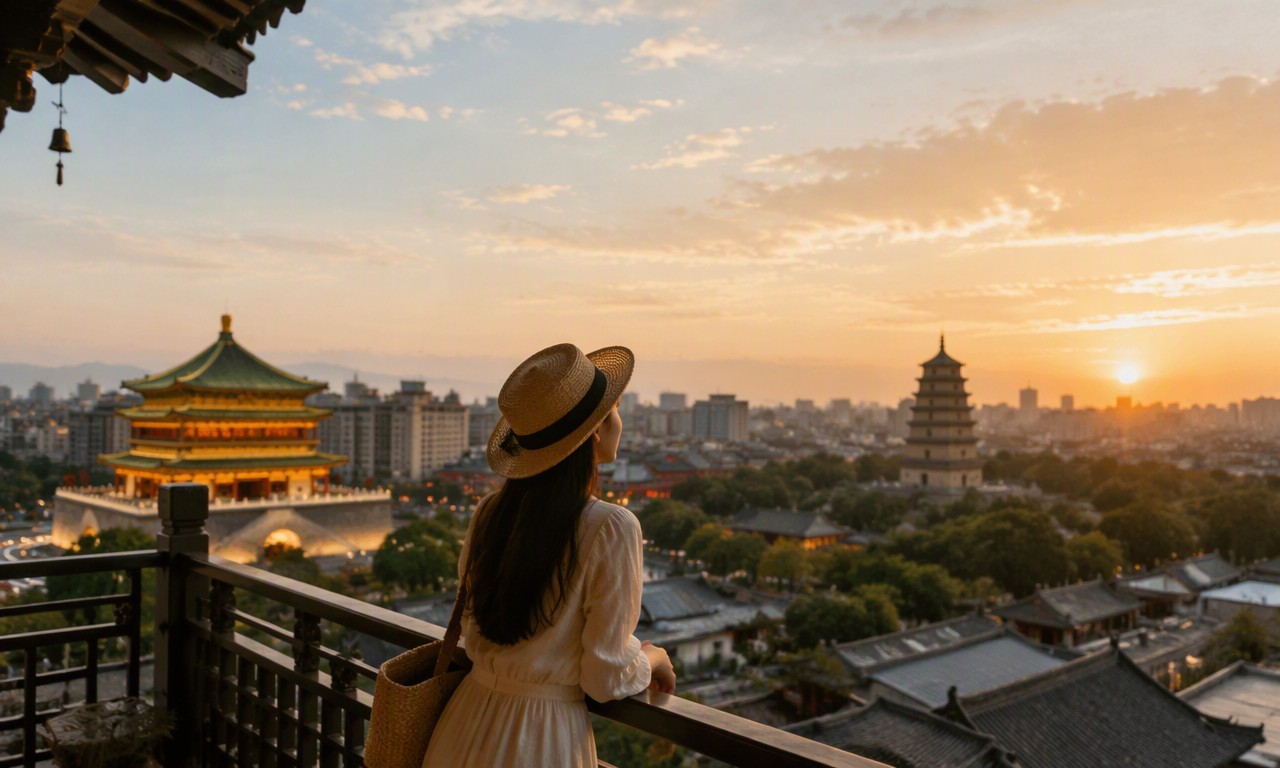
Before arriving in Xi'an, deciding where to stay is often more agonizing than deciding what to eat. Some say you have to stay near the Bell Tower, others say staying near the Big Wild Goose Pagoda is the only way to feel like a vacation; some feel that guesthouses offer a more authentic Xi'an experience, while others only trust chain hotels for a more comfortable sleep. This article won't list any rankings, but rather lay out the most common choices on both sides, explaining which is suitable for which type of person and itinerary. Just find the one that fits you. Why is this a question worth answering seriously? Because in Xi'an, the location of your accommodation directly determines how much more walking you'll have each day, whether you can get back home at night, and whether you'll even want to go out the next day.
Group 1: Should we stay in the Bell Tower commercial area or around the Big Wild Goose Pagoda?
Most travel guides will tell you that "staying near the Bell Tower is the most convenient, as it's close to everything." In reality, the Bell Tower commercial area's advantages lie in its transportation hubs and the Muslim Quarter's late-night food scene. Staying in this area means you can still feel the lively atmosphere even at 11 or 12 at night. Two subway lines intersect here, making it quick to get to Xi'an North Railway Station and Xi'an Railway Station. However, rooms near the Bell Tower are generally small, many are in older buildings, and rooms facing the street might be noisy at night, so light sleepers should be cautious.
The area around the Big Wild Goose Pagoda presents a different picture. Most travel guides tout it as "just a stone's throw from the Tang Paradise," but it's actually more suitable for those who plan to spend their evenings in Qujiang. If you're planning to spend two or three days in the Tang Paradise, Joy City, and Nanhu area, staying near the Big Wild Goose Pagoda certainly saves you the hassle of traveling back and forth. However, be aware that traffic restrictions are frequent around the Big Wild Goose Pagoda on holidays and evenings, making taking a taxi less convenient than taking the subway, and hotel prices rise significantly during peak tourist season.
Group 2: Chain hotels or local guesthouses?
Most travel guides portray guesthouses with a distinct "Chang'an flavor," complete with long tables, bamboo curtains, and Tang-style paintings. However, the reality is that Xi'an's local guesthouses vary greatly: some in the old city, converted from family compounds or old residential buildings, offer good locations and affordable prices, but soundproofing, hot water, and elevators may not be guaranteed. There are indeed excellent boutique guesthouses, but you need to be selective and not just look at photos.
The advantage of chain hotels is their stability. Most tourists are already tired from walking all day and just want a hot shower, a mattress that doesn't collapse, and decent soundproofing at night. Mid-range chains are widely distributed in Xi'an, with locations around the Bell Tower, South Gate, Xiaozhai, and Big Wild Goose Pagoda. For those with a limited budget or who aren't picky about accommodation, choosing a chain hotel is generally a safe bet. Those who are passionate about taking photos and "staying in the old city" should consider guesthouses, but it's recommended to choose those with a physical storefront and reviews mentioning soundproofing and reliable hot water.
Group 3: Old City or Qujiang New District?
Most travel guides describe the Old City as "the most authentic Xi'an area." Indeed, the Old City's strengths do lie in its everyday atmosphere, including the city walls, the Forest of Steles, Xiangzi Temple Street, and the morning market—you can wake up to find people walking their birds and long queues for meatball soup. However, many accommodations in the Old City are outdated, the roads are narrow and congested, making it inconvenient to drag large luggage.
Qujiang New District, on the other hand, boasts wide roads, lush greenery, and convenient parking. Its hotels are mostly mid-to-high-end, making it suitable for families with cars or elderly members and children. Many people worry that Qujiang "lacks the feel of the old city," but in reality, Qujiang's night views and strolls around Nanhu Lake are excellent. However, it's a bit far from traditional tourist attractions like the Muslim Quarter and the Bell Tower, adding 20-30 minutes to your daily commute. Whether to stay in the old or new city depends on whether you define your Xi'an trip as "exploring the alleyways" or a "relaxed vacation."
Group 4: Near the scenic area or on the subway line?
Most travel guides suggest staying near tourist attractions, implying that "you'll have the sights right outside your door." However, many established tourist attractions in Xi'an are not ideal for accommodation: for example, the Muslim Quarter is difficult to access at night due to the bumpy cobblestone streets; the area around the Terracotta Warriors offers little in the way of nightlife and limited restaurant options. Unless you're aiming for the first wave of visitors to the attraction the next morning, it's not worth staying near it just for the sake of staying at a particular site.
A more practical approach is to stay along Line 2 and Line 3, such as in the areas of Nanshaomen, Xi'an Stadium, and Xiaozhai. Although the Xi'an subway is crowded during the evening rush hour, it's smooth to get to the Bell Tower, Xiaozhai, Big Wild Goose Pagoda, and North Railway Station during the day. Staying along the subway line means you don't have to change accommodations for each attraction, and you don't have to spend your budget on inflated prices at tourist attractions.
Group 5: High-rise apartment with a view or a quiet courtyard house?
Most travel guides consider "seeing the city wall from the window" as the romantic finale of accommodation in Xi'an. In fact, high-rise view rooms do have their unique advantages. Several high-rise buildings outside the South Gate can see the city wall and the night view of Yongning Gate. However, most of these rooms face the street, and the noise of cars and squares is constant from morning to night, so they are not suitable for people who want to go to bed early.
Quiet courtyard houses are mostly concentrated in Beilin, Shuyuanmen, and some low-density communities in Qujiang. They are often not near main roads, quiet at night, and you can hear birds chirping in the morning. The downside is that the lighting may be average, and some older courtyards do not have elevators, so people with a lot of luggage have to carry it upstairs. When choosing which one to go for, ask yourself first: Do you want to come back and fall asleep immediately, or are you willing to spend more money and tolerate more noise for the view outside your window?
Group 6: Student-style hostel or family room?
Most travel guides describe hostels as "the top choice for budget travelers" and "a place to meet friends." Indeed, hostels in Xi'an are concentrated around the South Gate and Bell Tower area, with a lively atmosphere and large common areas. However, dorm rooms may not be suitable for solo female travelers or those with high sleep requirements, as snoring and noise from people coming and going can disrupt rest.
Family rooms or twin hotel rooms offer another option. For groups of three or four, the per-person cost might not be much higher than a hostel, while still providing a private bathroom and quiet, locked room. Especially when traveling with elderly people, hostel bunk beds are almost unacceptable. If you have a limited budget but want a comfortable stay, consider family rooms in business hotels outside the old town; they are more cost-effective than hostels inside the tourist area.
Group 7: Should we stay in Qujiang during peak season or in the old town during off-season?
Most travel guides rarely link seasons to accommodation areas. In reality, during peak seasons like May Day, National Day, and summer vacation, not only do hotel prices rise in the Big Wild Goose Pagoda and Qujiang areas, but the crowds at night are also exhausting. Staying in the old city or the outer areas around the city walls during peak season can actually help you avoid some of the congestion in Qujiang. While the Muslim Quarter is also crowded, at least there are more transportation options.
Visiting Xi'an during the off-season, especially from mid-November to February of the following year, means many hotels around the Big Wild Goose Pagoda see price drops, making Qujiang's tranquility and night view its advantage. If your itinerary includes a significant portion of evening activities at the Tang Paradise, choosing Qujiang during the off-season is a wise decision; during peak season, it's advisable to focus your accommodation efforts on the Bell Tower, South Gate, and South Slight Gate areas, as these offer convenient access to the city and faster dispersal.
Group 8: How many days should we stay? Should we change hotels?
Most travel guides won't seriously advise against changing hotels. In reality, the attractions in Xi'an are not far apart, and there's absolutely no need to change accommodations within four days. Frequent hotel changes mean checking out, storing luggage, dragging luggage, and checking back in, which can easily waste half a day. A typical itinerary in Xi'an revolves around the Bell Tower, radiating outwards in all directions; changing hotels will only add to the hassle.
If you have more than a week to spare, you can switch your accommodation from the Old City to Qujiang for the latter half of the trip. Spend the first four days exploring the city walls and the Muslim Quarter, and the last three days leisurely strolling through Qujiang, the Big Wild Goose Pagoda, and South Lake. This makes the change of hotels worthwhile. The core criterion for deciding whether to switch is this: does your itinerary clearly divide into two activity zones of different radii? If not, don't switch.