
How different are Xi'an food guides and local eating habits?
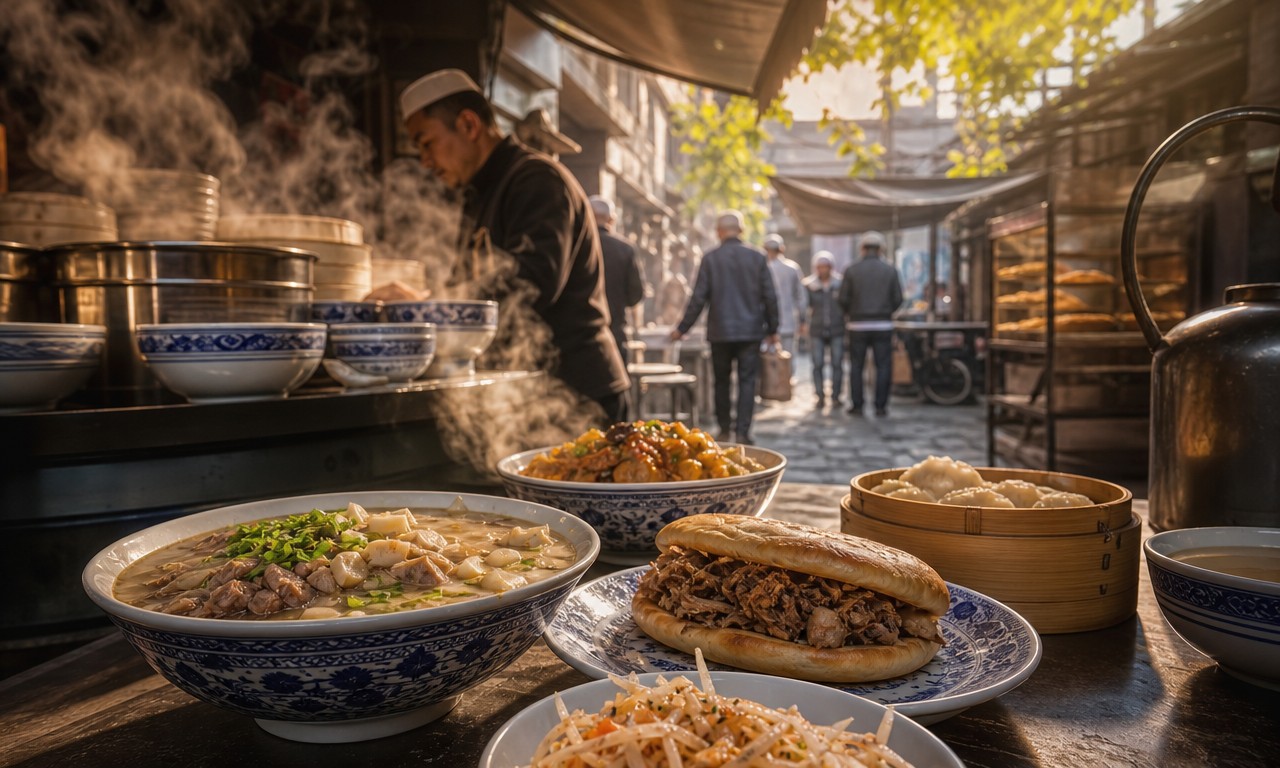
Many people memorize food guides before visiting Xi'an, then try every restaurant they find, only to find them underwhelming. The problem often isn't the food itself, but rather that the restaurants you visit aren't the same ones frequented by locals. This article compares the most widely circulated online recommendations with what locals actually eat, explaining the differences, which side to trust, and when both are valid.
Muslim Quarter Main Street vs. Sajinqiao and Dapiyuan
Most travel guides will tell you that the Muslim Quarter is the epitome of Xi'an's snacks, and that the street behind the Drum Tower is a must-visit. In reality, when locals talk about "Muslim Quarter," they generally mean the entire Muslim neighborhood. However, the main street, Beiyuanmen, has become overrun with tourists, with repetitive stalls and distorted flavors; locals rarely go there specifically. The truly authentic destinations are the parallel alleys like Sajinqiao, Dapiyuan, and Beiguangji Street, which have a vibrant, lively atmosphere and shops catering to locals. If it's your first time visiting and you want to experience the atmosphere, walking along the main street is fine; but if you're just looking for good food, it's safer to head straight into the alleys.
Lamb Stew with Flatbread: Lao Sun's vs. Lao Liu's and Tong Sheng Zhai
Most travel guides will tell you to go to Lao Sun's for mutton stew, because it's famous, has many branches, and is easy to find. However, locals actually prefer established restaurants like Lao Liu's, Tong Sheng Zhai, and Yi Zhen Lou, where the broth and meat are more substantial, and the bread-breaking is more meticulous. Lao Sun's, in recent years, caters more to tour groups and tourists; the taste isn't bad, but it lacks the "oily aroma" that locals crave. If you're short on time and have specific ambiance requirements, Lao Sun's is fine; but if you're willing to walk a little further and break the bread into smaller pieces yourself, going to the local favorites will give you a better experience of the stew's nuances.
Roujiamo (Chinese hamburger): Fan Ji vs. Ziwu Road Zhang Ji and Qin Yu
Most travel guides will tell you that Fanji Roujiamo (Chinese hamburger) is a long-established brand in Xi'an and worth a special trip. While Fanji does have a long history, the quality of its branches has become inconsistent in recent years. Locals are more likely to queue at shops like Zhangji, Qinyu, and Wangkui on Ziwu Road, where the roujiamo is made to order and baked fresh. These shops have crispy buns, tender meat, and a well-balanced lean-to-fat ratio, with the older branches maintaining a more consistent standard. Fanji's advantage lies in its convenient location and fame, making it suitable for those passing by. However, if you have higher expectations for your roujiamo, find a shop that makes it fresh and eat it while it's hot – the difference is obvious.
Liangpi (cold skin noodles): Weijia vs. Qin Town Rice Noodles, Hanzhong Hot Rice Noodles
Most travel guides will tell you that Wei Jia Liangpi is the representative of Xi'an Liangpi, with many chain stores and a clean and hygienic reputation. In reality, Wei Jia is a fast-food style modification, with a standardized taste but lacking the chewy texture and aroma of handmade Liangpi. Locals are divided into two camps when it comes to Liangpi: one camp prefers Qin Town rice noodles, which are soft and smooth, served with mung bean sprouts and diced celery; the other camp prefers Hanzhong hot rice noodles, which have a stronger rice aroma and a more glutinous texture, and are especially comforting when eaten hot. Wei Jia is suitable for those who are in a hurry or have sensitive stomachs; if you want to taste authentic handmade Liangpi, go to a small shop near a residential area, order a freshly steamed serving, and you'll know how fragrant the chili is as soon as you taste it.
Steamed Rice Cake: Southeast Asian Steamed Rice Cake vs. Early Morning Street Vendors
Most travel guides will tell you to go to Southeast Asia for Zenggao (steamed glutinous rice cake), claiming it's famous and comes in generous portions. However, Southeast Asia Zenggao is mostly sold during the day, tending to be sweeter and less glutinous. Locals prefer the Zenggao sold from small carts at 5 or 6 am, where the ratio of jujube paste to glutinous rice is more harmonious, and it's piping hot and fragrant – perfect for enjoying on the go. The advantage of Southeast Asia Zenggao is that it's available all day and easy to find, making it suitable as a must-try experience. But if you can get up early and find a steaming tricycle near the Muslim Quarter or old residential areas, that's the authentic Xi'an morning.
Popular persimmon cakes and mirror cakes vs. oil tea twists and vegetable tofu
Most travel guides will tell you that persimmon cakes and mirror cakes are Xi'an's specialty snacks, with attractive colors that are perfect for photos. In reality, these two are more like tourist treats; locals rarely buy them specifically, and even when they do eat them, it's usually just a snack. What Xi'an locals truly enjoy for breakfast or late-night snacks are savory, hot dishes like fried dough twists with oil tea, vegetable tofu, and meatball soup with chili. Softened fried dough twists with oil tea, served with sesame seeds and almonds, are warming and filling; vegetable tofu is tangy and appetizing. If you're looking for a nice photo opportunity, buying a persimmon cake is fine; but if you want to eat like a local, getting up early for a bowl of oil tea is more authentic than taking a picture with a mirror cake.
Hulutou: Chunfasheng vs. Small shops around Xiaonanmen
Most guides will tell you to go to Chunfasheng for gourd head soup, a time-honored brand with a particular approach. However, Chunfasheng is actually a safer choice. Local gourmets often frequent the smaller shops around Xiaonanmen and Bao'en Temple Street, where the broth is richer, the intestines are cooked more tenderly, and the chili oil is more fragrant. The key to gourd head soup is the perfect balance of broth and intestine cooking, and the smaller shops have a stronger personal touch. Chunfasheng is suitable for first-timers who are afraid of making a bad choice; if you're open to stronger flavors and a more lively atmosphere, head to a busier shop around Xiaonanmen – the taste is often more memorable.
Soup Dumplings: Jia San vs. Xiao Liu from the Residential Area and Shijia Baozi
Most travel guides will tell you that Jia San's soup dumplings are a must-try in Xi'an, with long queues often forming outside the old shop on Muslim Street. However, Jia San's dumplings and ambiance are actually more suited to tourists; the skin is thick and the filling is rather bland. Locals tend to prefer shops like Xiao Liu Tang Bao and Shi Jia Bao Zi, located in residential areas, where the dumplings have thinner skins, more soup filling, and are more reasonably priced. If you're passing through Muslim Street, you can stop by Jia San for a break; but if you're specifically looking for soup dumplings, it's better to go to the chain stores or smaller shops frequented by locals, where the taste is closer to everyday life.
In summary: many of the restaurants recommended in online guides aren't bad, but they're more suited to tourist routes and preferences, while locals eat a different kind of food. If it's your first time here, you can try both, but don't take guides as the only standard. Be willing to explore an extra alley or ask a local for directions; the differences in Xi'an's cuisine will become apparent.