
These 4 kilometers in Nantong are definitely worth it | A firsthand experience exploring the old streets, markets, and vinyl record shops, making Zhang Jian's city your own (with 2 side routes include
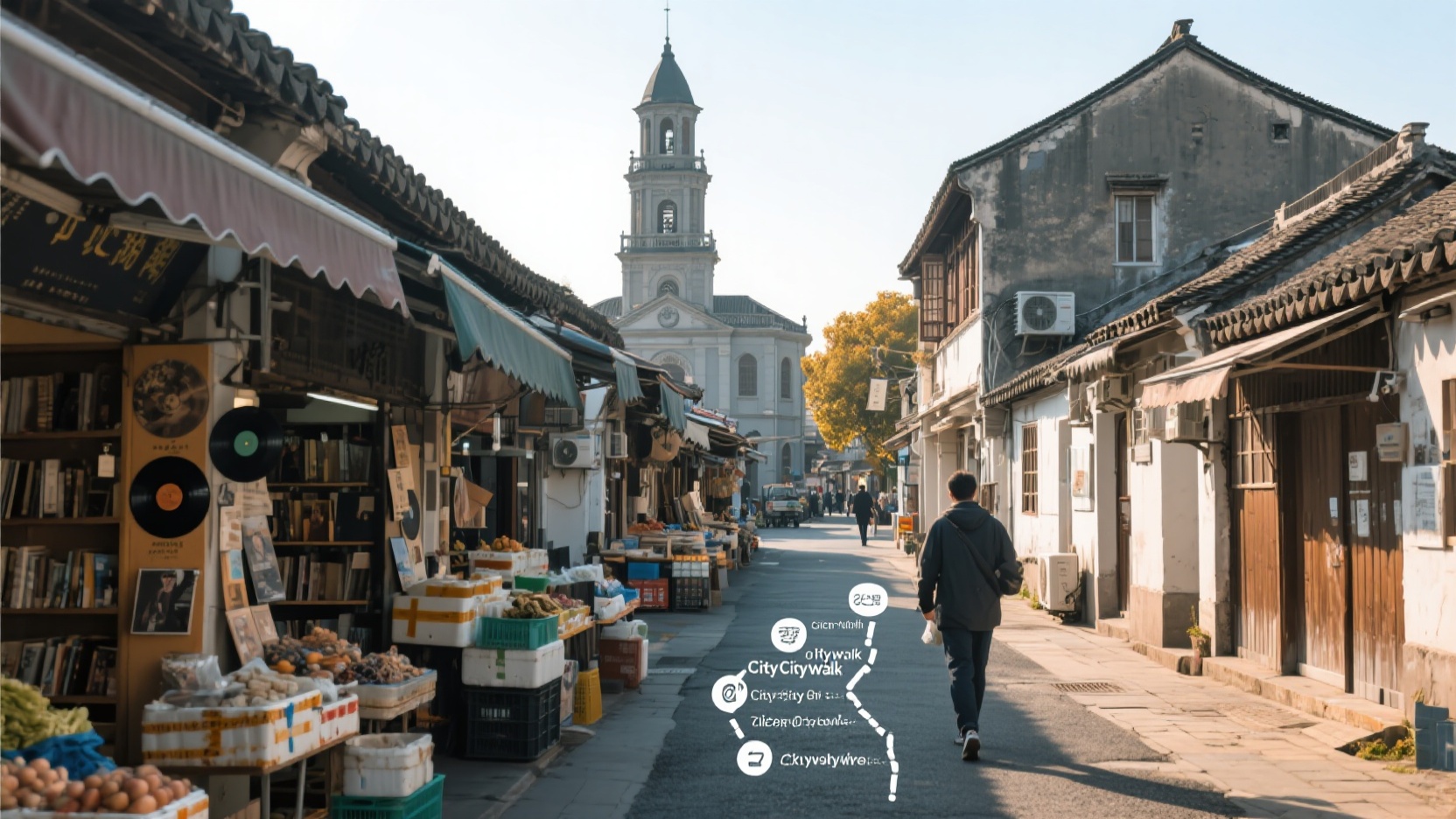
I walked this route twice. The first time, the navigation misplaced "Sijie" to the back gate of a new residential area, causing me to wander around the back alley of the market for twenty minutes. Ironically, I unexpectedly stumbled upon locals queuing to buy fish balls. Later, I redrawn the map, limiting the main road to 3.8 kilometers and adding two side streets. The whole route was leisurely, taking about two and a half hours. It's perfect for a weekend getaway after sleeping in, or for solo travelers with their cameras to explore the streets.
This article doesn't provide a guide to the attractions; it's just a walking perspective based on my personal experience: which street corners are worth stopping for an extra five minutes, which camera angles can capture the wrinkles of the old town, and which side streets are more likely to lead to encounters with vinyl record shop owners.
Let's look at the route outline first: Why start from Haonan Villa?
The main road is approximately 3.8 kilometers long: Haonan Villa → East Ring Road Haohe River Trail → Temple Street → Duanping Bridge Market Corner → Bell Tower Square. Branch Line A turns right into "Medical School Alley" in the middle of Temple Street, about 500 meters round trip; Branch Line B turns southwest from Duanping Bridge, about 600 meters further to Pocket Park. This route connects the grand buildings from the Republican era, the alleys from the Ming and Qing dynasties, the smell of the market, and the bookstores and vinyl record shops of today's young people into a cohesive line.
Why start with Haonan Villa? Because the renewal of Nantong's old city is almost inextricably linked to Zhang Jian. This old building, a blend of Chinese and Western architectural styles from the Republican era, is like a "time capsule." Standing in the courtyard, you can see the starting point where Nantong people first encountered modern urban civilization a century ago. From here, every stone slab you walk on seems to be a reflection of time itself.
Section 1: From Haonan Villa to Huancheng East Road (approximately 1.2 km / 20 minutes)
Camera position: Stand under the wisteria trellis in the courtyard and shoot upwards at the round dormer window of Haonan Villa, letting the ivy cover half of the corner of the building. Why it's worth stopping for 5 minutes: Look at the rings of the wisteria planted by Zhang Jian; the summer flower shadows cast on the blue bricks are more convincing than any exhibition board. Don't rush into the building; go around to the back wall and find a boundary marker from the Republican era—that's the "signature of private ownership" of old Nantong.
Exiting from the north gate of Haonan Villa, walk east along Haonan Road, and after two intersections you'll reach Huancheng East Road. Shooting location: Find the old stone steps next to the waterfront platform, lower the canopy of the plane trees to frame the gray tiles of Sijie Street on the opposite bank. Stop for 5 minutes because the Hao River isn't just a staged backdrop; it's alive—in the afternoon, elderly people bring small stools to the riverbank to listen to Pingtan (a traditional Suzhou storytelling performance), and when cleaning boats pass by, the ripples shatter the reflections, making that moment more like Nantong than any filter.
Second section: Enter Temple Street, and then turn into the corner of the vegetable market (approximately 800 meters/15 minutes).
The entrance to Sijie Street is hard to find. Navigate to "Sijie Historical and Cultural District," and you'll find the right spot when you see a large locust tree and a gray brick screen wall. The main alley is only wide enough for two electric scooters to walk side-by-side, and the brick carvings on the lintels on both sides are remarkably well-preserved. Camera position: Standing outside the courtyard of an old house with a "one-entrance, three-bay" layout, using the door frame as the foreground, waiting for a resident carrying groceries to pass by. I stopped for five minutes not to take pictures, but to listen—a neighbor greeted me in Nantong dialect; the tone echoed through the alley, and you suddenly understood what "neighborhood" truly meant.
Continuing on, at the intersection of Sijie Street and Beihouqiao Road, you'll first smell a salty, fresh aroma—that's the corner of the market. Camera angle: Shoot from above through the red plastic basins at the seafood stalls, capturing the water droplets splashing from the fish's tails; the background must include light filtering through the market's roof. Why stop for 5 minutes: The vendors here will proactively tell you, "The clams are plump today!" Even if you don't buy any, they'll still chat about the weather. This is the least "cultural" stop on the entire street, but also the most authentic expression of Nantong.
Branch Line A: Turn right at the middle section of Temple Street and head to Medical School Alley to visit bookstores and vinyl record stores (approximately 500 meters/10 minutes).
If you walk halfway down the main alley and see a blue brick wall covered in ferns, turn right to reach branch line A. This alley, near the old medical school campus, has gradually sprouted several independent shops. One of the used bookstores has placed its wooden bookshelves at the entrance, the spines of the books fading to a beautiful color in the sun. Camera angle: Stand inside the bookstore and shoot outwards, using the corner of an old atlas to blur out passersby, creating dappled sunlight on the ground. Stop for five minutes to browse through old books on Nantong's local history and culture; the owner won't rush you, and will casually tell you which book provides the most detailed information about Sijie.
Twenty steps further on, there's a coffee shop that only sells vinyl records. The storefront is so small that only one person can squeeze through sideways, but the first click of the needle as you push it open will immediately quiet you down. Next to it is a vintage clothing store without a sign; the trench coats and old suitcases hanging in the window look like they came straight out of a 90s Hong Kong movie. This side path is about 500 meters round trip, so there's no need to rush. Every shop along this path is perfect for "entering empty-handed and leaving empty-handed," but you'll take away a touch of the old city's new expression.
Branch Line B: Turn from Duanping Bridge towards Southwest Camp, and go to Pocket Park to watch the elderly play chess (approximately 600 meters/12 minutes).
After reaching the Duanpingqiao Market on the main road, don't rush to turn right towards the Bell Tower. First, turn towards the Southwest Camp Historical District, which is quieter than Temple Street. Several alleyways still retain the terrazzo gate towers from the Republican era. Camera position: crouch at the entrance of a narrow alley called "Big Wharf," using a vertical composition to push the gable walls on both sides to the top of the frame, leaving a little skylight. Stop for 5 minutes and watch an old man slowly disappear into the alley with his bicycle, a bunch of celery in the basket. That slowness will make your breathing lighter.
Hidden in the Southwest Camp is a pocket park, so small you can see it all at a glance, but it has a stone table and benches and an old locust tree. Camera angle: Through the park's moon gate, use the view to photograph the gray walls across the street; overhead, a few power lines resemble musical staves. Why stop and watch for 5 minutes: There are no tourists waving flags, only locals playing chess, preparing vegetables, and dozing off. This is the right way to revitalize an old town—not by removing life, but by leaving life a stone table.
End point: Clock Tower Square: Capture a century in one frame (approx. 500 meters/10 minutes)
Leaving the Southwest Camp and walking north along South Street, you'll reach the clock tower – that's your destination. This Republican-era clock tower has clock faces on all four sides; you can capture the entire tower from under the arcade at the crossroads. Camera position: Place your phone against an arcade pillar, using the colonnade as a frame, and wait for a bicycle to pass directly beneath the clock tower. Stop for 5 minutes and compare the time on the clock tower with your phone's time – if there's a 5-minute difference, you'll suddenly realize that "city time" isn't based on your own.
Reaching this point, the main road plus two branch lines cover approximately 4 kilometers. If you still have the energy, you can walk along the moat back to the starting point, but my suggestion is to stop here, buy a cup of mung bean soup or osmanthus cake near the Bell Tower, and eat it by the roadside. This sweet taste can soothe all the past memories you've just left behind.
Blogger's Summary and Practical Tips List
The blogger summarizes: This route isn't about checking off tourist attractions, but rather a "city reading." From Zhang Jian's Western-style mansion to the Ming and Qing dynasty houses on Temple Street, to the hawkers in the market and the phonograph needles in the record shop, the entire fabric of Nantong's old city is explored. It's perfect for artsy tourists who want to avoid crowds and queues at tourist attractions.
Practical Tips: First, it's recommended to set off before 9 AM or after 3 PM. At midday, the sun is directly overhead, making the narrow alleys of Temple Street feel cramped, and most of the market stalls will be closed. Second, wear flat shoes with slightly thick soles; avoid hiking boots. While some sections of the stone-paved roads in Temple Street and Southwest Camp are uneven, they are not difficult to walk on.
Third, the vinyl record stores and vintage clothing stores on Branch A usually only start to get busy in the evening. If you want to hear the owners play records, it's best to go around 4 PM. Fourth, don't deliberately look for the "cafe street." Just follow the curve of the alley; it's more interesting than finding house numbers on a map. Fifth, when taking photos, if you want to photograph a resident's face, please smile and indicate so first. Nobody likes being photographed without their consent.