
Liuzhou at the Song Festival | Listening to Lusheng in Miao Villages during the First Month of the Lunar New Year, Learning Antiphonal Singing at the Foot of Yufeng Mountain
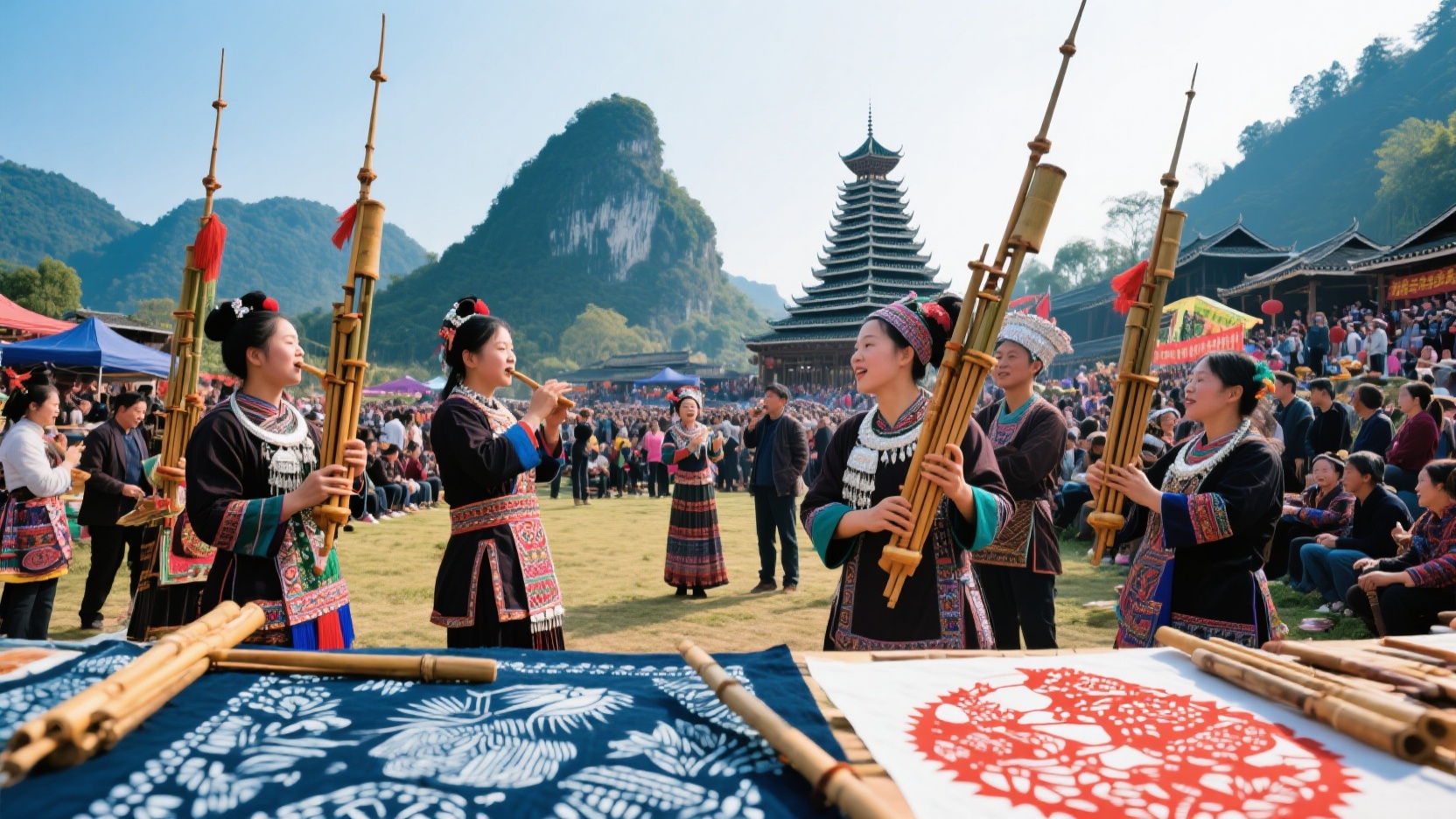
The cultural and artistic experience in Liuzhou is less about "seeing" and more about "entering" it. Festivals and folk customs here aren't just timed performances in tourist attractions; they are still part of everyday social interaction. If you only want to take photos and check off your list, you might easily miss the Yufeng Song Festival, the Miao Village Slope Fair, and the Dong Duoye Festival. But if you're willing to sit down, reach out your hand, and sing, half a day can transport you to another Liuzhou. The following four points, arranged by depth of experience, are suitable for travelers who want to slow down their pace.
Yufeng Folk Song Festival: Folk songs are not a performance, but a dialogue.
The core of the Yufeng Song Festival is located at the foot of Yufeng Mountain, peaking on the third day of the third lunar month, with spontaneous antiphonal singing also taking place on weekdays and weekends. There's no designated stage; singers form a circle, one starting a tune, and the other must respond within a very short time. Lyrics are improvised, and the Liuzhou dialect is known for its dense rhymes. Tourists shouldn't rush to take photos; instead, stand outside the circle and listen to the rhythm of the "response," paying attention to the ending notes and the question-and-answer structure. This will help you understand that "one side sings, the other responds" isn't just rhetoric but a rule. Liuzhou folk songs are mostly seven-character quatrains, with a structure resembling a mini-debate; whoever can't respond loses. To participate, simply ask an elderly person nearby for a phrase to begin; usually, someone will quickly join in. The legend of Liu Sanjie is vividly portrayed here: Yufeng Mountain is considered by the locals to be the place where Liu Sanjie spread her songs, thus imbuing the folk song tradition with a "song for expressing feelings and for wit" element. Therefore, traces of antiphonal singing and intellectual challenges still remain at the festival.
Rongshui Miao Ethnic Minority Slope Festival: Lusheng Dance and Horse Fighting Scene
The series of Miao village festivals in Rongshui County are concentrated in the first month of the lunar calendar, from the second to the seventeenth. Each village takes turns hosting on a fixed date. This is the best window into understanding the relationships between Miao villages. Upon arriving at the festival, one is usually greeted with a welcoming drink, followed by the most striking sight: several Lusheng (a type of reed pipe instrument) teams form concentric circles, playing and dancing, with young women in their finest attire joining in, their silver ornaments jingling to the rhythm. The Lusheng is not just accompaniment, but the lead instrument; the dance steps correspond to the tunes, and even a layman can discern the level of understanding between villages from the changes in formation. In the afternoon, there are usually horse fights and cockfights, and the cheers and comments from the audience are more informative than the competitions themselves. At noon, one doesn't need to leave; one can join the villagers in making oil tea and sharing sticky rice. While the festival appears to be a celebration, it actually serves as a platform for village gatherings, ancestral worship, and youth social interaction. Each village has a fixed host village and a "slope leader," and this sense of order is the reason why the festival has continued to this day. When participating, don't just stand on the outside taking panoramic photos. Follow the crowd into the vicinity of the dance circle to hear the breathing sound of the lusheng pipe and the faint sound of the silver plates colliding.
Sanjiang Dong Ethnic Group's Duoye Festival: Holding hands and dancing Duoye at the Hundred Families Feast
The Duoye Festival and Dong New Year of the Dong ethnic group in Sanjiang are usually held from October to November of the lunar calendar, with the atmosphere being most vibrant in the Chengyang Eight Villages area. The experience begins with a "Hundred Families Feast," where long tables are arranged along the alleys, and each household brings its own dishes, with sour fish, sour meat, and glutinous rice being the main attractions. The meal is not a communal dining experience for tourists; instead, guests are assigned to different tables and eat with the hosts—this is the first lesson in Dong village social etiquette. The Dong people always serve "sour" dishes when entertaining guests; the longer the sour fish has been pickled, the more respect it shows. It's not necessary to refuse; it's common to try a bite before eating glutinous rice. After the meal, a bonfire is lit in front of the drum tower, and the Duoye dance is usually led by a singer. Everyone holds hands and forms a circle, moving left and right to the rhythm. Dong grand songs also appear at night, featuring polyphonic, unaccompanied parts, with lower parts supporting higher parts. The lyrics are often related to farming, nature, and village history. The literal meaning of "Duoye" is close to "collective dancing and singing." Its core experience is not watching others dance, but the moment when your hands are held by the people on either side of you. Once the circle is formed, your steps will naturally follow.
Fabric dyeing and paper cutting: Sitting down and being a craftsperson for half a day
In the Miao villages of Rongshui and the Dong villages of Sanjiang, many families still maintain the daily practice of batik, tie-dye, and paper-cutting. The experience is simple: first, draw patterns on homespun cloth with a wax knife. The wax must be heated to the right temperature; too thin and it will spread, too thick and the thread won't be able to be drawn. After drawing, immerse the cloth in a vat of dye, primarily indigo fermented from Isatis root, requiring repeated soaking and drying several times. Finally, remove the wax to reveal the color, leaving a blue background with white patterns on the cloth. The entire process takes about half a day. Miao batik patterns often include bronze drums, butterflies, birds, and migration routes, while Dong paper-cutting often uses them as embroidery patterns, emphasizing symmetry and continuity. The most worthwhile part is not completing the piece, but listening to the host explain the meaning of the patterns: for example, butterfly patterns are related to Miao ancestral legends, bronze drum patterns represent the rhythm of the village, and spiral patterns resemble the direction of mountain paths and rivers. This kind of experience doesn't feel like a standardized "course"; it's more like being invited to participate in a household chore. Sit down and work at your own pace; after half a day, you'll take home a piece of cloth you've dyed yourself, not just a photograph.
Connecting the above points, the most suitable time window is the first month of the lunar calendar. In Liuzhou, one can first experience folk songs at the Yufeng Song Festival, then head to Rongshui to participate in the Po Hui Festival. If visiting between October and November, prioritize the Sanjiang Dong New Year and the Duoye Festival. Allocate at least half a day for each stop; avoid a rushed, check-off-the-board approach. Liuzhou's festival customs are essentially a still-used social language; only by sitting down, extending your hand, and singing can you truly enter the experience.