
Spiritual Corners Along the Liujiang River: A Map of Liuzhou's Lesser-Known Urban Cultures Away from the Crowds
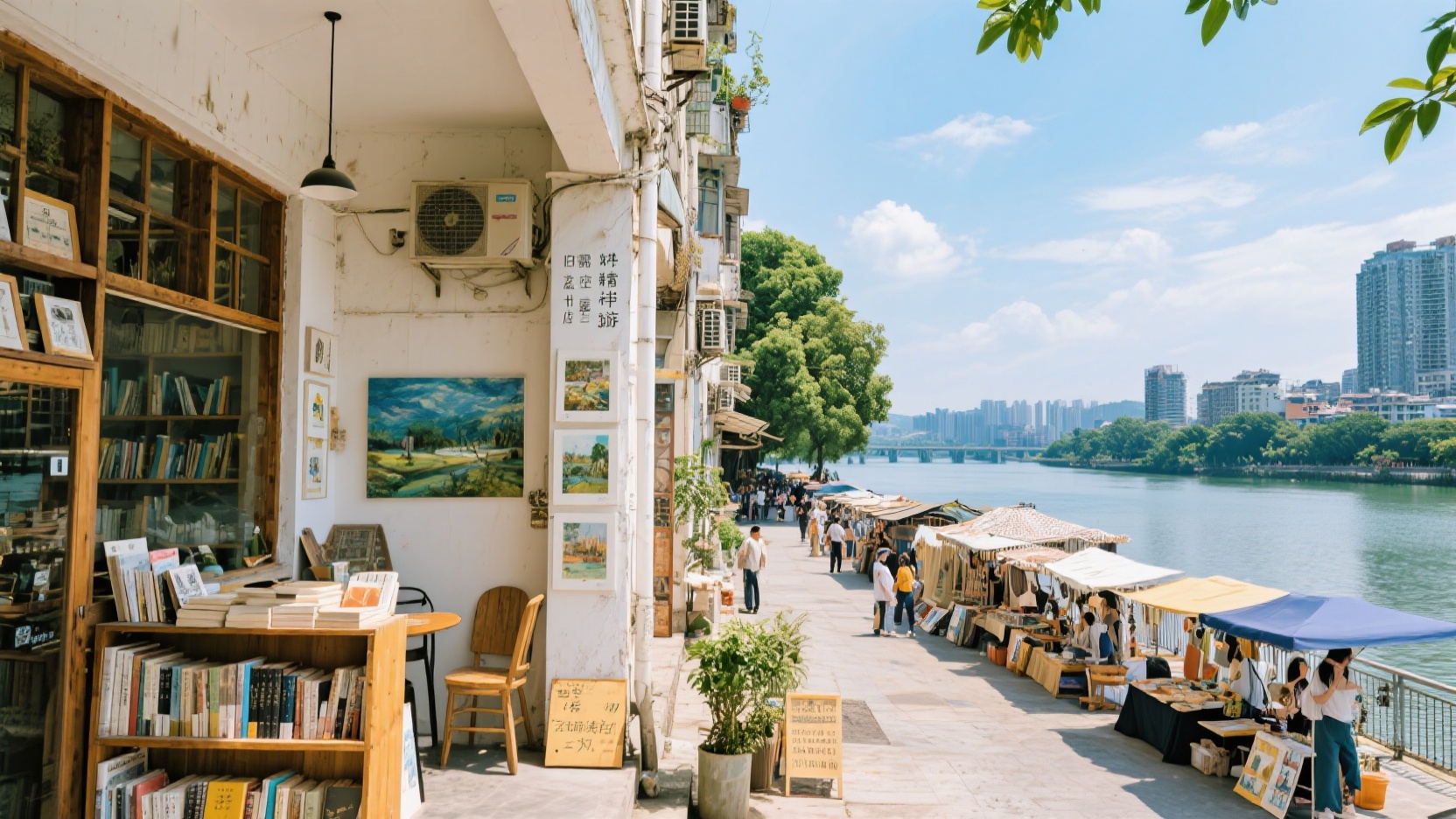
Liuzhou's cultural depth is often obscured by its famous snail rice noodles and industrial symbols, but what truly makes people want to stay are the small cultural spaces embedded deep within old communities, factories, and arcade buildings. As a major industrial city in Southwest China, Liuzhou's cultural consumption has long been squeezed out by functional spaces, but urban renewal has transformed a number of old warehouses and workshops into small cultural clusters. Avoiding well-known tourist spots, this route uses bookstores, art galleries, antique warehouses, cafes, and independent galleries as its coordinates, connecting the soft spiritual heartland of this industrial city.
Yimen Bookstore | A warehouse bookstore that sells only poetry and independent publications
Hidden on a corner in an old factory dormitory area in Liubei, a bookstore converted from an old warehouse has no sign at the entrance, only a light blue iron gate. Inside, the cement walls, wooden beams, and old wooden stairs are preserved. The selection is almost entirely poetry, independent publications, and local Guangxi literature, with no bestseller lists. A highlight is a wall of handwritten poems where readers can leave their own lines, which are changed periodically. Deep inside the bookstore is a small reading room for only two people, where shoes must be removed before entering. Poetry readings are often held on weekend evenings, featuring readings of local works in Liuzhou dialect. For photography, it's recommended to take photos between 3 and 5 pm, utilizing the west-facing window light to capture the bookshelves and textured cement walls; the corner of the old wooden stairs provides a natural frame for portrait silhouettes.
Bailu Old Warehouse: A Touchable Memory of Liuzhou's Industry
Bailu Antique Warehouse is located in a cluster of old warehouses in Liubei District. Its collection mainly consists of everyday items from Liuzhou's industrial era: enamel mugs, old factory signs, old machine tool nameplates, blue work clothes, and stacks of handwritten receipts. Unlike conventional museums, most of the items are touchable and can be examined. The labels are mostly handwritten by the curator, recording the item's origin and year. The old-fashioned electricity meters and switches piled up at the entrance are suitable for foreground photography, quickly establishing the space's character. A highlight is the entire "Liuzhou Old Factory Sign Wall," showcasing items from machinery factories and dyeing and weaving factories to daily chemical plants from the last century. For photography, it's recommended to use a wide-angle lens to shoot from above the array of antiques, looking for the metallic reflections when natural light shines obliquely through the high windows; the blue work clothes area is best suited for cool-toned post-processing.
Liukong Cultural and Creative Park | Contemporary Art Scene Inside a Red Brick Factory
Formerly the Liuzhou Air Compressor Factory, Liukong Cultural and Creative Park retains its large-span red brick factory buildings, giant crane beams, chimneys, and a section of narrow railway track. The park regularly hosts small contemporary art exhibitions and architect sketch exhibitions, and occasionally hosts independent publishing markets on weekends. The highlight isn't any particular permanent exhibition hall, but rather the factory buildings themselves: the spatial rhythm created by old-fashioned steel windows, cast iron pipes, and weathered slogans. The railway track on the south side of the park is covered in weeds, offering opportunities to capture rim lighting in the evening using low-angle backlighting. For photography, it's recommended to capture the silhouettes of the red bricks and chimneys during the blues of the evening; inside the factory buildings, use the deep, winding passageways as leading lines in your composition.
Half Acre Pond Community Cafe | A hybrid space for local magazines and hand-drip coffee
Located on the ground floor of a residential building in the old Yufeng community, Banmu Fangtang juxtaposes a coffee bar with a small reading area for local publications. The shop features a slow-paced magazine edited by a team of young locals in Liuzhou, documenting the changes in the neighborhood and sharing personal stories. They also sell independently designed hand-drawn maps of Liuzhou's streets, folded to fit in a travel journal. Highlights include the magazine wall and the seasonally updated list of single-origin coffee beans from Yunnan and Ethiopia. For photography, it's recommended to sit by the folding window facing the street and use a 35mm focal length to capture the coffee cup, magazine, and street scene in the same frame; diffused light on a cloudy day is ideal for photographing the details of the wooden bar.
Between Gallery | A young artist residency in an office building mezzanine
Nestled in a mezzanine space of an office building, the gallery occupies less than 100 square meters and showcases only paintings, photographs, and installations by young artists from Liuzhou and Guangxi. Exhibitions are frequently updated, with artist residencies and occasional small dialogues. The mezzanine entrance is an unassuming fire door; the transition itself is part of the spatial experience. The highlights are the close-up viewing experience offered by the small space and the detailed site-specific creative notes in the curatorial foreword. For photography, it's recommended to use the blank spaces on the exhibition walls for minimalist compositions, avoid direct spotlights, and use a mix of natural and ambient lighting to capture details of the installations.
Yunye Art Museum | Light and Shadow Containers in an Old Knitting Factory Workshop
Yunye Art Museum is a converted workshop of an old knitting factory, preserving its terrazzo floor, skylight, and some old machinery. The permanent exhibition, "Memories of Liuzhou Textiles," features old photographs, fabric swatches, and workers' diaries; the temporary exhibition hall focuses on experimental installations. On rainy days, the reflection from the terrazzo floor and the skylight creates a secondary refraction, ideal for photographing abstract textures. A highlight is the dialogue between the changing beams of light from the skylight and the remnants of old machinery. For photography, it's recommended to wait for the skylight beams to fall directly to the ground and shoot from above, using the remnants of old machinery as a foreground to enhance the sense of depth.
Dongmen Used Book Market | A Sunday Paper Book World Under the Arcade
Every Sunday morning, dozens of secondhand book stalls set up under the old arcades along the Liujiang River, mainly selling local chronicles, industrial history, old maps, and literary magazines from the last century. The Dongmen Secondhand Book Market isn't a tourist attraction, but it's a small, direct hub for understanding Liuzhou. When browsing, pay attention to the cardboard boxes under the stalls; they often contain unsold periodicals and handwritten notes. Highlights include yellowed copies of "Liuzhou Historical and Cultural Materials," hand-drawn old maps, and old tickets and certificates. For photography, it's recommended to take photos from the second floor of the arcades, looking down at the array of book stalls; the sidelight in the early morning will highlight the layers of paper. You can also use macro photography to capture the text on the spines of old books.
These spaces are mostly unassuming, sometimes requiring a few turns to find. They don't contribute to grand urban narratives; they simply preserve Liuzhou's aesthetics, memories, and expressions quietly. Exploring the city's spiritual corners on foot is a more authentic experience than any travel guide.