
How can you eat your way through Hangzhou 24 hours a day so that you don't waste your trip?
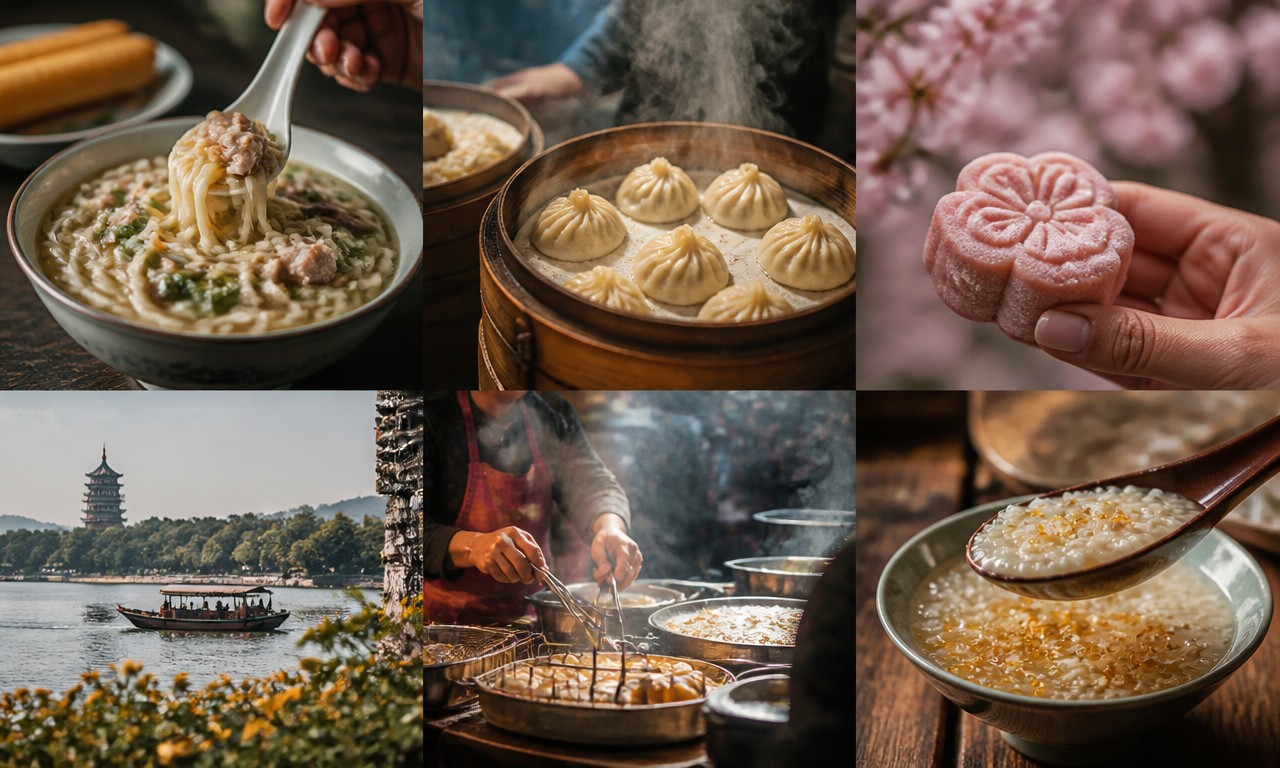
Many tourists visiting Hangzhou only focus on restaurant signs, unaware that the same food can taste completely different at different times of day. This article provides a timetable, from the first pot of food at the morning market to the closing time late at night, telling you what to eat at each time and why. The key is that for many snacks and dishes in Hangzhou, it's not about whether they're available, but about the "window of opportunity" for cooking. Once that window is missed, the flavor diminishes.
6:00 AM First pot of rice at the morning market
At this time of day, you should eat "youdun'er" (fried dough cakes) and freshly ground salty soy milk. Youdun'er is a deep-fried dough cake filled with shredded radish. It looks ordinary, but the significance of the first batch at the morning market lies in the oil. Most breakfast stalls in Hangzhou's old city start heating the oil at 4:30 a.m. The temperature of the first batch of oil gradually rises from cold to hot. By the time the first youdun'er is put into the oil, the temperature is just at its most stable range. The resulting fried dough cakes have a thin and crispy outer shell that doesn't stick to the oil, and the shredded radish inside still retains the freshness of the ingredients when they were prepared in the early morning. It's served with a bowl of freshly ground salty soy milk, which should be made by pouring boiling hot tofu over it, adding dried shrimp, pickled mustard greens, and a little bit of chili oil.
Why rush to this time? Because after 7 a.m., the oil has already been fried several times, the oil temperature is higher, and there are more impurities in the oil, making the fried dough sticks prone to being burnt on the outside and raw on the inside, or absorbing too much oil. Also, the first batch at the morning market usually doesn't have a queue, as the aunties making breakfast have the most steady hands. If you live in the old town, such as near Dama Lane or Shiwukui Lane, you can find it in just a few minutes' walk.
8:00 Local breakfast
This is the perfect time to eat a bowl of "Pian'erchuan" noodles. Pian'erchuan is the soul of Hangzhou noodles, topped with stir-fried mustard greens, bamboo shoots, and lean pork slices. Why specifically 8 AM? Because of the bamboo shoots. Pian'erchuan's bamboo shoots must be fresh; spring bamboo shoots are used in spring, and winter bamboo shoots in winter. Bamboo shoots delivered fresh from the market in the morning are the crispest and most juicy. After noon, the bamboo shoots start to become tough. If you go at 8 AM, the kitchen will have the first batch of bamboo shoots of the day, which will be moist when cut open and have a slightly sweet taste when stir-fried.
In addition, Hangzhou locals are particular about "first-boiled noodles," which is the water used to cook the noodles in the very first pot. The first pot of water in the morning is the clearest, resulting in noodles that are neither sticky nor cloudy, and the broth is also clean. Many locals specifically arrive at noodle shops before nine o'clock just for this. Pian'erchuan noodles themselves aren't expensive, averaging ten to twenty yuan per person, but you must order those with freshly stir-fried toppings, not the kind that's been cooked in a large pot in advance. The criterion is simple: after you order, you should hear a "sizzle" from the oil pan in the kitchen—that's a sign that it's being freshly stir-fried.
11:00 Lunch Service
For lunch, I recommend "deep-fried shrimp," preferably river shrimp. Hangzhou locals are particular about the season when eating river shrimp, but even more so about the timing. The market vendors typically receive their shrimp early in the morning, and the live shrimp selected before 9 AM are delivered to their partner restaurants. Around 11 AM, these shrimp are still alive, uniform in size, with thin shells and plenty of meat. The method for deep-frying shrimp involves quickly frying them in hot oil until the shells tighten instantly, and the meat is just cooked through. If you order them in the evening, the shrimp will have been kept in tanks all day, causing the shells to soften and the meat to become loose, making it easier for the shells to fall off during the deep-frying process.
It's not that you can't eat stir-fried shrimp at night, but rather that the shrimp in this pot at lunchtime are at their "last leap before death," meaning their freshness and springiness are at their peak. You can choose a small restaurant near the market and see if the owner displays red plastic basins containing river shrimp outside. When ordering, specifically ask for "river shrimp, not tiger prawns," because many restaurants sell both. For around 100 yuan per person, you can get a decent plate of stir-fried shrimp plus two side dishes to go with rice.
3:00 PM Afternoon tea or sweet soup
I went to wait at 3 PM for the first batch of "Ding Sheng Gao" to come out of the steamer. Ding Sheng Gao is a traditional Hangzhou rice flour cake, made from a mixture of glutinous rice and regular rice flour, filled with red bean paste or osmanthus sugar, and steamed in a wooden mold. Many Ding Sheng Gao makers rest until 2:30 PM after lunch, and then start steaming the first batch at 3 PM. At this time, the Ding Sheng Gao is the softest and the rice aroma is most pronounced because the rice flour is freshly sifted at noon, with just the right moisture and particle size. If it's too late, the steamer lid is repeatedly opened, causing moisture to escape, and the cake becomes too dry.
If you're near Hefang Street or Xiaohezhi Street, keep an eye out for small shops that steam rice cakes on-site. Don't buy the vacuum-packed kind, or the ones that are pre-steamed and displayed in a glass case. Freshly steamed Dingsheng cake should still be hot to the touch, and when you break it open, you should see the osmanthus sugar inside slightly flowing. Pair it with a cup of green tea or plain water; don't go with milk tea, as it will mask the rice aroma. Eating it at this time is also good because it's two hours before lunch, so you have enough room in your stomach without affecting your dinner.
18:00 Night market or evening market
The evening is the perfect time to eat "mutton shumai," especially at restaurants that also serve mutton soup. Although Hangzhou isn't a major mutton-producing area, locals have a tradition of eating mutton in autumn and winter. The filling for mutton shumai uses fresh mutton slaughtered that morning, hand-chopped, mixed with scallion and ginger water and a small amount of aspic. Why is it best to eat it in the evening? Because the mutton filling needs to sit for several hours to allow the moisture and fat to fully meld. Filling made in the morning will be too loose by noon, while filling made in the evening is at its firmest and juiciest. The steamed shumai has a thin but unbroken skin, and each bite releases a burst of broth.
Another reason is the mutton soup. Good mutton soup restaurants start simmering the broth at 2 PM, cooking the bones and mutton together for exactly four hours until 6 PM. The broth becomes milky white, and the gamey smell transforms into a savory flavor. You can order a basket of mutton shumai, a bowl of clear mutton soup, and a side dish of chili sauce and vinegar. This combination is perfect for dinner; your body needs a little nourishment without being too greasy late at night. It costs between tens and hundreds of yuan per person, depending on whether you want to add a side of boiled mutton.
22:00 Late-night snack
After 10 PM, a bowl of "Ban Chuan" is the perfect choice. Ban Chuan is a unique Hangzhou-style stir-fried noodle dish. The noodles are first boiled and then stir-fried, topped with lard, pickled mustard greens, chives, and shredded pork or pork kidney. Why late at night? Because Ban Chuan is incredibly oily. If you eat it in the morning or at noon, the aroma of the lard will be overwhelmed by other foods, and it can make you feel sleepy afterward. But at 10 PM, people's sense of taste is more sensitive, and their craving for oil is strongest. A bowl of freshly cooked Ban Chuan, with the aroma of lard mixed with the salty and savory flavor of the pickled mustard greens, and the chives still slightly crunchy, is the most comforting way to finish your meal.
Another reason: Mixed noodles need to be stir-fried fresh, with high heat and a short cooking time. During peak mealtimes, when it's crowded, the chef might stir-fry two or three portions at a time, leading to uneven heating of the noodles. Late at night, with fewer customers, the chef can stir-fry only one portion at a time, resulting in a more pronounced wok hei (wok aroma). Find an old noodle shop that's still lit up, order a bowl of pork liver mixed noodles or pork kidney mixed noodles, and ask the chef to add a little spice. After eating, don't lie down immediately; walk a couple of stops back to your accommodation—that's just right. Eating at this time isn't because you're hungry, but because the last bite of the day should taste like Hangzhou.