
What should you eat for your first meal in Hangzhou to make your trip worthwhile?
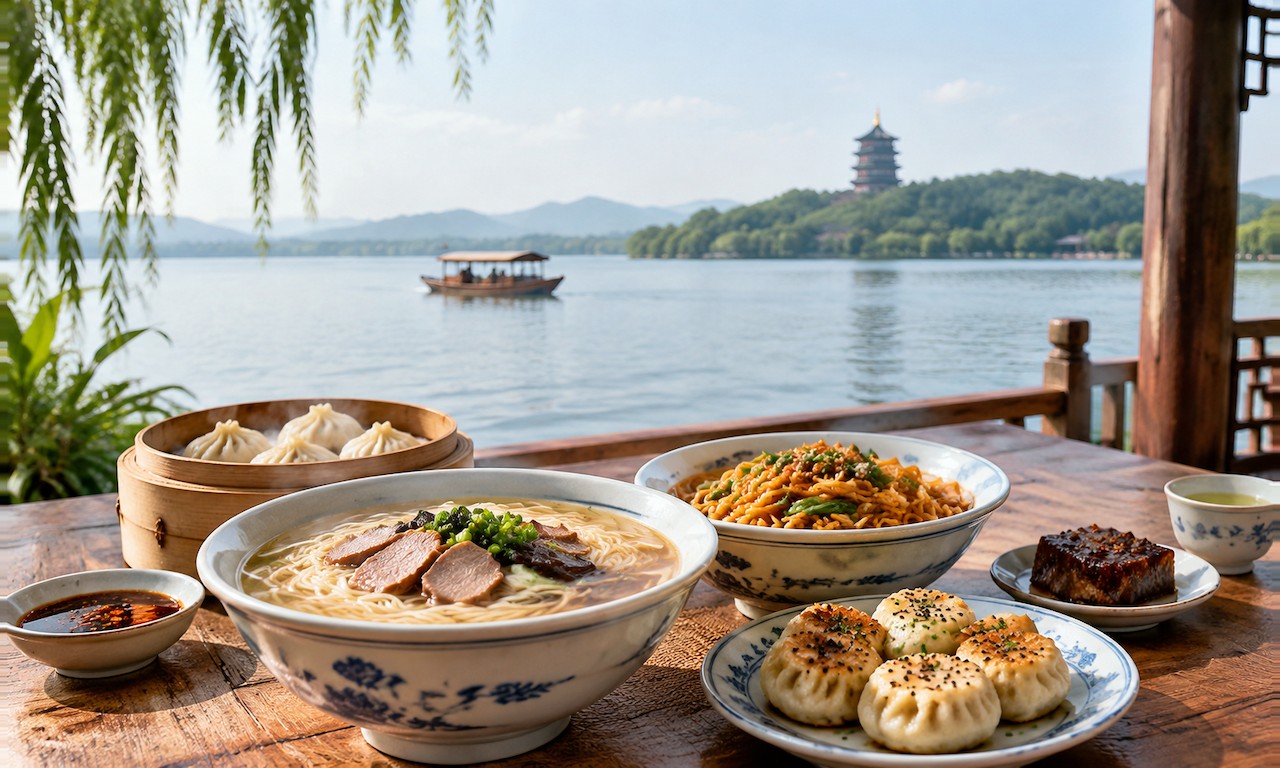
The question, "How should one eat Hangzhou cuisine?" is asked most frequently, and also answered most haphazardly. Most answers either list a bunch of restaurant names or lead tourists to tourist attractions. I want to answer it seriously, not because it's particularly profound, but because if you eat the wrong meal the first time, your impression of the city's flavors will be distorted for the next few days. The following eight questions are ones I was repeatedly asked by locals and readers while documenting my experiences in Hangzhou. I will provide a judgment for each one and explain why.
This is my first time in Hangzhou, and I only have one meal. What should I eat?
Forget about the famous "family reunion" dishes; three dishes are enough for a meal: one of pickled bamboo shoots and pork soup, one of braised spring bamboo shoots, and one of steamed Qiantang River delicacies. Pickled bamboo shoots and pork soup is Hangzhou people's fundamental expression of "freshness"—salted pork, fresh pork, and bamboo shoots, the broth is white but not thick, offering layers of flavor. Braised spring bamboo shoots depend on the season; spring and winter are the most reliable times. The savory sauce coats the sweetness of the bamboo shoots, representing Hangzhou people's daily life even better than braised pork belly. The river delicacies depend on what's available that day; whitebait or perch steamed with a drizzle of soy sauce—Hangzhou people's approach to fish is "don't mess with it." A meal like this will allow you to experience the three flavor profiles: savory, sweet, and steamed.
The reasoning is simple: the soul of Hangzhou cuisine lies not in the over-emphasized dish "West Lake Vinegar Fish," but in seasonality and restraint. A meal like this for one or two people, costing around a hundred yuan per person, is closer to the authentic Hangzhou dining experience than ordering a table full of cold dishes and stir-fries.
Is Hangzhou cuisine sweet or not? How does it differ from Shanghai and Wuxi cuisine?
Sweetness is present in Hangzhou cuisine, but it's not the main focus. Shanghai cuisine's sweetness comes from the rich, dark sauce of braised dishes with soy sauce and sugar; Wuxi cuisine's sweetness is more direct; while Hangzhou cuisine is more about a "salty and savory base with a sweet finish." For example, Dongpo pork is colored with rock sugar, but the first taste is of wine and meat, with the sweetness only emerging at the very end. Hangzhou people sometimes add a touch of sugar to stir-fried vegetables to enhance the flavor, but it's never noticeably sweet.
If you don't usually eat sweets, Hangzhou cuisine is perfectly acceptable. The real things to watch out for are dishes like "braised duck" and "honey-glazed ham," which are quite sweet; ask before ordering. My assessment is that Hangzhou cuisine is milder than most people imagine; it's more like the "subtle yet flavorful" taste nurtured by the humid climate of Jiangnan, not a sugary concoction.
What do locals actually eat for breakfast? Is it different from what tourists imagine?
Hangzhou locals have two main breakfast preferences. One is the "noodle school," where people eat a bowl of Pian'erchuan noodles or Banchuan noodles with freshly stir-fried toppings. The other is the "snack school," which includes fried dough sticks and savory soy milk, or a serving of xiaolongbao (soup dumplings) and a bowl of wontons. Tourists often assume that Hangzhou locals eat scallion pancakes in the morning, but these are actually an afternoon snack, not the main breakfast.
The must-try is the savory soy milk. Hangzhou-style savory soy milk includes dried shrimp, fried dough stick crumbs, and pickled mustard greens. After adding soy sauce, the soy milk slightly curdles, releasing its umami flavor. Paired with a freshly baked sesame flatbread, it's warm and satisfying. Reason for recommendation: This is one of the cheapest local breakfast options and a standard for judging whether a breakfast stall is truly "local." If the savory soy milk is too thin and doesn't curdle, go to another stall.
Pian'erchuan and Banchuan, which should I choose if it's my first time trying them?
If you're in a hurry or want a light meal, choose Pian'erchuan; if you want a more satisfying or stronger flavor, choose Banchuan. Pian'erchuan's broth is made by simmering pickled mustard greens, bamboo shoots, and lean pork slices, resulting in a savory and slightly sour flavor with a hint of pickled mustard greens—a signature dish of Hangzhou noodles. Banchuan involves quickly mixing the noodles with toppings over high heat after cooking, resulting in a richer, more oily flavor and a stronger wok hei (wok aroma). Pork liver Banchuan and pork kidney Banchuan are classic local dishes that have been enjoyed by locals for decades.
There's an important point about how to eat it: For Pian'erchuan noodles, first take a sip of the broth before eating the noodles. Don't rush to add vinegar and chili sauce, as that will mask the freshness of the pickled mustard greens and bamboo shoots. For Banchuan noodles, stir them while they're hot so that every strand of noodle is coated with sauce; they become greasy when they cool down. Reason for this judgment: This bowl of noodles isn't the nationally standardized "noodles + toppings." The soul of Hangzhou noodles lies in the firmness of the "water-thinned noodles" and the perfect integration of the broth or sauce. Choosing the wrong one might lead you to mistakenly believe that Hangzhou noodles are nothing special.
What's the difference between trendy restaurants and old-fashioned shops tucked away in alleyways?
The difference lies in three areas: the pace of serving the food, the consistency of seasoning, and whether or not the food leaves room for lingering aftertaste. Trendy restaurants serve food quickly, with plating suitable for photos, but the seasoning is often heavy, making the first bite amazing but easily becoming cloying towards the end. Old-fashioned restaurants in alleys may not serve food quickly, and sometimes it depends on the owner's mood, but the taste has been refined over decades and will not fluctuate.
For example, consider the same fried tofu skin roll. The traditional shop rolls them one sheet at a time, controlling the oil temperature perfectly, resulting in a crispy yet not greasy texture. Dipped in salt and pepper, it has a wonderful bean flavor. The trendy shops often refry semi-finished products, which are crispy, but lack the original aroma of the bean skin. Reasoning: If you only have a day or two, you can visit one of each, but don't use "queues" as a criterion. The truly discerning way to eat is to see if there are many locals in the restaurant and whether they are ordering in Hangzhou dialect. These two points are more reliable than review scores.
Where in Hangzhou can I find a decent place to eat after 10 PM?
Hangzhou's late-night snack scene can be divided into two distinct types. One is the "noodle stall type," located downstairs in residential areas or next to wet markets, offering dishes like Pian'erchuan noodles, pork chop noodles, and stir-fried rice cakes, available until 2 a.m. The other is the "casserole and barbecue type," more common in the north and west of the city, featuring casserole noodles with grilled skewers, or a bowl of savory rice porridge with several dishes of braised meats—a staple for many Hangzhou residents after work.
My personal recommendation for late-night snacks is a bowl of "vegetable rice porridge" or "savory rice porridge." The rice is simply cooked in a broth, topped with vegetables, mushrooms, and shredded meat—simple yet incredibly comforting. My reasoning: the true value of Hangzhou's late-night snacks isn't in how amazing they are, but in the fact that "they're willing to make you something hot and delicious." Don't look for late-night snacks near tourist attractions; head towards residential areas—the brightly lit shops there are more authentic than anything else.
What should I buy in Hangzhou to take home so that my trip won't be a waste?
Don't just focus on lotus root starch and Longjing tea. Hangzhou locals often give three things as gifts: braised duck, pickled mustard greens, and Dingsheng cake. Choose braised duck with a deep red skin and a fragrant aroma of wine and soy sauce. Steam it, slice it, and it's savory with a hint of sweetness—perfect with drinks or rice. Pickled mustard greens are the hidden soul of Hangzhou kitchens. Buy the loose kind, slightly juicy, and use it to stir-fry with shredded meat or cook with rice cakes—it's more vibrant than vacuum-packed ones. Dingsheng cake is made from steamed rice flour with a little red bean paste in the center. It's soft, sweet, and chewy when hot, but hardens when cold. When you get home, steam it over water, not in the microwave.
Reasoning: These three items together form the foundation of "Hangzhou flavor," and they can be replicated at home. Lotus root starch and Longjing tea are certainly available, but avoid buying them from shops near the entrance of tourist attractions, as they are expensive and the quality varies greatly. It's more reliable to find them at established stores or near local markets.