
Step into old Hangzhou: Intangible Cultural Heritage Experiences of Weighing People on the Day of Lixia (Beginning of Summer), Dragon Boat Racing in Jiangcun Village, and Tea Banquet in Jingshan.
Experiencing Hangzhou's culture and arts shouldn't be limited to West Lake and museums. The true gateways to truly immerse oneself in the local atmosphere are often hidden among the seasonal festivals, river channels, and teahouses. The following four points correspond to the Beginning of Summer, Dragon Boat Festival, tea banquets, and canal handicrafts, respectively. They can be arranged individually or strung together into a deeper route that avoids the usual tourist paths.
Summer Solstice: Eating black glutinous rice halfway up the mountain, weighing people, and drawing a clay cat.
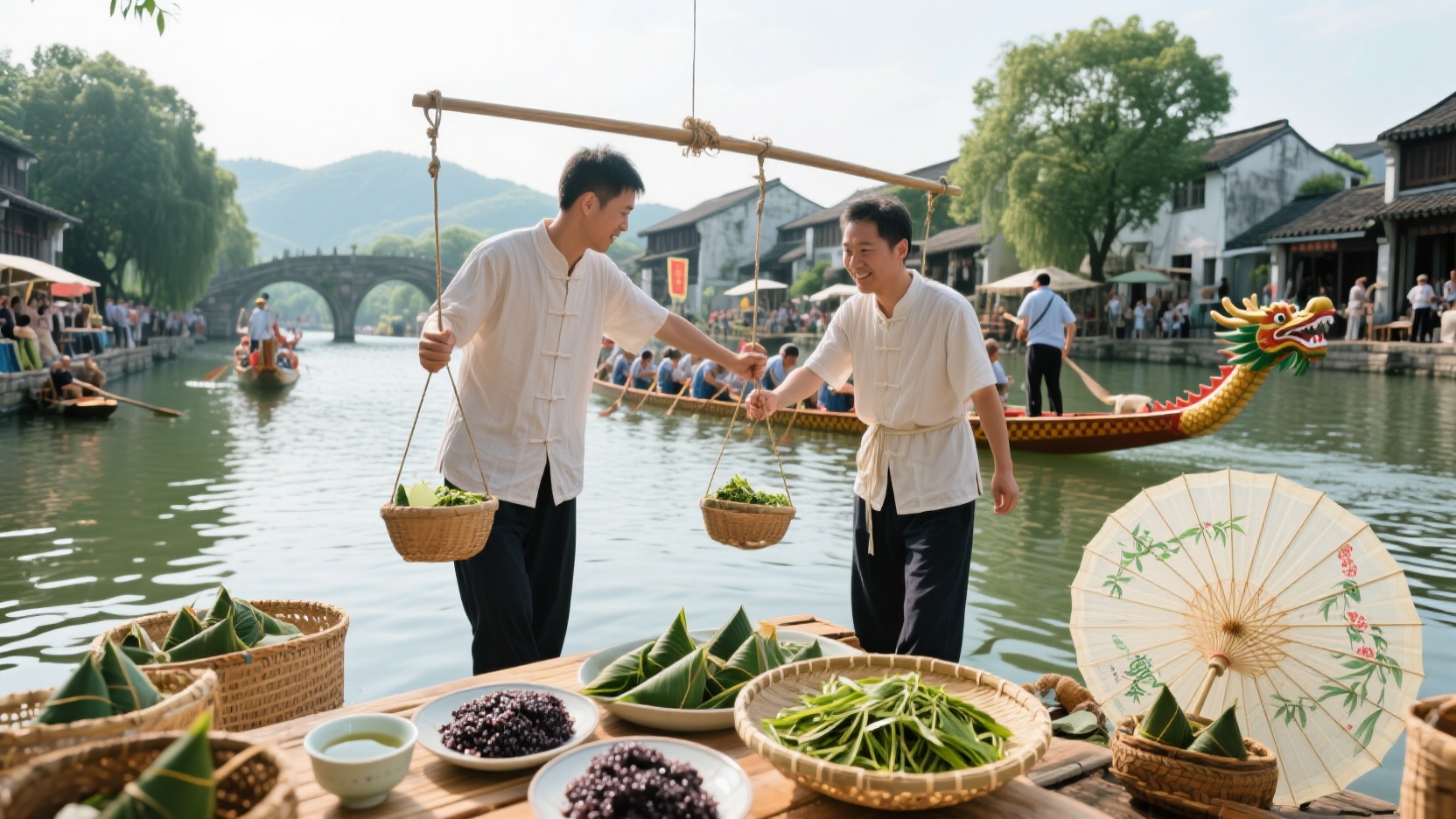
Every year on the day of Lixia (the beginning of summer), the Banshan area of Hangzhou still retains its complete Lixia customs. In the early morning, the streets of Banshan are filled with the aroma of black glutinous rice from steamers. The black glutinous rice is made by dyeing glutinous rice black with the juice of Nandina domestica leaves, which was believed in the past to prevent summer heatstroke and repel mosquitoes. The vendors often prepare the ingredients in the early morning, and locals will buy a small bowl, mix it with white sugar or pickled vegetables, and eat it in a few bites to officially mark the beginning of summer.
The most ceremonial activity is "weighing people." An old-fashioned steelyard hangs under a tree. People sit in bamboo baskets or grasp the hooks, while the weigher moves the weights and recites auspicious words. Tourists don't have to be mere spectators; they can line up to sit in the baskets and have a local announce their weight in a lucky phrase. Weighing people on the day of Lixia (the beginning of summer) originated in the Three Kingdoms period and later merged with the folk custom of praying for children to have a safe summer. During the experience, observe the dots on the steelyard and the differences in hand gestures—these are themselves overlooked aspects of traditional Chinese measurement.
Another easily overlooked handicraft in Banshan is the Banshan clay cat. In the past, silkworm farmers in Hangzhou, Jiaxing, and Huzhou regarded cats as guardian deities of their silkworm rearing rooms. During the Banshan Goddess Temple Fair, clay cats were the most sought-after items for protecting silkworms. Nowadays, clay cats are often made with two sides, one majestic and the other gentle. When trying it out, you can choose a blank blank and use a brush to outline the cat's eyes and markings. Making clay cats shouldn't be rushed; the paint needs to be dried in layers, which forces you to slow down.
Dragon Boat Festival: Jiangcun Dragon Boat Festival, a non-racing dragon boat race.
The highlight of Hangzhou's Dragon Boat Festival isn't West Lake, but Jiangcun, nestled deep within the Xixi Wetland. The Jiangcun Dragon Boat Festival isn't a modern racing event, but rather a "dragon boat gathering." Early on the fifth day of the fifth lunar month, dragon boats from various villages set sail from the river branches. The boats are categorized as "fully decorated," "half-decorated," and "bare-chested." The "fully decorated" boats are the most ornate, with their high-raised sterns adorned with colorful flags and embroidered umbrellas, resembling a moving stage on the river from afar.
The paddlers don't compete for rankings; instead, they follow the drumbeats, performing actions like "parting the water" and "sitting on the paddle." When the dragon boats meet, they sing dragon boat songs to each other, "inviting the Dragon King" along the riverbank. The whole process resembles a ritual performance between clans in the water town rather than a sporting event. Tourists can choose to stand along the banks of Shentankou or Jiangcun Port; arriving early is key to securing a spot close to the water. The drumming is intense, and the splashes are huge when the dragon boats turn around, so it's recommended to wear non-slip shoes and a phone strap. If villagers offer you cucumbers or salted duck eggs (one of the "Five Yellows"), don't refuse; it's a traditional custom of the Dragon Boat Festival in the water town.
The underlying cultural logic is that Xixi Wetland used to be a place where boats served as roads and waterways as fields. The Dragon Boat Festival was actually a way to pray for safe waterways and to ward off disease and plague. Understanding this layer will prevent you from simply viewing it as a lively event.
Jingshan Tea Banquet: From Posting Tea Lists to Discussing Poems and Enjoying Tea
The Jingshan Tea Ceremony is an important part of the intangible cultural heritage of "Traditional Chinese Tea Making Techniques and Related Customs," and also an important source of the Japanese tea ceremony. It is not found in the streets and alleys, but in the meditation hall of Jingshan Temple. A complete tea ceremony usually begins with posting a tea notice, beating a tea drum to summon participants, inviting them into the hall, offering incense and paying homage to the Buddha in turn, then having the tea master brew the tea, serve the tea, and finally recite verses while drinking tea.
The tea-making process is the most crucial part of the entire event. Tea powder is placed in a cup, a small amount of boiling water is poured in, and the tea is quickly whisked with a tea whisk to create a delicate white froth. Don't rush to drink it; first observe the color and aroma, then sip it slowly. The Jingshan Tea Ceremony emphasizes "harmony, respect, purity, and tranquility," with slow and orderly movements. A complete experience can be booked, guided by a master, where you refrain from taking photos or talking, focusing solely on enjoying a cup of tea. Many tourists are surprised by the difference in taste and texture between Song Dynasty tea-making and modern tea brewing—this is precisely what makes the Jingshan Tea Ceremony irreplaceable.
If time is limited, you can also observe the tea whisk making process or participate in tea grinding in Jingshan Village, but the complete tea banquet ritual is more suitable as the core experience, allowing people to enter the rhythm of a practitioner from the tourist's seat.
West of Gongchen Bridge: In the canal handmade market, you can polish a fan rib and stretch a silk umbrella.
The Qiaoxi Historical District along the Grand Canal is a hub for modern handicrafts in Hangzhou. Intangible cultural heritage items such as Wang Xingji fans, West Lake silk umbrellas, Zhang Xiaoquan scissors, Tianzhu chopsticks, and Hangzhou brocade can still be seen here, showcasing their complete production processes. During the Grand Canal Temple Fairs in spring and autumn, the intangible cultural heritage market is particularly concentrated, but everyday handicraft workshops are also open for hands-on experience.
I suggest spending half an hour first browsing the arts and crafts museum complex to see the division of labor and tools involved in fan making, umbrella making, and scissor making, before choosing one to sit down and try it yourself. Stretching the fan surface is suitable for beginners; first, place the damp fan paper on the frame, secure it with glue along the edges, and then trim the corners. Threading the fan ribs requires more patience, as you need to insert each polished bamboo rib into the fan surface's layers. Making a West Lake silk umbrella requires learning how to stretch the surface and apply the design; the paint should not be too thick when applying the design, otherwise the pattern will be blurred. Regardless of which method you choose, spending two or three hours on just one step is the closest you can get to becoming a "half-day artisan."
Behind these crafts lies the raw materials and orders brought by the canal ports. The workshops in Qiaoxi used to operate on a "front shop, back factory" model, and tourists can still recognize Hangzhou's essence as a city of a hundred crafts from the sounds of hammering and the fragrance of bamboo and wood.
Each of the four events has its own time frame: half a day can be allocated for the Beginning of Summer and the Dragon Boat Festival, the Jingshan Tea Banquet is best booked in advance, and the Qiaoxi Handicrafts are suitable as a half-day buffer before leaving Hangzhou on a rainy day. They all share the characteristic of having a low barrier to entry, but requiring people to sit down, participate, and wait. The true memories of a cultural and artistic journey in Hangzhou often don't come from the signs at the attractions, but from a bowl of black glutinous rice, a dragon boat race, a cup of tea, and a fan you've carefully crafted yourself.