
Experience half a day as a Hainanese person while enjoying the lantern displays and shadows of the Lantern Festival in Haikou: An in-depth experience of lantern displays, Lady Xian's military costume,
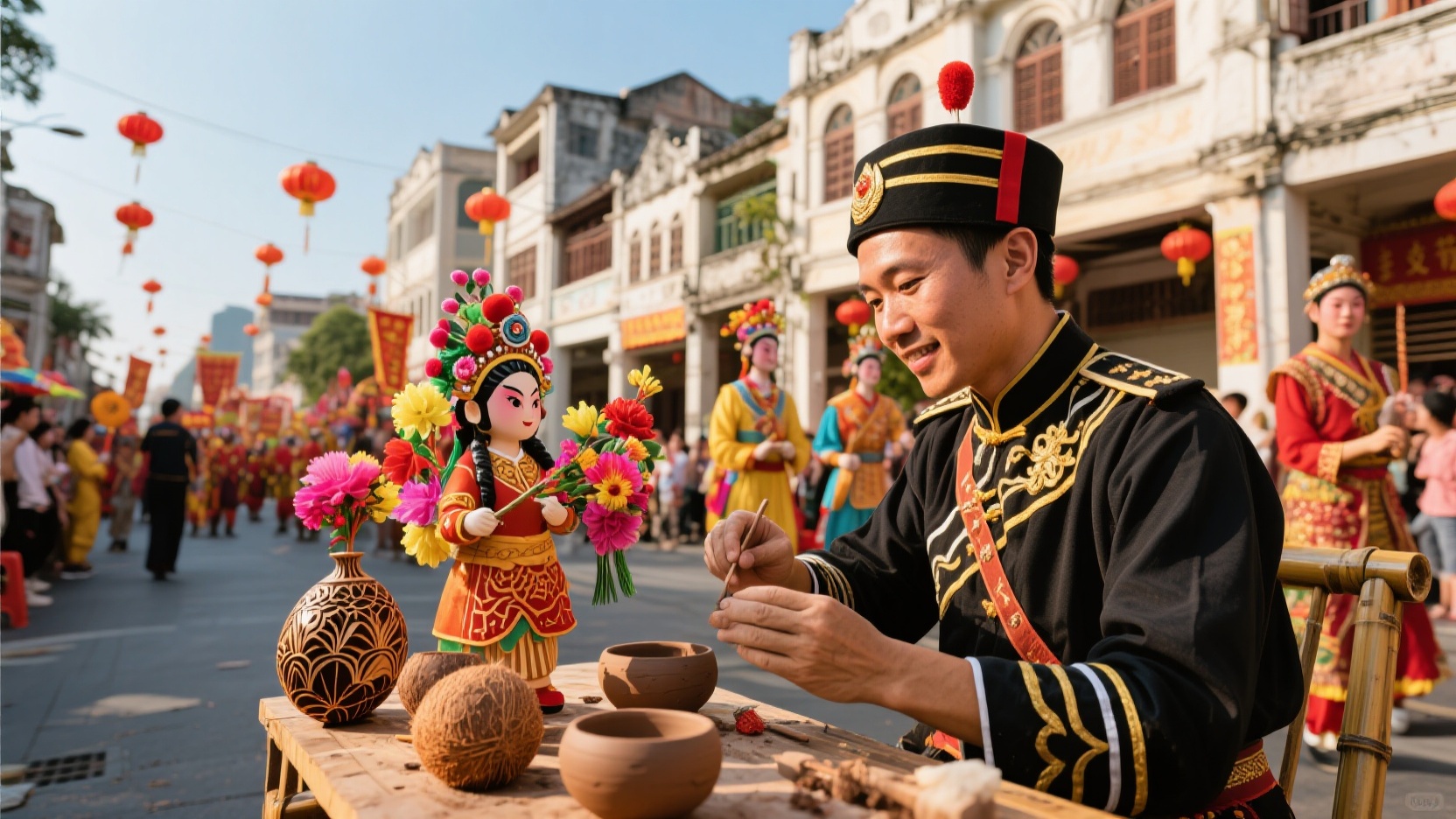
Haikou's old town festivals never lock away folk customs in display cases. Lantern Festival flower exchange, Junpo costumes, puppet shows, and coconut carving are all still alive in the daily order of the streets, alleys, and village temples. This route is not connected by attractions, but follows the time and crafts: carving coconut shells and making pottery bowls during the day, listening to opera and flower exchange at night, or following a parade to the sound of gongs and drums in early February.
Fucheng's Lantern Festival Flower Display: "Stranger Social Interaction" on an Old Street
The event takes place from nightfall to early morning on the fifteenth day of the first lunar month, with locations concentrated in the area around Zhongjie Road, Wenzhuang Road, and Xiuyifang in Fucheng. Visitors can take a bus or ride-hailing service from downtown Haikou to the vicinity of Fucheng and enter the area on foot; no entrance fee is required. The core action of exchanging flowers is proactive: holding a loose bouquet without packaging, you nod and smile at passersby, offer them a sprig, and say short phrases such as "Happy New Year" or "Good Health." After receiving the flowers, the recipient usually takes a sprig from their own bouquet to give in return. This back-and-forth continues until half a street has been covered, resulting in completely different bouquets. The flowers used are mainly gladioli, roses, carnations, and pussy willows, avoiding white chrysanthemums. In the past, Fucheng exchanged "incense" during the Lantern Festival, with neighbors exchanging incense to ward off disease through the smoke; later, due to the dense wooden structures in the streets and alleys, incense was replaced with flowers for fire prevention, but the underlying logic of "exchanging blessings" remained unchanged. Offering tables, riddle-solving booths, and temporary stages were set up on both sides of the old street, and many Qiong opera performances were held on the roadside. It is suitable to walk around and watch, rather than just standing at one intersection to take pictures.
Lady Xian's "Military Attire" Parade: A Glimpse into an Ancient Custom of a Village Temple in Northern Hainan
Junpo is the most concentrated village festival in Haikou after the start of spring, peaking from the sixth to the twelfth day of the second lunar month, and most commonly seen in Xinpo Town and Zuntan Town of Longhua District. The ceremony begins in the morning in front of the Lady Xian Temple, with gongs and drums sounding first, followed by a procession of "army" figures leaving the temple according to ancient customs: the lead lantern clears the way, followed by command flags, soldiers, lion dancers, and a traditional eight-tone ensemble, simulating the formation of Lady Xian when she commanded her troops to go to war. Tourists are advised not to just stand at the starting point but to walk halfway through the procession to observe how it crosses the field ridges and passes through village entrances. Villagers will set up offerings and burn incense in front of their homes, and the palanquin will briefly stop in front of the door, where the host will bow to receive blessings; this is called "Xingfu". Lady Xian was a female leader of the Li ethnic group who maintained stability in Lingnan from the Southern Dynasties to the early Sui Dynasty. Most villages in Hainan respectfully call her "Pozu". Junpo incorporates historical figures into village festivals, and the procession serves both as a commemoration and as a function of inter-village interaction and prayer for a good start to the farming season. When following along, be sure to leave the way for the palanquin, do not block the incense table, and do not walk through the procession.
Qiong Opera and Sanjiang Puppet Show: A Half-Performance Play Performed Under the Arcade
To experience Haikou's local opera styles, you don't have to wait for official performances. During the first and second months of the lunar calendar, red paper notices are often posted at the Sanjiaochi Square in Fucheng, the Qilou Old Street gathering square, and in front of some temples, where Hainanese opera and Sanjiang puppet shows are performed alternately. For Hainanese opera, pay attention to the transitions between "zhongban" and "kuban" sections; the female lead's flowing sleeves and footwork show traces of Minnan opera, and she speaks in Hainanese dialect. During the intermission, listen to the instrumental ensemble; the coconut shell fiddle, throat pipe, flute, and gongs reveal the underlying characteristics of northern Hainan folk music. Sanjiang puppet shows are more concise, requiring only a bamboo stage and a few puppets. A backstage ensemble performs both male and female roles. Visitors are best advised to arrive in the afternoon when the stage is being set up to watch the craftsmen "open the faces," add beards, and straighten the strings of the puppets, then sit on plastic stools to watch half the performance. During the intermission, go backstage and you can often see one person simultaneously manipulating two puppets, singing and playing gongs. In the past, puppet shows were mostly used at temple fairs to thank the gods. The scripts were mainly about encouraging good deeds and family reunions. Even if you only understood 30% of the Hainanese dialect, you would still be drawn in by the drumbeats and the puppets' movements.
Coconut carving and Longtang pottery: Sit down and be a local craftsman for half a day
Beyond festivals, the most accessible intangible cultural heritages in Haikou are coconut carving and Longtang pottery. Hainan coconut carving uses old coconut shells as a base, with records of it being a tribute item dating back to the Tang Dynasty. The standard process involves selecting the shell, removing the coconut fiber, air-drying, drawing the design, carving lines, chiseling the base, polishing, and oiling. Participants don't need to aim for a full piece; choosing half a coconut shell to make a tea scoop or small incense holder, and learning to carve wave patterns or mountain orchid and rice patterns from a master craftsman, can be completed in two to three hours. Longtang pottery is concentrated in Longtang Town in northern Hainan. The volcanic soil and the tradition of dragon kilns continue to this day. Local pottery mainly consists of water jars, earthenware pots, and earthenware steamers. Visitors can throw pottery on a wheel or hand-shape a small pottery bowl, carving simple string patterns, and then collect the finished product when the kiln opens again. Both crafts share the commonality of using local materials and being primarily handmade. The resulting items are not exquisite but functional, offering a more authentic "half-day Hainanese experience" than simply buying them. These activities can be arranged year-round, with indoor coconut carving being preferred during typhoon season.
A cultural and artistic tour of Haikou can be arranged by focusing on seasonal festivals and crafts. The route could include: exchanging flowers in Fucheng on the fifteenth day of the first lunar month, followed by a parade on Junpo after the sixth day of the second lunar month, enjoying half a puppet show in the arcades on weekdays, and spending half a day carving coconut shells or making pottery bowls. This way, the folk customs are not just stage performances, but a part of local life that you can immerse yourself in.