
Haikou Art Scenery: An In-Depth Exploration of Northern Hainan's Culture and Art
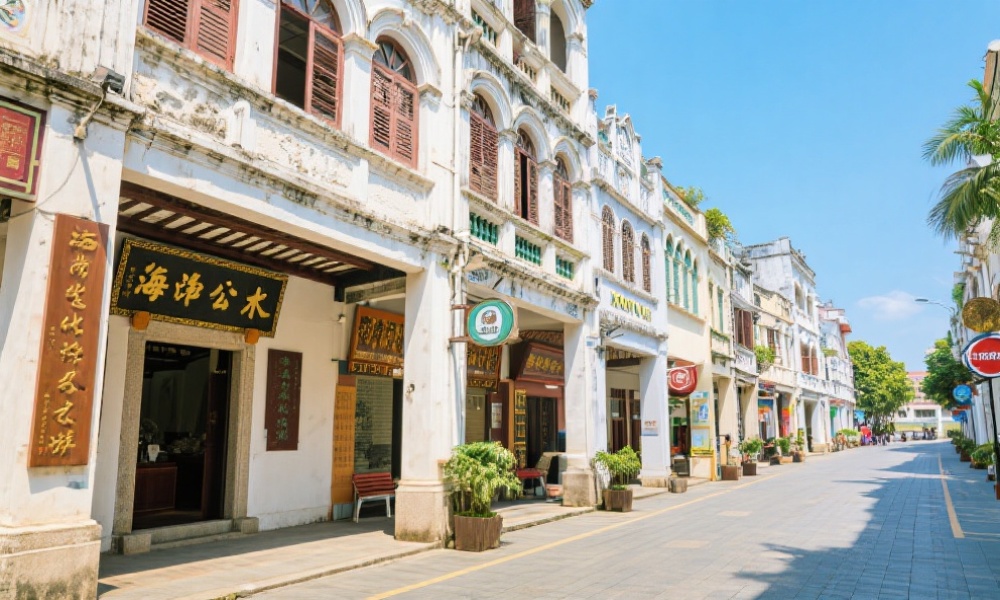
Haikou, the capital of Hainan Island, is often seen as a gateway to tropical scenery. However, beneath this coastal city lies a rich historical heritage and a unique cultural and artistic lineage. XOOTOUR has planned an in-depth journey centered on humanities, aiming to guide you beyond a superficial sightseeing experience and immerse you in Haikou's historical splendor and artistic depth.
Arcade Street: A Living Museum of Nanyang Style and Maritime Merchant Culture
To begin your journey, we recommend starting with Haikou's iconic Qilou Old Street . This area isn't a single attraction, but a historical district comprised of hundreds of Qilou buildings. Its architectural style blends elements of Southeast Asia, Gothic, and Romanesque styles, serving as historical evidence of Hainan's trade with Southeast Asia and the world in the late 19th and early 20th centuries. Strolling through it, you'll see exquisite carvings, reliefs, and window lintels overhead, and feel the marks of time on the cobblestone streets below.
The formation of the arcade culture is inextricably linked to Haikou's status as an important node on the ancient Maritime Silk Road and a modern port for foreign trade. Overseas Chinese returning from Southeast Asia combined exotic architectural styles with local customs, creating this unique commercial and residential space with shops in the front and residences in the back, offering shelter from the rain and sun downstairs. Behind each arcade may lie a story of family rise and fall, or a merchant's legend. It's recommended to slow down and observe the details, such as the stone lions in front of the Tianhou Temple or the shop names carved on some doorways; they silently tell the story of Haikou's past prosperity and openness. This is not only an architectural feast but also a microcosm of Haikou's maritime merchant culture, overseas Chinese culture, and everyday life. Some time-honored shops are still in operation today; enjoying a traditional "Lao Ba Cha" (old man's tea) or local snacks is the best way to experience its slow pace of life.
Hainan Provincial Museum: A Grand Narrative of Hainan Island Civilization
Starting from the Qilou Old Street and heading to the Hainan Provincial Museum is an indispensable stop for a comprehensive understanding of Hainan's history and culture. As a provincial-level comprehensive museum, its exhibits cover the evolution of Hainan from prehistoric civilization to modern times, as well as its unique marine culture, ethnic customs, and natural ecology.
The museum's highlights are the "Hainan History Exhibition" and the "Hainan Ethnic and Folk Customs Exhibition." The former, through rich archaeological artifacts and historical documents, outlines Hainan's important position on the Maritime Silk Road and the fusion of Central Plains culture and local culture throughout history. From Neolithic stone tools and pottery to Han Dynasty bronze drums and Song and Yuan Dynasty porcelain fragments, all testify to the frequent interactions between Hainan Island and the outside world. The latter deeply showcases the unique lifestyles, clothing art, and traditional crafts of ethnic minorities such as the Li and Miao, especially the Li brocade, a national intangible cultural heritage whose exquisite weaving techniques and symbolic patterns are breathtaking. The museum's permanent intangible cultural heritage performances and special lectures further deepen understanding of these cultural treasures.
The Temple of the Five Officials: A Hall of Exile Culture and Loyalty
Next, we visited the Five Officials Temple , an ancient architectural complex built to commemorate five virtuous officials—Li Deyu, Li Gang, Zhao Ding, Hu Quan, and Li Guang—who were exiled to Hainan during the Tang and Song dynasties. The Five Officials Temple is not only an important historical and cultural site in Hainan, but also a symbol of the Chinese nation's "exile culture" and "spirit of loyalty and righteousness."
Despite facing adversity, these five officials remained devoted to their country and its people, bringing advanced Central Plains culture to the remote and undeveloped Qiongzhou, thus promoting local education and economic development. The plaque inscribed "Hainan's First Building" within the ancestral hall, along with other ancillary buildings such as the Su Gong Ancestral Hall, Fu Bo Ancestral Hall, and Guan Jia Hall, together create a historical space for commemoration, learning, and reflection. In the Five Officials Ancestral Hall, you can feel their unwavering ambition despite adversity, and the unique role Hainan Island, as a cultural exile site, played in absorbing, transforming, and disseminating Central Plains civilization throughout history. Every stone tablet and every couplet carries profound historical weight and deep emotion, worthy of careful contemplation.
Hai Rui's Former Residence and Xiuying Fort: A Symbol of Integrity and Coastal Defense
Extend your journey to the former residence of Hai Rui , exploring the legacy of this upright Ming Dynasty official. Hai Rui is renowned throughout history for his incorruptibility, integrity, and love for the people, earning him the title "Hai Qingtian" (Hai the Upright Official). Although the residence has undergone several renovations, it still retains its Ming Dynasty architectural style. Through the displayed historical materials and artifacts, it showcases Hai Rui's life and his philosophy of incorruptibility. This place is not only a memorial to a virtuous figure but also an important base for conducting anti-corruption education and promoting traditional virtues. Here, you can gain a deeper understanding of the moral integrity and governance principles of ancient Chinese scholar-officials and feel Hai Rui's unwavering integrity in refusing to "bow down for five pecks of rice."
The final stop on the itinerary is recommended to visit Xiuying Fortress . This coastal defense fortification, built in the late Qing Dynasty, was once an important military stronghold for Haikou and even Hainan Island, witnessing the vicissitudes of China's modern history in resisting foreign aggression. The fortress consists of five gun emplacements, which are relatively well-preserved, with some of the cannons still clearly visible. Climbing the fortress and gazing at the Qiongzhou Strait, one can not only feel the formidable strength of the former coastal defenses but also reflect deeply on national sovereignty and independence. It is a silent textbook of modern history, reminding future generations to remember history and cherish peace.
Intangible cultural heritage experience and slow living: Deeply integrated into Haikou
Beyond the aforementioned cultural routes, XOOTOUR encourages you to incorporate intangible cultural heritage experiences into your itinerary. For example, seek out local coconut carving studios or inheritors of this intangible cultural heritage to experience this exquisite art form using coconut shells as a medium. As a unique traditional craft of Hainan, coconut carving is itself a form of aesthetic enjoyment and cultural transmission. Additionally, if time permits, check with local theaters or cultural centers to see if there are performances of Qiong Opera (Hainan local opera). Qiong Opera, with its unique singing style, performance form, and local flavor, vividly showcases the life and aesthetic pursuits of the people of Hainan Island.
A cultural and artistic journey in Haikou is not just a quick visit to tourist attractions, but an exploration of history, an appreciation of art, and an understanding of human nature. Slow down, connect with locals, and savor authentic cuisine, making your trip to Haikou a cultural immersion that enriches both body and soul.