
Following the Lusheng (a traditional reed pipe instrument) to various performances | Experiencing life as a semi-Japanese person at dance performances, paper mills, and Nuo noodle stalls in Guiyang.
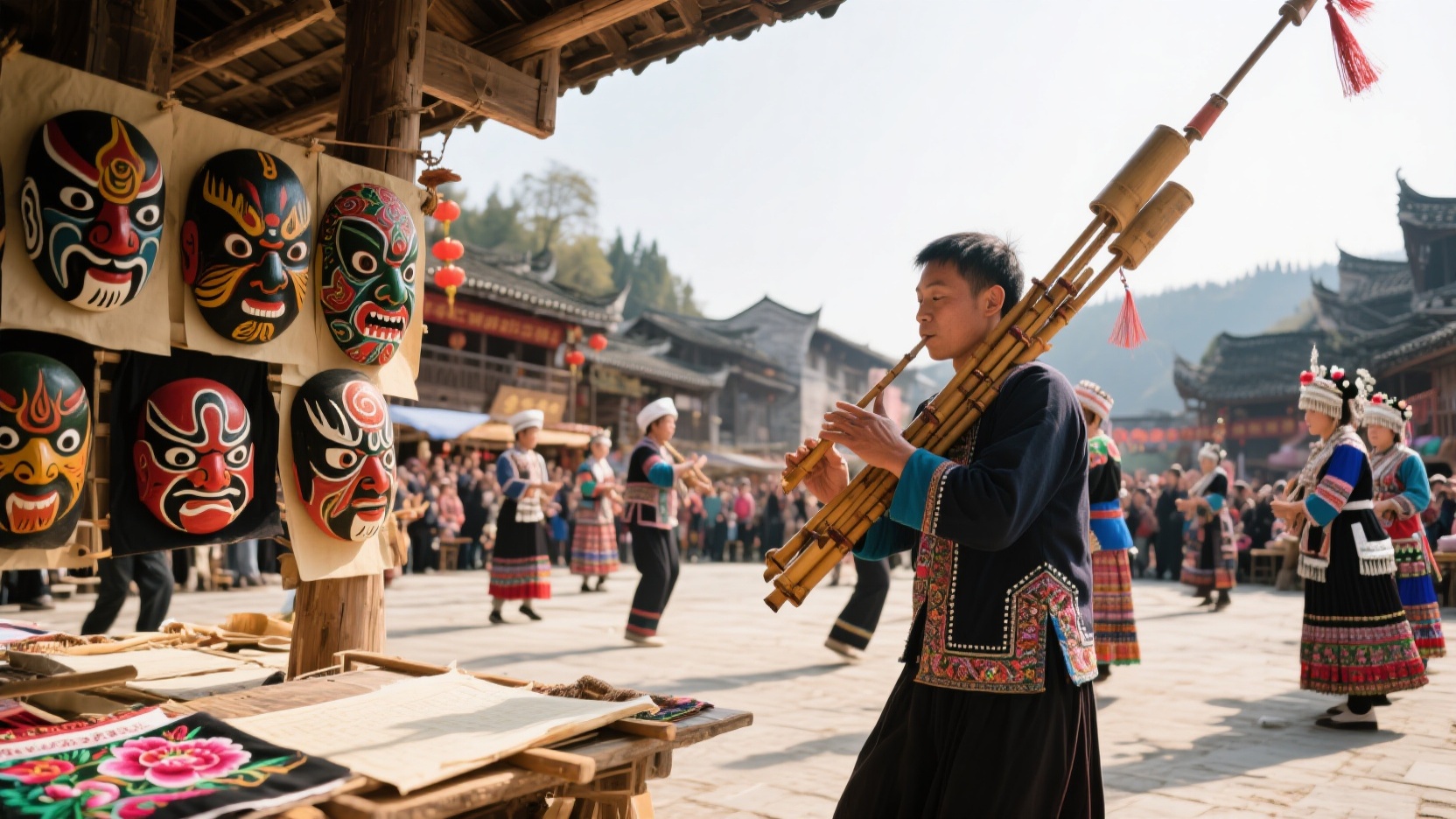
A cultural and artistic experience in Guiyang shouldn't be limited to sightseeing at tourist attractions. Splitting your trip into half-days to full days makes it easier to understand the practical logic behind the folk customs of central Guizhou, from the rhythm of the lusheng (a traditional reed pipe instrument) at the Miao ethnic group's dance performance, to the bamboo curtains used for making paper in Xiangzhigou, to the reverse stitches of Huaxi embroidery, and to the color schemes of the Nuo masks at the Qingyan Temple Fair.
Huaxi Tongmuling Miao Ethnic Group's Dance Performance: A Social Gathering for Lusheng (a traditional reed pipe instrument) during the Lunar New Year
From the 12th to the 14th day of the first lunar month each year, the Miao ethnic group's "Jumping Festival" in the Tongmuling area of Huaxi District revolves around the erection of flower poles, the playing of the lusheng (a reed pipe instrument), and a procession around the square in full costume. In the center of the square, straw markers and flower poles are erected, and lusheng teams from various villages take turns entering. Men play the lusheng, while women, dressed in layers of silver clothing, keep time with the rhythm. Tourists can wait until the "public square" opens and join the end of the procession, circling the square three times to the rhythm, without needing to strive for perfect movements. Circling the square serves as both a social prelude and a boundary between spectators and participants. At noon, one can sit down by the square and enjoy a bowl of sour soup rice, asking an elder a blessing in the Miao language. The Jumping Festival originated from Miao ancestral worship and youth gatherings. The red silk on the flower poles symbolizes family reunion, and the bronze drum and horse patterns on the hems of the clothing record migration routes. While laymen see only the spectacle, connoisseurs can read a history of migration from the patterns.
Wudang Xiangzhigou: Copying a sheet of bamboo paper, half a day's work in the paper mill.
The papermaking workshops in Xiangzhigou are built along the stream and can be experienced year-round, with the bamboo material being most abundant in spring. The process begins with pounding the pulp. Visitors use a bamboo screen to gently shake the pulp in the pulp vat, evenly scooping up the fibers to form a paper film. Then, flower petals and grass leaves are added, and after pressing and drying, a sheet of floral paper is formed. The craftsman will repeatedly correct the angle of his wrist, because the thickness of the paper depends entirely on the feel; too fast and the paper surface will be fuzzy, too slow and the thickness will be uneven. This craft preserves the bamboo papermaking process used by the Ming Dynasty garrison troops. In the past, the handmade paper was used for military documents and folk sacrifices. Many paper mills in the village worship Cai Lun as their patron saint, and the paper mills close for one day every year on the fifteenth day of the third lunar month to commemorate Cai Lun. Sitting for two hours, with your hands covered in bamboo pulp, you will remember the principle of "paper lasting a thousand years" more effectively than looking at the exhibition boards.
Huaxi Embroidery Workshop: Unearthing a Wordless History from the Back
Huaxi embroidery doesn't use a draft; the stitches are made on the reverse side, revealing the pattern on the front, emphasizing "one stitch every three threads." Workshops are mostly located in villages or around ancient towns, with the most embroiderers during the off-season. The experience begins with recognizing octagonal flowers, bronze drum patterns, and butterfly patterns, followed by lightly sketching a simple coin pattern on dark homespun cloth with a pencil, and then practicing according to a mnemonic. The most common mistake beginners make is pulling the thread too tight, causing wrinkles and distorting the pattern. The embroiderers demonstrate how to hide the stitches between the threads, ensuring only the neat pattern is visible on the front. The Miao people consider embroidery a "wordless history book," with patterns of rivers, mountains, and cities recording ancestral migration routes—patterns that can be read, passed down, and worn. Spending two or three hours carefully embroidering often only yields a bronze drum pattern the size of a coaster, but it helps one understand why handcrafting cannot be replaced by machines.
Qingyan Ancient Town Spring Festival Temple Fair: Nuo Mask Painting and Juntun Dixi (a type of traditional opera)
From the first to the fifteenth day of the first lunar month each year, the Ming and Qing dynasty streets and alleys of Qingyan Ancient Town are filled with performances of Dixi (a type of traditional Chinese opera), dragon dances, and intangible cultural heritage markets, reaching their peak around the Lantern Festival. Dixi performers wear masks and carry flags on their backs, their singing high-pitched and powerful; a short performance of a scene from the Three Kingdoms or Investiture of the Gods can last up to twenty minutes. After watching the Dixi, you can choose a small, unpainted Nuo mask from a market stall and paint it with mineral or acrylic paint. The craftsman will explain the coloring rules: red symbolizes loyalty and bravery, black symbolizes uprightness, white often represents treachery, and green often represents wildness; if there is a "福" (fortune) character or sun and moon patterns on the forehead, it signifies warding off evil and bringing good fortune. Qingyan was an important military town and a node on the Tea Horse Road during the Ming Dynasty. Dixi was introduced from military Nuo, and the temple fair still retains the culture of garrisoning troops. When experiencing the performance, you should respect the deities behind the masks and not try on masks of other ethnic groups. You can take home your own painted mask.
These four experiences can be combined according to the seasons: the first half of the first lunar month is suitable for combining the Tongmuling Jumping Field and Qingyan Temple Fair, while Xiangzhigou and the embroidery workshop can be arranged separately throughout the year. If you want to truly experience being a local for half a day, you should reserve at least two half-days and shift the focus of your trip from "seeing" to "doing it yourself." A cultural and artistic trip to Guiyang is more like an on-site training in craftsmanship and seasonality.