
Fuzhou Seasonal Handbook | From Aojiu Congee and Night Dragon Boat Races to Lacquerware Workshops, Intangible Cultural Heritage is Made a Part of Everyday Life
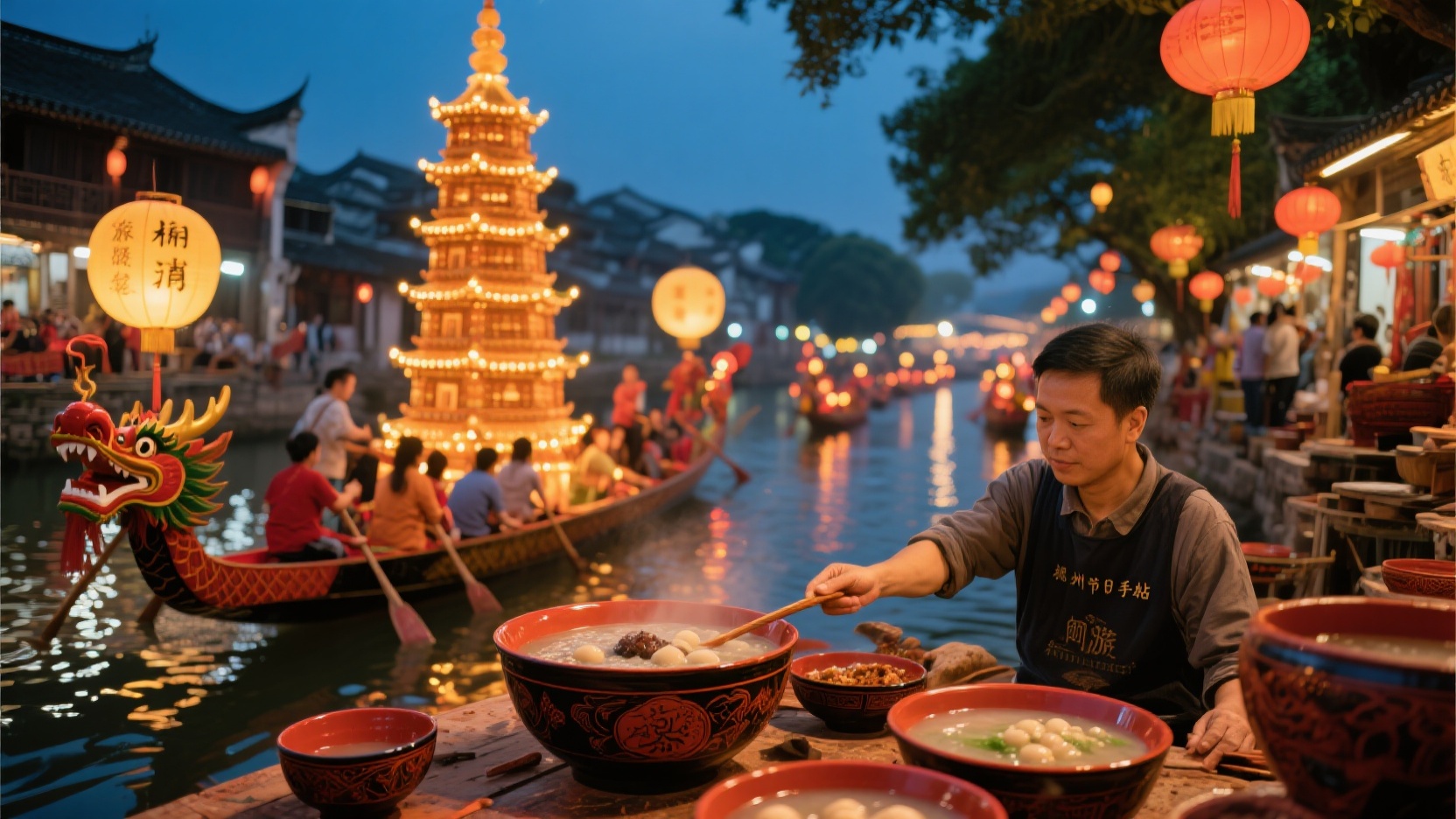
Fuzhou's culture and art rarely remain confined to display cases; they are more often found in the aroma of congee during the Lunar New Year, the shadows of oars on the Mid-Autumn Festival streams, the tiled towers in the Mid-Autumn Festival halls, and the polished surfaces of lacquerware workshops. To truly understand Fuzhou, why not choose a festival or workshop, sit down, and experience life as a local for half a day? The following four experience routes correspond to the Filial Piety Festival in spring, the night dragon boat races in early summer, the tower-building custom of the Mid-Autumn Festival, and the art of lacquerware, which requires patience.
Aojiu Festival: Filial Piety and Neighborly Kindness in a Bowl of Porridge
The date falls on the 29th day of the first lunar month, a day celebrated as "Filial Piety Festival" in Fuzhou. Aojiu porridge, made with glutinous rice, red dates, peanuts, longan, and water chestnuts, is sweet but not cloying, and the number "nine" is a homophone for "long-lasting." If you visit Fuzhou at the end of the first lunar month, you'll often see scenes of porridge being cooked and distributed collectively in communities, ancestral halls, and senior citizen centers. The experience is simple: receive a bowl of porridge and listen to the elders tell the story of "Mulian Saving His Mother"—legend has it that Mulian tried to bring food to his mother in prison, but each time the food was stolen by hungry ghosts. Later, he cooked a dark red porridge with water chestnuts and peanuts, finally delivering it to his mother. Fuzhou people thus associate Aojiu porridge with filial piety. Tourists can participate in preparing the ingredients and packaging, joining locals in delivering the porridge to elders and neighbors. During this process, remember two local rules: the porridge should be served hot, and elders should be addressed as "Yibo" or "Yimu." In half a day, a bowl of porridge can take you into the heart of Fuzhou's social order and community spirit more effectively than a sightseeing bus.
Dragon Boat Race at Sanxi, Changle: A Water Race Amidst Lanterns on Dragon Boat Festival
In Fuzhou, the Dragon Boat Festival isn't just about daytime dragon boat racing; the "Night Dragon Boat Races" at Sanxi in Changle offer a unique visual spectacle. The races take place from the fourth to the sixth day of the fifth lunar month, reaching their peak in the evening as dusk falls. The Sanxi stream is narrow, with old houses and stone bridges on both banks creating a narrow lane just wide enough for one or two dragon boats to pass. The key to the experience is the atmosphere: dragon boats adorned with lanterns at the bow and stern, and shirtless crew members shouting slogans as they pass under bridges amidst the sounds of firecrackers and drums. Visitors can stand along the stream bank or on the stone bridges, watching the dragon boats glide past their feet, the water splashing and drumbeats almost brushing against them. This custom isn't a professional race, but rather a way for villages to connect emotionally and perform a water-praying ritual. It's recommended to come after dinner, walking along the stream to watch the dragon boats from different villages take turns launching. If locals invite you to "eat a bowl of fish balls before you go," don't refuse; it's part of the night journey. When taking photos, be careful not to stand on slippery sections of the stream bank or block the stone steps where the dragon boats launch and launch.
Mid-Autumn Festival Tower Building: A Handcrafted Competition in the Halls of Old Fuzhou
Around the 15th day of the eighth lunar month, the custom of "building towers" reappears in some traditional streets and folk museums in Fuzhou. In the past, Fuzhou families would display tiles, clay sculptures, porcelain figurines, and pagoda models in their halls during the Mid-Autumn Festival, stacking them layer by layer to see who could build the tallest and most stable tower. Today, visitors can practice at folk activity sites in Sanfang Qixiang or Shangxiahang, using modified pottery shards and wooden components under the guidance of experienced craftsmen. The experience begins with "laying the foundation": first, choose the most stable base layer, then gradually narrow the layers, decorating the middle with colorful lights and small flags. The difficulty in building a tower lies in the center of gravity; too much force will cause the entire tower to tip over, requiring good hand control. This custom originated after Qi Jiguang's victory against Japanese pirates in the Ming Dynasty, when people celebrated the victory by building towers. Later, it evolved into a seasonal game for children to compete in skill during the Mid-Autumn Festival. Visitors with children can treat building towers as a Fuzhou version of the "Building Blocks Challenge," offering a more engaging experience than simply visiting a lantern festival.
Lacquerware workshop: Producing a lacquerware piece in half a day
Fuzhou bodiless lacquerware, along with Shoushan stone carving and cork painting, is known as one of the "Three Wonders of Fuzhou." Among them, lacquerware is most suitable for short-term experiences for beginners. Experiences usually take place in lacquer workshops in Zhuzifang or Shangxiahang areas, requiring advance booking. A small tea scoop or lacquer bead can be completed in half a day. The process is quieter than expected: first, watch the master demonstrate scraping and polishing, then apply a thin layer of lacquer to the base, place it in an air-drying box, and then repeatedly polish it with fine sandpaper and polishing powder. The lacquer surface initially appears dull, but after polishing, a subtle luster slowly emerges. Shen Shaoan revived the bodiless technique during the Qing Dynasty, making lacquerware light yet sturdy. Fuzhou's humid climate is also perfect for the air-drying of lacquer. Sitting down and experiencing it firsthand will help you understand the "time-sensitive nature of lacquer art": each layer of lacquer must be applied patiently; it cannot be rushed. If time is limited, you can only do the polishing stage, leaving the warmth of your hands on the finished product. After the experience, don't rush to leave. The wall of unfinished products and old tools in the workshop are themselves a history of craftsmanship without glass.
Connecting these points creates a seasonal cultural route through Fuzhou: drinking porridge on the ninth day of the first lunar month, watching dragon boat races at midnight on the Dragon Boat Festival, displaying pagodas and competing in craftsmanship during the Mid-Autumn Festival, and polishing lacquerware in workshops on weekdays. These routes don't need to chase after a large number of attractions; instead, they emphasize sitting down, reaching out, and waiting. Fuzhou's intangible cultural heritage isn't far away; it's in the locals' porridge bowls, oars, roof tiles, and lacquer layers.