
How can I make sure my trip to Chongqing is worthwhile if I schedule it by the hour over three days?
Arrive at 2 PM on the first day and check in first. Don't rush to Hongyadong.
"How should I plan my three-day trip in Chongqing to avoid being exhausted and missing anything important?" This is the question I get asked most often before every trip. This guide doesn't list attractions; instead, it breaks down the three-day, two-night itinerary by the hour, telling you where to go at each time slot and why it's crucial to visit those times. Following this plan will save you from having to constantly check your phone. Staying near Jiefangbei or Jiaochangkou is the safest bet, as all subsequent routes will originate from there.
Arriving in Chongqing around 2 PM, the first thing to do wasn't to drop off my luggage and rush to the attractions, but rather to check the hotel's location and the surrounding terrain. Chongqing's light rail station exits often have a road on one side and a cliff on the other; dragging your suitcase to the wrong exit could mean climbing half a mountain extra. I recommend checking the walking distance to Jiefangbei on your phone after checking in. If it's more than fifteen minutes, decisively switch to the light rail or take a taxi, saving your energy for the hills and slopes later in the day.
On the first day at 5:30 PM, walk from the mountain city trail to Jiaochangkou to see a three-dimensional view of Chongqing during the day.
Before dusk, the light is still good, and most tour groups have dispersed. Starting from the entrance of the mountain trail near Jiaochangkou subway station and walking uphill, or vice versa, walking downhill from Qixinggang, the entire journey takes about forty minutes. This route is free and offers clear views of the Yangtze River and the buildings on the opposite bank. Crucially, it allows you to experience Chongqing's unique sense of displacement—"you think you're on the first floor but you're actually on the eighth floor"—the most direct way to understand the city during the day.
Why this particular spot? Because the trail offers no shade, making it unbearably hot at midday, and obscuring the views after dark. Completing the hike brings you back to Jiaochangkou, where you can grab a bowl of tofu pudding or noodles to tide you over, ensuring you're not hungry while waiting in line for Hongyadong in the evening. This sequence seamlessly connects "observing the terrain" and "having dinner," avoiding unnecessary detours.
Day 1, 8:00 PM: Take photos of the night view from the opposite bank of Hongyadong. Avoid crowding inside the scenic area.
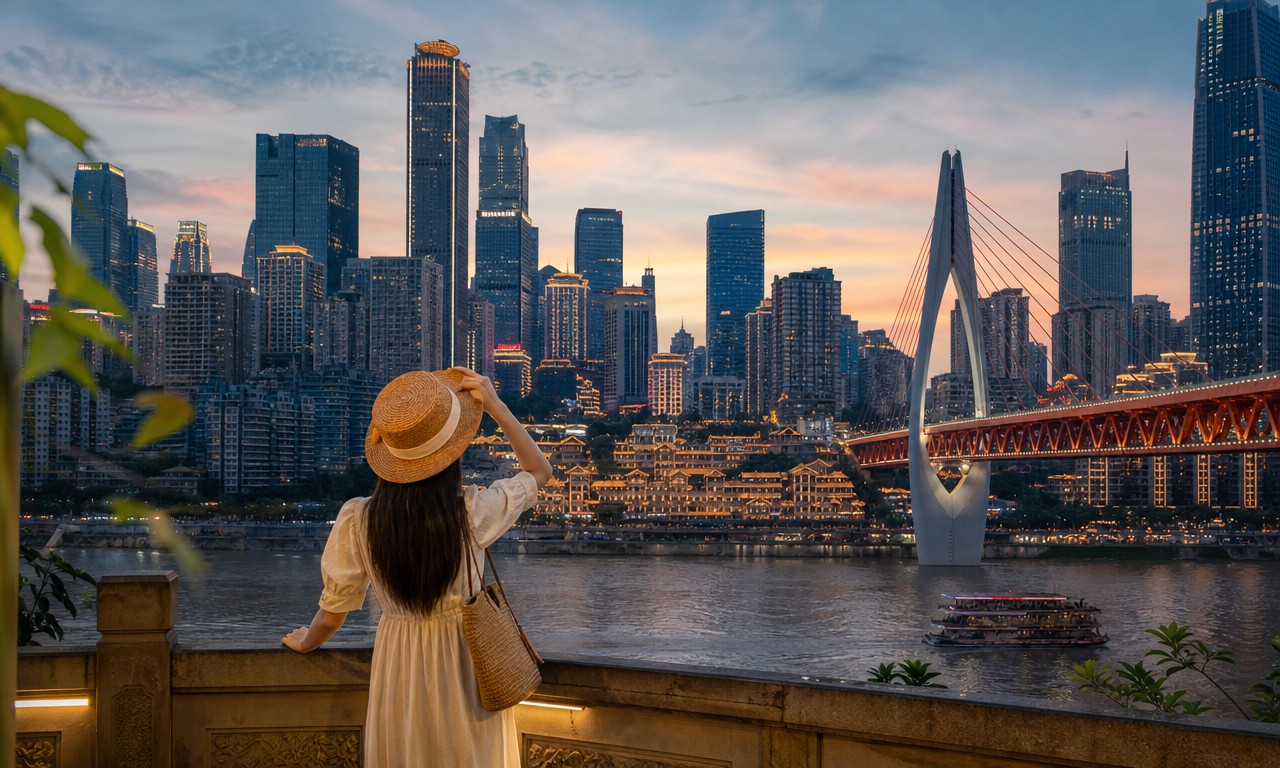
Hongyadong lights up at 7 PM, but the peak tourist season is between 7:30 and 8 PM. Most guides will tell you to go straight into the scenic area, but it's actually just a commercial street where you'll only see heads. A better approach is to walk to the Qianmen Bridge around 8 PM, or to the riverbank below the Grand Theatre, and stand on the opposite bank for a panoramic view of Hongyadong. This angle captures the golden outlines of the stilted buildings and their reflections in the river, providing a much more complete view than looking up from below.
If you really want to go inside Hongyadong, you can wait until after 9:30 PM, when the crowds start to thin out. However, it's not recommended to exhaust yourself on your first day in Chongqing. After taking photos of the night view, head straight back to your hotel, stopping by Jiefangbei on the way to catch a glimpse of the shopping district lights. Chongqing has a long nightlife, but save your energy for the early morning light rail on the second day.
The next day at 7:30 AM, we visited Liziba and Eling No. 2 Factory, before the tour groups arrived.
The observation deck at Liziba where the light rail passes through a building is rarely crowded before 7:30 am; tour groups usually arrive after 9:00 am. Taking the light rail line 2 from Jiefangbei provides a perfect experience along the river, with the Jialing River visible from the train window. After taking photos of the light rail passing through the building from the observation deck, don't rush off. Take the side path towards Eling No. 2 Factory; that uphill section offers a more authentic view of old residential buildings and the light rail running parallel to each other, even more so than from the observation deck.
Eling No. 2 Factory is a cultural and creative area converted from an old printing factory. It opens at 10:00 AM, but you can enter the courtyard earlier. Arriving before 9:00 AM allows you to have the rooftop and stairs all to yourself. After taking photos, you can wait for the shops to open, buy a coffee, and sit down to rest. The key to this arrangement is "early," because both Liziba and Eling No. 2 Factory are small-scale attractions, and the experience will drop drastically when there are many people. The only price for getting up early is a hotel breakfast.
The next day at 12:30, find a small noodle shop near a residential building and have lunch there during off-peak hours.
You don't need to go to trendy Chongqing noodle shops. Just look for locals eating their noodles on plastic stools in the residential areas around Jiefangbei, Jiaochangkou, and Guanyinqiao – it's a safe bet. Between 12:30 and 1:00 PM, office workers finish eating first, while tour groups are still at the attractions, so there's no need to queue. A bowl of pea and minced meat noodles or beef noodles will cost around 10-20 yuan per person, and adding a fried egg makes for a satisfying meal.
Why schedule lunch at this time instead of 11:30? Because the morning's itinerary ends around 12:30, eating earlier would disrupt the rhythm, while eating later might mean catching the tail end of the lunch rush at 1:30. Many small noodle shops in Chongqing close at 2:00 PM, so 12:30 PM is a safe window; after eating, you can go back to the hotel to rest for half an hour, avoiding the hottest part of midday.
On the second day at 6:00 PM, go to Nanbin Road or Nanshan Yikeshu (One Tree) to see both the sunset and the night view.
I don't recommend going to Ciqikou or the Yangtze River Cableway in the afternoon. The former is packed with people, and the latter requires queuing for an hour for a three-minute experience. Save the evening for Nan'an. You have two options: If you want a relaxed experience, take the light rail to Nanbin Road and walk along the riverside path from Dongshuimen Bridge to Haitangxi to watch the Yuzhong Peninsula transform from sunset to lights. If you want panoramic views, take a taxi to the Yikeshu Viewing Platform in Nanshan. Arrive before 6 pm to get a front-row spot. After sunset, don't rush to leave; wait until it's completely dark to take a comparison photo.
This time slot is scheduled for the south bank because the best viewing direction for Chongqing's night view is from south to north towards Yuzhong District. Since there's only a half-hour interval between sunset and the night view, it's better to stay in one place until dark than to go to two different locations. Returning to Jiefangbei after viewing the night view involves crossing the river; taxis or light rail are convenient options, so there's no need to rush for the last train.
On the third day at 09:00, visit Baixiangju and Huguang Guild Hall for a leisurely final stop.
On the third day, after storing our luggage at the hotel, we went to Baixiangju. This is an old-style residential building complex with no entrance fee. Entering from the Baixiang Street entrance, you can capture the view of the Yangtze River Cableway passing between the buildings. Arriving around 9 am, the sunlight streaming into the stairwells was more beautiful than at midday, and the stairwells were lively but not noisy with residents out buying groceries. After Baixiangju, a ten-minute walk took us to the Huguang Guild Hall, where well-preserved Ming and Qing dynasty guild hall architecture contrasts sharply with the surrounding modern high-rises.
These two places are chosen as the final stops because they are close to Jiefangbei, so the walks won't be too tiring, and you can return to the hotel to pick up your luggage at noon. If you need to catch a train or plane on the afternoon of the third day, finish at Huguang Guild Hall before noon to allow for buffer time. It's not recommended to include Nanshan or Ciqikou on the last day, as traffic jams or rain could easily cause you to miss your train or flight.
On the third day at 12:30, we had our last meal of local cuisine. After eating, we went straight to the station.
Chongqing's local cuisine is more suitable for a farewell meal than hot pot, because hot pot has a strong smell, takes a long time to prepare, and leaves you smelling unpleasant while rushing to catch your train. Find a home-style restaurant in a residential area, order a dish of spicy blood curd or spicy chicken, and a bowl of rice; you can eat very well for just a few dozen yuan per person. The meal starts at 12:30 PM and you should finish before 1:30 PM, giving you ample time to get to the station or airport.
Why choose Sichuan-style cuisine instead of hot pot for lunch on the last day? Hot pot restaurants are less open at lunchtime, and eating there takes at least an hour and a half, making you sleepy. Sichuan-style cuisine is served quickly, has strong flavors but doesn't require cooking, and it's convenient to take leftovers home. This decision ensures a smooth three-day trip without one meal affecting your return journey.