
Chongqing in the Vegetable Basket: Ten Authentic Local Products from Shihuishi and Xuetianwan Vegetable Markets
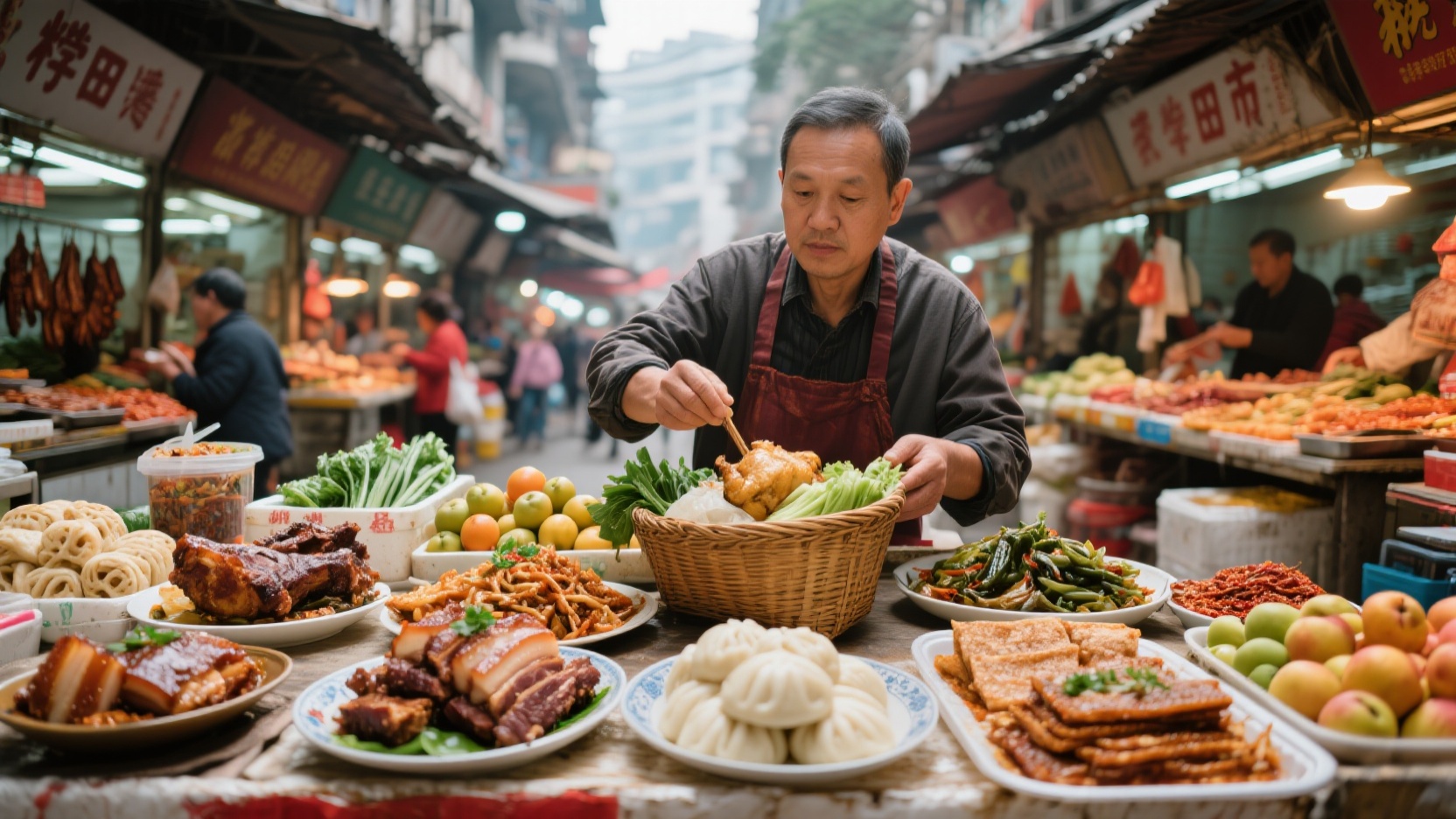
The true culinary essence of Chongqing lies not in the tourist snack streets, but in two old vegetable markets on the Yuzhong Peninsula—Shihui Market and Xuetianwan Market. The former guards the pulse of the Jiaochangkou area, while the latter continues the memories of the vegetable baskets from the Dayanggou area. At seven in the morning, steamers, braising pots, sauce jars, and fruit baskets open simultaneously, the air filled with the aroma of Sichuan peppercorns and fermented rice. This guide outlines ten local must-buy items along four lines: cooked food, handmade snacks, pickled vegetables, and seasonal fruits. This list doesn't seek novelty, but only selects items that locals buy repeatedly every day and that represent the essence of Chongqing's dining scene.
Cooked food stalls: Braised pork belly, steamed pork with rice flour, and poached chicken.
Steamed pork belly is the first test of a cooked food stall's skill. In the market, it's often steamed in earthenware bowls, the fatty part is translucent amber, and it's served on a bed of bean sprouts or dried plums. A wrinkled surface indicates it's cooked thoroughly. When choosing, it should smell of soy sauce and oil, not the smell of stale oil. After buying it, steam it again for ten minutes and serve with steamed rice. For steamed pork with rice flour, choose a cut with a slightly fatty, three-layered fat. The freshly ground rice flour should have a noticeable grainy texture, and the spiciness comes from fermented broad beans and Sichuan peppercorn powder. The pork slices should be fully coated in rice flour, with no raw starch visible.
For poached chicken, choose chickens with a thin layer of jelly-like aspic between the skin and meat. This indicates that the chicken was set in cold water after poaching, resulting in firm but not dry meat. Cooked food stalls usually provide a packet of chili oil dipping sauce; don't pour it directly over the chicken at home, use it as a dipping sauce to maintain the crispy skin. If you also buy chicken giblets, ask the vendor to add a spoonful of the original broth; you can then use it as a topping for noodles at home.
Handmade snacks: Steamed rice cakes in leaf wraps, corn cakes, and fermented glutinous rice.
In Chongqing markets, Ye'erba (叶儿粑) is often sold alongside white cakes and steamed cakes. The outer layer is made from a mixture of glutinous rice and indica rice, filled with pickled mustard greens and minced meat or sesame and peanut filling, and placed on a bed of pomelo leaves or galangal leaves. When choosing, prioritize those where the leaves are still moist and the cakes are not sticky, indicating that the steaming time has just passed. Corn cakes (玉米粑) are made with freshly ground old-variety yellow corn, with slightly coarse husk residue. The mixture is spread on corn leaves and steamed. Before eating, it's pan-fried in a little oil until both sides are slightly browned; the sweetness comes from the natural flavor of the corn, not added sugar.
Oil-fried fermented glutinous rice is a type of fermented glutinous rice distinct from regular fermented glutinous rice in Chongqing. It's made by simmering lard, black sesame seeds, and crushed peanuts with fermented glutinous rice, resulting in a dark brown paste. It's usually sold by weight at the market stalls. After buying it, take a small spoonful to make egg drop soup or cook small glutinous rice balls; it has a richer aroma than regular fermented glutinous rice. If you see freshly pounded soybean flour at the stall, you can also buy a bag; it's great for dipping glutinous rice cakes or mixing with glutinous rice balls. It's also good for storing in a jar and refrigerating to prevent spoilage.
Pickled and preserved vegetables: Chengkou cured pork, pickled vegetables, and spicy dried tofu.
The most worthwhile items to bring back from the cured meat section are Chengkou cured pork belly and Sichuan-style sausages. For the cured pork belly, choose pork belly or spare cuts; the skin should be smoked to a glossy reddish-brown color. When pressed, the lean meat should be springy, and the fat should not ooze oil. Before eating, boil the whole piece for twenty minutes, then slice it. Stir-fry it directly with garlic sprouts or steam it with fermented black beans. The water used to boil the meat can be reserved for cooking vegetables. For the sausages, check if the casing adheres well to the filling; if it's too dry, it's over-dried. After steaming, the slices should have an oily sheen but not fall apart.
Pickled vegetables are a staple at the market's pickle stalls, typically made with red radishes, young ginger, cowpeas, and cabbage stalks, pickled in clear glass jars. When choosing, ask the vendor to scoop them out fresh; avoid those with a whitish, cloudy bottom. Once home, chill them and serve with porridge or chop them up and stir-fry with minced meat. For spicy tofu, buy thick pieces harvested that day, coated with chili seeds and Sichuan peppercorns, and springy to the touch. Perfect for slicing into strips and serving cold or as a snack with drinks; refrigerate before keeping overnight.
Seasonal fruits: Fengjie navel oranges, Liangping pomelos, and Jiangjin plums
The fruit stalls in the farmers' market understand Chongqing's phenology better than supermarkets. Fengjie navel oranges are in season between winter and spring; choose those with a regular shape, a slightly concave bottom, and dense oil cells on the peel. A heaviness in the hand indicates plenty of juice. When eating, don't just cut into segments; slice thinly horizontally to experience more distinct sweet and sour layers. Liangping pomelos are known for their flat, round shape, thick peel, and slightly bitter aroma. Let them sit for a few days until the peel wrinkles slightly before peeling; the bitterness will fade, revealing a sweet and refreshing taste.
In summer, Jiangjin plums are divided into crisp plums and honey plums. Crisp plums are greenish-yellow with red and have intact bloom, while honey plums have yellowish skin and the flesh separates from the pit. Before buying, you can try one; those with a strong astringent taste are mostly unripe. Local loquats and plums are also commonly seen in the fruit section. The principle is the same: first check the freshness of the bloom and stem, then ask for a taste, and do not buy fruit from baskets that have been soaked in water.
Visiting the local market is the best way to experience a city. Tourists see the skeleton of Chongqing at Jiefangbei, but only in the market can they truly feel its stomach. The steaming heat of braised pork belly, the oily aroma of fermented glutinous rice, the sourness of pickled vegetables, and the earthy smell of fruit baskets create the unadorned culinary order of the city. There are no menus or guides; just follow the locals carrying their baskets and stand in front of the same steamer, and you'll know what to eat that day.