
Taizhou Night Tour Map | My Three-Night Trip to Linhai's Night Economy Route (Including Night Photography Spots and Avoidance Tips)
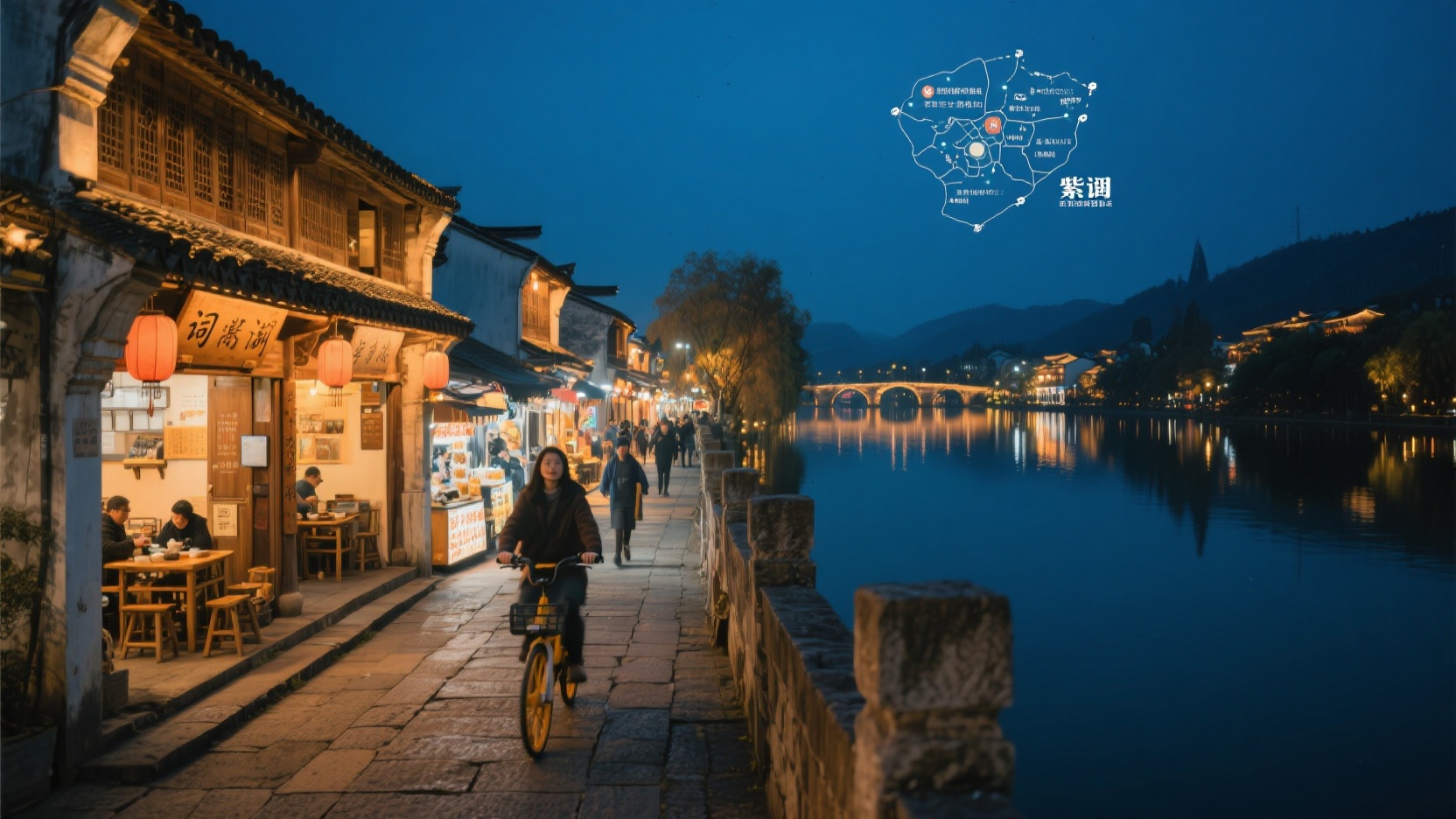
On my first night, I went the wrong way on this route, plunging directly into the crowds of tourists from the southern section of Ziyang Street. I queued until the seaweed pancake stall closed and still didn't get to eat any. The second night, I learned my lesson and started at the Blue Moments at Kaling Lake, then went in the opposite direction from the northern section of Ziyang Street. Only then did I discover a few stalls frequented only by local elderly people. Below is my revised itinerary for a seaside night tour from 6:00 PM to 11:30 PM, suitable for those who don't want to get up early and prefer the lights and the lively atmosphere of the alleyways.
18:00—19:10 | Linghu Lake: Don't wait until it's completely dark; the blue hour is the best backdrop for the lights.
Linghu Lake in Linhai is free to enter, but most guides suggest circling the lake during the day, which is completely wrong. Arrive at the East Gate around 6 PM; the sky is still deep blue, the lakeside lights are just coming on, and the reflections are much cleaner than at night. Don't try to do too much; you don't need to ride the entire loop. Just walk from the East Gate along the left bank to the boardwalk on the island in the middle of the lake. Twenty minutes is enough to complete your first round of photos.
Pitfalls: There's square dancing at the East Gate Square in the evening, which is loud and takes up valuable camera positions. It's recommended to walk south along the path for about 100 meters, near the aquatic plant area, where there are fewer people and you can capture the skyline of Linghu Lake overlapping with the distant mountains. After 7:00 PM, the sky is completely dark, and the lighting atmosphere becomes weak, so you must leave by 7:10 PM at the latest.
19:10-19:30 | Shared bikes will turn onto Ziyang Street after 20 minutes, and the parking spot will be located on Chicheng Road.
From the east gate of Linghu Lake to the southern section of Ziyang Street, it's about three kilometers. Riding a shared bike is more flexible than taking a taxi. I checked twice before confirming that parking the bike at the electronic fence at the intersection of Chicheng Road and Tianning Road would only take three minutes to walk into Ziyang Street. If I had followed the navigation and parked at Xingshan Gate, I would have had to turn back against the crowds and walk an extra distance along the stone path.
This section of the bike ride generally has non-motorized vehicle lanes, but the evening rush hour is just ending, and some vehicles turning right at intersections don't yield to pedestrians. Avoid running yellow lights. Arrive at Ziyang Street around 7:30 PM, just as the night market is entering its busiest period; the southern section is already packed with people. If you're going on a weekend, it's recommended to reduce this ride to fifteen minutes and arrive at the northern section earlier to secure a good spot.
19:30-20:40 | Ziyang Street Night Market: Don't force your way from south to north; go against the flow to get the local favorites that people queue up for.
Ziyang Street Night Market differs from most ancient streets. The southern section is the tourist hotspot, while the northern section is where locals buy groceries and grab a bite to eat in the evening. I personally tried going in reverse, entering from the northern entrance. First, buy a freshly baked seaweed pancake, then look for freshly fried egg white lamb tail. Don't order too many seaweed pancakes; one per person is just right, as they lose their flavor when cold. For the egg white lamb tail, choose the stall with less sugar powder sprinkled around the edge of the fryer, otherwise it'll be so sweet you'll need to drink a whole bottle of water.
For a truly satisfying meal, try the shrimp or rice porridge. Choose a stall with low tables outside where local elderly people chat in the local dialect; you're unlikely to be disappointed. A few dozen yuan per person will get you a very satisfying meal. A special note: in the southern section, half the queues at the so-called "old-established" shops are filled with tourists. In the northern section, shops serving similar dishes don't have long queues, and the taste is largely the same.
Control your pace while you're out and about. Make sure to leave before 8:40 PM, because the teahouse you're going to next is deep in the alley. If you go too late, you might only be able to sit by the door and feel the wind.
20:40-22:00 | Explore the old teahouses of Linhai Cidiao tucked away in a side alley; there are more locals than tourists.
Turning into a moss-covered side alley from the middle of Ziyang Street, a two-minute walk reveals an old wooden door with a bamboo sign that reads "Training of Ci Opera." This teahouse has no signboard or lightbox; by day it serves as a training center, and in the evening, tables are set up where local grandfathers come with their teacups to listen to Linhai Ci opera. Unlike the opera performances in tourist areas, there are no LED subtitles here; the actors' voices resonate with the powerful energy of those from the old city walls.
Once inside, don't sit in the front row, right in the middle; that's reserved for seasoned enthusiasts. Order a pot of green tea or ginger rice tea (around a few dozen yuan per person) and sit in the back row against the wall. This way, you can hear the singing clearly and it's easy to get up during the performance. Silent your phone and don't use the flash. When they sing classic excerpts like "Diao Chan Worships the Moon," the locals will clap along; just nod along.
If you don't appreciate the melody, you can replace this stop with a small tavern by the Lingjiang River. But in the old town of Linhai, I always feel that teahouses are more fitting for the atmosphere than taverns, especially on autumn and winter nights. Hot tea and the sound of stringed instruments are much more enjoyable than ice-cold beer.
22:00—23:30 | Take a walk to digest your food and stroll along the Lingjiang River wall. Take photos from five different vantage points in one go.
After leaving the teahouse, don't call a taxi directly. Walk towards Xingshanmen; it's a ten-minute walk to the barbican. After 10 PM, most tourists have left this area. The city wall lights illuminate the blue bricks, and only a few scattered fishing lights remain on the opposite bank of the Lingjiang River. It's the quietest spot for night photography in Linhai. All five of my recommended shooting locations are along this route, so you don't need to take a detour.
The first camera position was on the left bank of the pier at the east gate of Linghu Lake, capturing the reflection on the lake surface; the second camera position was on a two-meter-wide alley in the northern section of Ziyang Street, waiting for the vendors to pack up before taking pictures of the empty alley and lanterns; the third camera position was inside the gate of Xingshanmen, using a wide-angle lens to capture the silhouette of the gate; the fourth camera position was on the steps of the flood control embankment along the Lingjiang River, lowering the phone close to the ground to capture the reflection of the city wall and the river; the fifth camera position was outside the bamboo curtain at the entrance of the old teahouse, using a telephoto lens to capture the warm light shining through from across the street.
Finishing before 11:30 PM is ideal; otherwise, the riverside will be damp, and the stone path will become soggy. If you don't have time to explore the Taizhou City Wall during the day, this free-access area at night is perfect for taking photos.
Blogger's Summary and Practical Tips
This night tour route avoids popular tourist spots and daytime crowds, creating a closed loop that connects the lights, snacks, traditional arts, and nighttime city wall views of Linhai Old Town. Based on my own experience, the entire route is on foot and using shared bikes, without needing to enter paid scenic areas. It's suitable for solo travelers, groups of friends, or leisurely strolls with parents.
Five camera spots for night photography (remember them again): Linghu Pier, the alleyway at the northern end of Ziyang Street, Xingshanmen Wengcheng, the flood control embankment along the Lingjiang River, and outside the bamboo curtain of the old teahouse. Four safety tips: Don't wear noise-canceling headphones while cycling; keep two meters away from the shore when shooting reflections on the river; don't put your phone in your outer pocket; use GPS landmarks to wait for transportation on your return trip late at night.
Autumn and winter are the more recommended seasons, as the days get light quickly but the nights are not stuffy, and the blue tones are always stable; in summer, be careful of mosquitoes and showers.