
Don't go to Hongyadong to count heads | A local's firsthand experience: a 4-day, free, anti-trendy route – don't be fooled by travel guides!
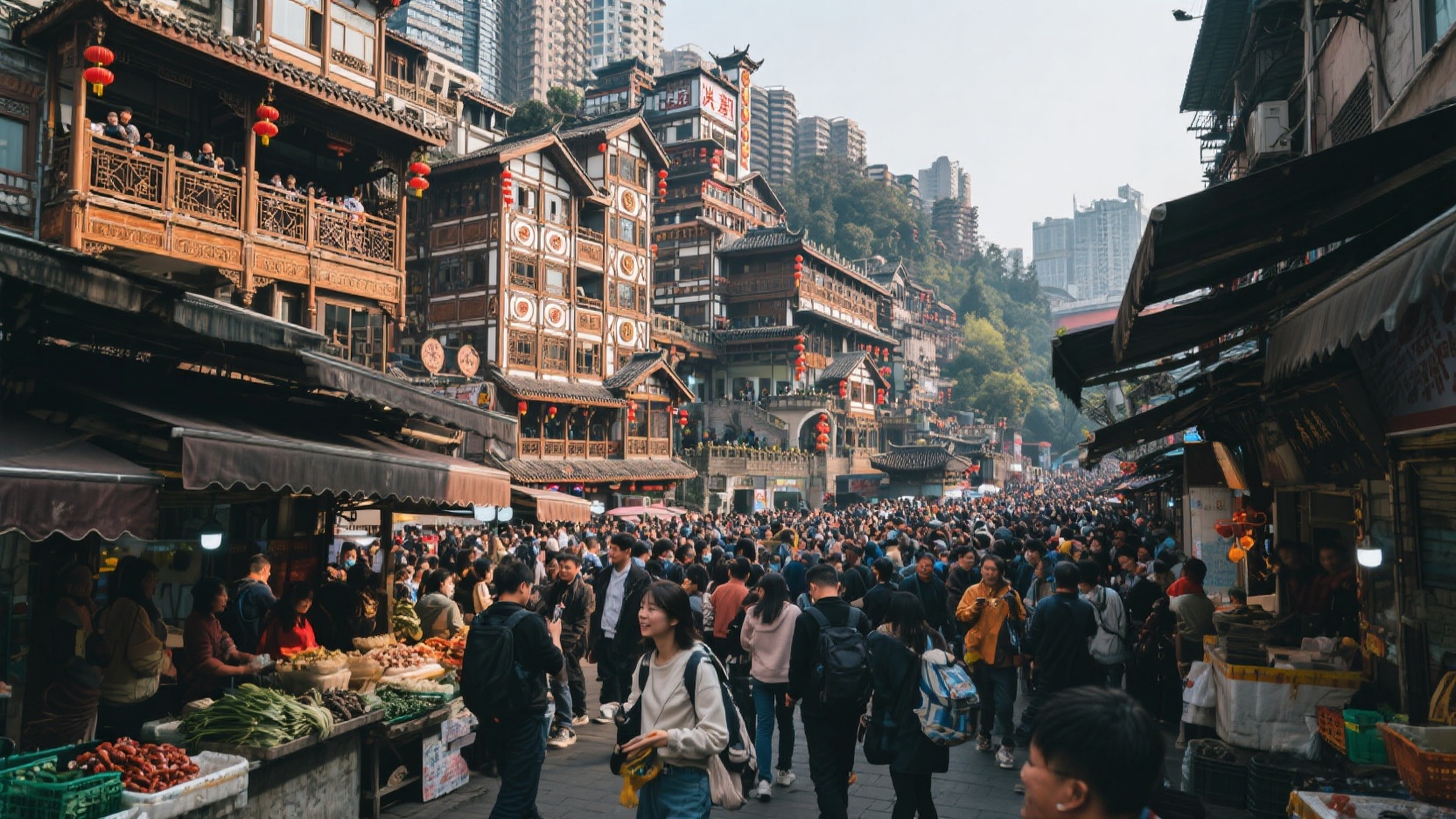
Having lived in Chongqing for so many years, the advice I most want to give you is: don't waste three days on Hongyadong, Ciqikou, and the Yangtze River Cableway—those are real rip-offs. It's not that they're bad, but queuing for two hours and taking photos for three minutes simply doesn't give you a taste of Chongqing's character.
This time, I'm giving you an anti-tourism route: four days without visiting any major paid attractions, exploring everything from farmers' markets and university areas to old industrial zones and old town alleyways, with a different theme each day. The entire trip relies solely on rail transit, buses, and walking, with zero entrance fees and mostly affordable local food. It's perfect for solo travelers.
Day 1: Community Market Day, from Xuetianwan to Shihuishi
Chongqing's true morning charm isn't found at Jiefangbei, but at Xuetianwan Market. Emerging from the subway station, follow the people carrying bamboo baskets; the entire area is lined with aunties carrying vegetables and freshly steamed pork buns. There are no tourists here; the vendors will ask you in Chongqing dialect, "What would you like to eat, girl?"—more authentic than any travel guide.
After strolling around Xuetianwan, take a few bus stops to Shihuishi. Nearby is the Luzumiao Old Street area, where many stalls selling handmade glutinous rice balls, glutinous rice cakes, and roasted meats are hidden around the market; you can eat your fill for just a few dozen yuan. The point isn't what you buy, but how Chongqing locals haggle over lunch and how they neatly arrange a bunch of water spinach.
In the afternoon, head towards Mianhua Street to find an old teahouse or a bench under the shade of a tree, order a cup of tea, and sit for the afternoon. You'll discover that Chongqing's everyday life isn't a replica of tourist attractions; it's the vibrant, living reality of the market.
Day 2: University Surroundings Day - Another Way to Explore the Old Campus in Shapingba and Huangjueping
Skip the crowds at Ciqikou and take a stroll around the old campus of Chongqing University in Shapingba District. The old teaching buildings, air-raid shelters, faculty dormitories, and densely packed steps have a more historical feel than many paid ancient towns. The surrounding noodle shops and tofu rice stalls offer student-priced meals, so you can't go wrong with any of them.
In the afternoon, I took a bus across the river to Huangjueping. The neighborhood where the old campus of the Sichuan Fine Arts Institute is located has a natural, untamed feel. Although the graffiti street is famous now, turning into the alleys next to it, you can still see old factories, secondhand bookstores, and shoe repair stalls. There's no entrance fee here, yet you can experience the original texture of Chongqing's art district.
Just stroll around the entrance of Jiaotong Tea House in the evening; there's no need to go inside and take photos. What's really interesting are the noodle shops and ice jelly stalls near the steps frequented by students; their taste is just as good as those big restaurants in the bustling city.
Day 3: Old Industrial Zone Renovation Day - Afternoon visit to the Chongqing Iron and Steel Plant Ruins and Eling No. 2 Factory (no entrance fee).
Chongqing's industrial heritage is free to enter. The Chongqing Iron and Steel Industrial Heritage Park in Dadukou District preserves many old factory buildings, chimneys, and railway tracks. It's less crowded, spacious, and perfect for a leisurely stroll. Standing next to the old steel furnaces, you'll understand why this city is called "Steel City," rather than just a product of a commercial street.
In the afternoon, we went to Eling No. 2 Factory. Although it has been labeled a "cultural and creative park," the old factory buildings and rooftop views are still worth seeing. Don't go into the paid exhibition halls; just walk along the nearby slopes and platforms to capture the city skyline at the confluence of the two rivers. The key to saving money is to only visit the exterior and not buy a combined ticket.
Walking downhill towards Liziba in the evening will take you past many old residential buildings and air-raid shelter entrances. This section of the road feels more residential than waiting for the light rail to pass through the buildings at the Liziba viewing platform, and it's completely free.
Day 4: Old town alleys day, lower city, mountain city trails and Ma'anshan.
The last day is reserved for the old city. The upper part of the city is commerce and traffic, while the lower part is the true essence of Chongqing. Walking down the streets and alleys near Baixiangju, don't just focus on that building; the old-fashioned barbershops, tailor shops, and narrow, long staircases next to it will make you feel like you've stepped into the last century.
The third hiking trail in the mountain city must be explored on foot; don't book a "day trip." The trail connects many old city walls, old houses, and riverside views. Taking breaks along the way provides a much clearer view of the city's three-dimensional structure than simply passing by in a car. The banyan tree roots embedded in the cracks of the rocks along the way are more breathtaking than any popular photo spot.
In the afternoon, cross the river to Ma'anshan on the south bank and find an unnamed path to climb up. Old streets, old houses, and the Yuzhong Peninsula on the opposite bank of the Yangtze River slowly unfold behind you. When the lights come on at dusk, you'll find that Chongqing, which doesn't cost much, is the most captivating.
Free admission throughout the entire route, what's the easiest way to get there?
A four-day itinerary can be arranged in the order of "Yuzhong—Shapingba—Jiulongpo—Dadukou—Nan'an". It's recommended to choose accommodation near the interchange station of Metro Lines 1 and 2, rather than staying near Jiefangbei. Check real-time bus schedules before leaving home in the morning; this will make it easier to observe the commuting patterns of locals compared to taking a taxi.
Many "attractions" in Chongqing are more beautiful from the outside than inside, such as the outer street of Eling No. 2 Factory, the perimeter of Chongqing Iron and Steel Group, and the alleys of Huangjueping. Adhere to one principle: only visit the public areas that are free of charge, and do not buy any additional items, including combined tickets, sightseeing buses, or fast lanes. Over several days, the total cost of transportation and meals will be lower than a single package ticket.
In closing: Don't ask the locals if I didn't tell you.
1. If you're traveling alone, don't carry a large backpack. Chongqing has many steps and frequent ups and downs, so traveling light with a pair of non-slip sports shoes is more important than any travel guide. Try to bring a small backpack so your hands are free to hold onto handrails and take photos.
2. Ignore signs for "Fast Track to Popular Spots" or "Best Camera Spots"—the best views are often found around the corner, often for free. Following local aunties is less likely to lead you astray than using GPS.
3. It's best to visit farmers' markets and areas around universities before 10 AM or after 4 PM to avoid peak shopping and school dismissal times. This way, you'll see the most authentic side of the place without the crowds. The midday break is a good time to visit old industrial areas, where there are fewer people and it's easier to take photos.
4. Both buses and subways support QR code payment, but some older routes use segmented fares, so it's best to ask the driver when you board. When traveling alone, avoid rushing; crossing rivers and transferring in Chongqing takes longer than the map suggests.
5. Don't try to hike the mountain trails in summer. Spring, autumn, and early winter are the most comfortable seasons for this free-entry experience. Avoid the rainy season when the ground is slippery. Early morning and evening offer better lighting and you might even catch a quiet stroll with locals.
6. Don't be scared off by headlines like "Locals don't go there." On the contrary, the locals' real living radius includes places like farmers' markets, university back gates, and old industrial areas. It's safer and less stressful to explore these places alone than to wander around the entrance of tourist attractions.