
Avoid paid tourist attractions | A local's firsthand guide: a four-day in-depth itinerary in Harbin without spending any entrance fees – don't be fooled by travel guides!
The last time I was a "tourist" in Harbin was when a friend dragged me to the Ice and Snow World and waited in line for three hours. After we came out, he said something very true: "Besides being cold and expensive, this place is all about short video filters." At that moment, I realized that the truly interesting everyday life in Harbin doesn't require a ticket at all.
This four-day itinerary avoids all major paid attractions, relying solely on walking, subway, buses, and a ferry to explore the old town. It's not for those wanting to capture every landmark, but rather for those wanting to spend very little and avoid touristy routes. Each day has a different theme, allowing you to eat like a student and explore like someone who grew up in the alleyways.
Day 1 | Community Market Day: Hongzhuan Street Morning Market is not a tourist attraction, but a local's alarm clock.
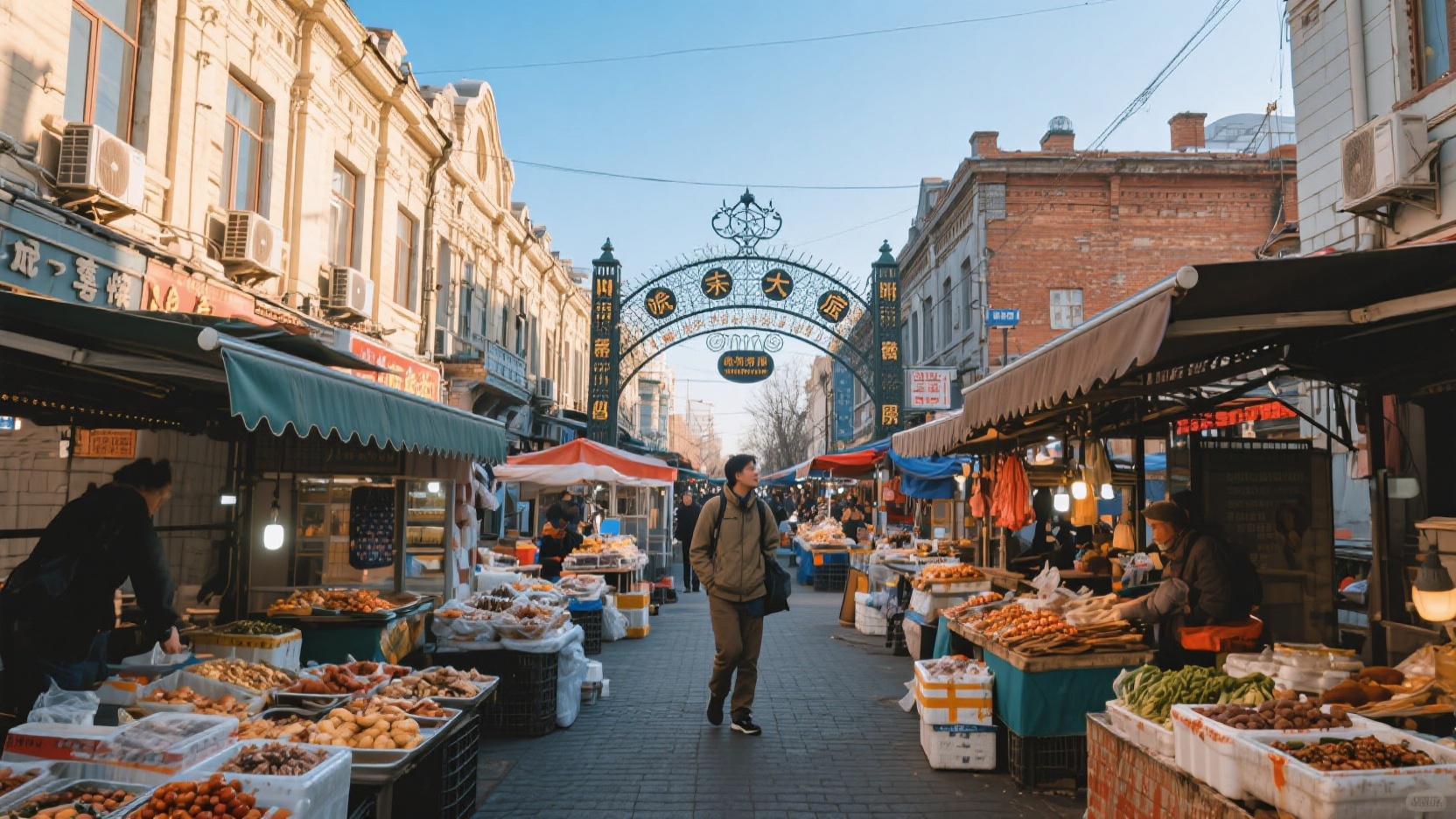
I went to the Hongzhuan Street morning market at six in the morning. Just as dawn broke, the oil in the fryers was already sizzling. Frozen pears, sticky rice cakes, tofu pudding, and large fried dough sticks—these old-fashioned flavors don't require an entrance fee, but they offer a closer look at Harbin than many tourist attractions. Tour groups started arriving after eight, so leaving before seven is the best option, allowing you to see the vendors' expressions as they opened their first batch of fried dough sticks.
Walking from the morning market through Jingwei Street to Daoli Farmers Market, the indoor market is filled with elderly men and women carrying cloth bags. You can choose not to buy anything, just watch the queues at the cooked food counters and listen to the vendors bantering in Northeastern dialect—the atmosphere is more authentic than any folk museum. If you want to save money but still have a good meal, the small community stalls in the corners of the market offer very decent food for just a few dozen yuan per person.
Day 2 | University Surroundings Day: From Harbin Institute of Technology to Heilongjiang University, Eating at Student Prices Along One Subway Line
The areas around universities in Harbin are a seriously underrated hub for affordable food. Take the subway to Harbin Institute of Technology station in the morning, walk towards Fuhua Street and Wajie Street, and you'll find noodle shops, dumpling restaurants, and fast food stalls lining the streets. You can get a very satisfying meal for just a few dozen yuan per person. Many of these shops have been around for a long time, with waves of students coming and going, but the taste hasn't changed much.
In the afternoon, I walked along Xuefu Road to the area around Heilongjiang University and Harbin University of Science and Technology. Xuefu Fourth Street is most vibrant in the evening. Students leave get out of class, street vendors light up, and grilled cold noodles, rice rolls, and fried skewers are all reasonably priced. You don't even need to go into the campus; just walking around the area, you can feel the youthful and unpretentious side of this city. There are no uniform signs like in tourist attractions, only small shops that rely on repeat customers to survive.
Day 3 | Old Industrial Zone Renovation Day: Visiting the Three Power Roads to See the Backbone of Harbin
Many people's impression of Harbin is limited to its Russian-style domes, but the old industrial area of Xiangfang District is even more hardcore. Take a bus to the Sandongli Road area, and you'll still see the red brick walls and chimneys of the old boiler and motor factories. That sense of order is something that newly built creative parks can't replicate. The streets are wide, the trees are old, and there are few people, giving you the illusion of time stretching out as you walk along them.
The nearby Xicheng Red Square, converted from old factory buildings, is free to enter and often features small exhibitions and bookstores. Spending an afternoon there without spending any money is perfectly fine. Don't treat it like a shopping mall; go to the central, high-ceilinged space and look up at the old steel beams—that's the skeleton left behind by Harbin's industrial era. To truly understand this city, seeing churches alone isn't enough.
Day 4 | Old Town Alleys Day: Behind Jingyu Street in the Old Daowai District lies the original, unrestored scene.
Old Daowai isn't just about the Chinese Baroque district. The truly authentic, textured areas are the alleyways extending inwards from Jingyu Street: the area around North Third Street, Shengping Street, and Nanxun Street, with its old courtyards, wooden staircases, and rusty iron doors—many corners haven't yet been filtered or enhanced. There are no ticket gates or guide signs here, but every loose paving stone seems to tell a story.
When walking through these alleys, don't wander into private courtyards; a quick glance from the public passageways is enough. The doorways in front of the old buildings, the verandas on the second floors, even the water stains on the walls, are more honest than any paid "old neighborhood experience." It's not bustling here; instead, you should slow down. If you only visit the renovated Baroque facades, you're only seeing the shell.
Transportation Bonus | Take a ferry across the river for just a few dollars and enjoy the Songhua River without even leaving the island.
Take the ferry from the pier near Jiuzhan Park to Sun Island Pier; the one-way fare is very cheap. The key is to avoid entering the Sun Island paid area. After disembarking, walk a short distance along the riverside promenade before heading back. The river breeze, the iron bridge, and the skyline on the opposite bank make this a more relaxing experience than taking a sightseeing boat, and you won't have to share a deck with tour groups.
If you don't want to take a boat, you can walk across the Songhua River Railway Bridge, which is open to the public free of charge. In the evening, watch locals stroll, play cards, and play the harmonica in Stalin Park. This kind of free and relaxing experience is the right way to enjoy the riverside in Harbin.
Avoid Dining Mistakes | Don't Waste Money on "Russian Food" on Central Street
Locals rarely eat proper meals on the main street of Central Avenue; it's more of a tourist trap. A short walk down Hongxia Street, Xiaman Street, and Tongjiang Street reveals a cluster of time-honored snack shops and neighborhood eateries, where you can enjoy decent sweet and sour pork and home-style cold dishes for just a few dozen yuan per person. The older the storefront, the more likely it is to hide a long-established, delicious culinary experience.
Russian food is worth trying, but there's absolutely no need to pay extra for "sitting in an old building." Find a small shop with an old storefront and a simple menu; it's much closer to the daily life of locals than the trendy restaurants crammed onto the main street. Remember one criterion: the cars parked outside are mostly locals, not tour buses.
In closing | Six hassle-free tips you shouldn't ask locals about.
1. The most convenient transportation combination for solo travelers is subway plus bus. Stay along subway line 1 or 2. Avoid taking taxis near scenic area entrances, as they are prone to detours and traffic jams. Harbin West Railway Station and Harbin Railway Station are both good options, but avoid staying directly above the main street of Central Avenue.
2. Neither the morning nor the night market requires an entrance fee, but be sure to avoid the peak tourist hours from 8 to 10 a.m. Locals get up early to buy groceries and go home, so the fewer tourists, the better for shopping. Try to arrive at the Hongzhuan Street morning market before 7 a.m., and avoid the Xuefu Fourth Street night market on weekends around 8 or 9 p.m.
Third, many old buildings in Harbin are residential buildings. It's fine to look at the exterior, but don't point your camera directly at the windows. This is the kind of "check-in" that locals dislike the most, especially in the old alleys of Daowai. It's better to remember it with your eyes than to disturb the residents for the sake of taking pictures.
Fourth, in winter, don't just wear a thick coat; non-slip shoes and gloves are more important than clothes. In spring and autumn, when it's windy, a hat is more important than makeup. When traveling alone, the biggest fears are falling and getting cold. For many tourists, icy steps outside attractions are more dangerous than the attractions themselves.
5. Not spending money doesn't mean you won't have an experience. Bringing a pack of tissues, a thermos, and a pair of comfortable shoes can save you half the trouble of making unexpected purchases in tourist areas. Public restrooms are scarce, so take care of them in shopping malls or markets beforehand.
6. Create a bookmark for your phone's map app in advance, as signal is weak in some areas of the old town, and offline maps can be a lifesaver. Only go into small shops where locals are queuing; online recommendations can be used to avoid bad experiences, but don't use them to make decisions.