
Xining's Niche Arts and Culture Map: 7 Spiritual Corners from Old Warehouses and Bookstores to Community Cafes
Xining's cultural and artistic resources are often overshadowed by its label as a "transfer station around Qinghai Lake." However, if you shift your focus away from Ta'er Monastery and Dongguan Mosque, you'll discover a hidden cultural corridor in the city's alleyways, connecting old warehouses, independent bookstores, and community cafes. The following seven locations are arranged logically as "industrial heritage—reading spaces—old objects and galleries—everyday cafes," making them ideal for a full day of walking.
North City Seventh District Cultural and Creative Park
The atmosphere is a blend of rugged industrial style and design studios. The park was converted from an old factory, preserving the steel frames, concrete beams, and old pipes. It primarily houses local designers, woodworking workshops, and small exhibition spaces. The highlights are the constantly changing open-plan exhibitions and wall graffiti, especially the temporary installations by local young artists from Xining. For photography, it's recommended to stand on the second-floor corridor and capture the structural lines of the lower level when the afternoon sunlight streams through the high windows, or use the rusted steel plates as a foreground to create industrial-style photos with a sense of depth.
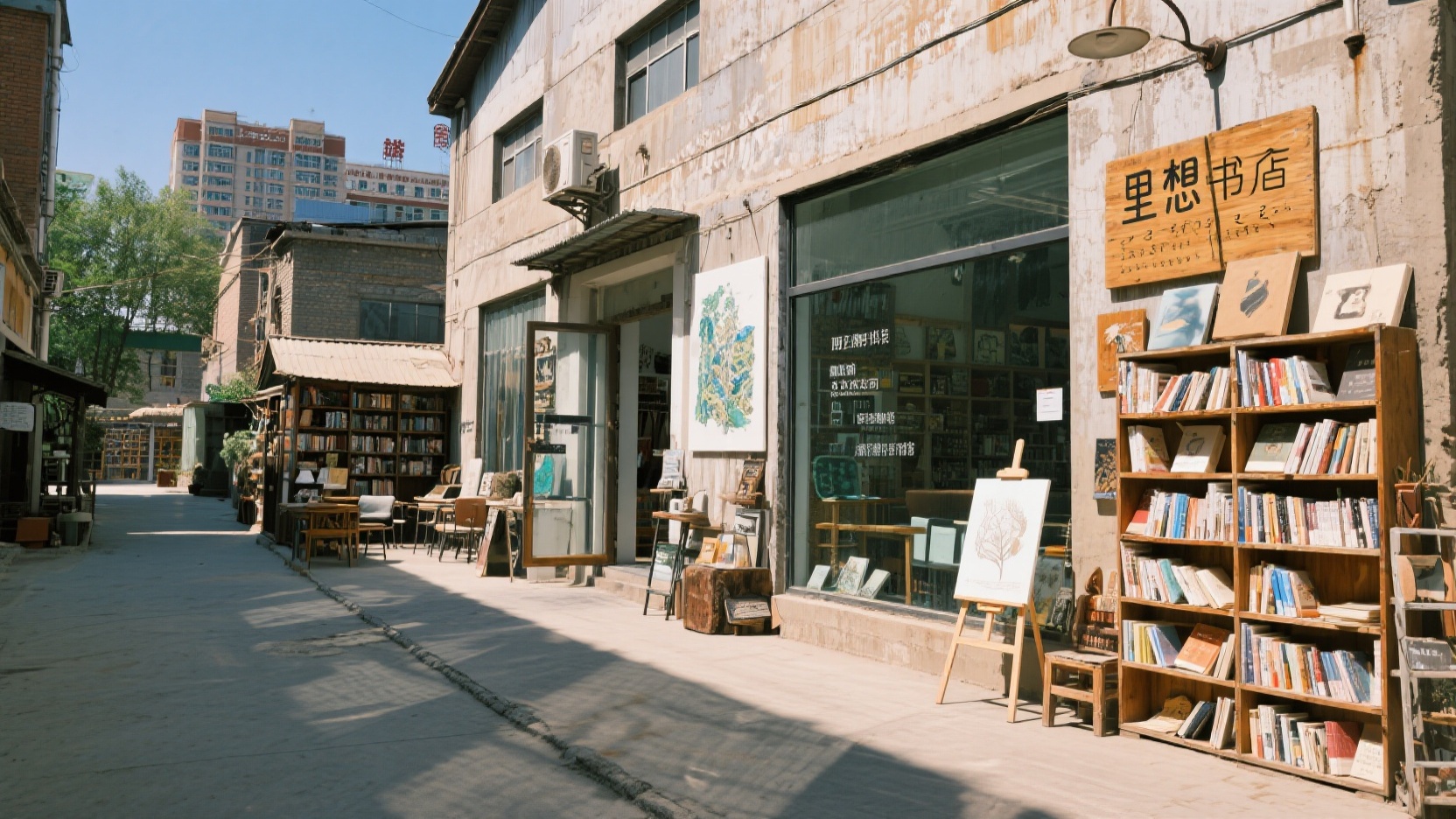
Lixiang Bookstore
Unlike large chain bookstores, Lixiang Bookstore's selection leans more towards Tibetan and Qinghai-Tibetan cultural literature, independent publications, and art books. The space is dominated by long wooden tables and low bookshelves, with plateau plant specimens and hand-drawn Thangka sketches displayed in the corners. The local history section and the Tibetan photo albums are particularly noteworthy, featuring many images of the Hehuang Valley and Qilian Mountains that are not easily found elsewhere. For photography, it's recommended to use natural light in the window reading area to capture still life shots of the book pages and pour-over cups, or to take low-angle shots of the bookshelves' depth. Please remain quiet and do not disturb readers.
Hehuang Old Warehouse
This place collects everyday objects from ordinary families in the Hehuang River basin, ranging from old doors and windows, saddles, and pottery jars to photographs of Xining street scenes from the 1970s and 80s, arranged by daily life scenes rather than by era. The atmosphere is one of warm nostalgia; all objects can be viewed up close, and some can even be touched. Highlights include an old-fashioned sewing machine, a copper butter tea pot, and a set of black-and-white photographs documenting the street scene of Dashizi, quickly establishing an understanding of the fabric of Xining's old city. For photography, it's recommended to use close-ups under warm light, using a wide aperture to blur the cluttered background; capturing the texture of old objects is more effective than photographing wide scenes, and avoid using flash.
Baiyang Art Space
This is an independent gallery focusing on young artists from Northwest China. It's small in size and its exhibitions are restrained. It regularly hosts small solo exhibitions and showcases the results of residencies, primarily in contemporary oil painting, installation, and video. It also exhibits artists' manuscripts and experiments with local materials. The key attraction lies in the connection between the works and the natural environment of the plateau and urban changes. Exhibitions are updated frequently. Photography is advised; check beforehand whether photography is permitted in the gallery. If permitted, use even natural light to photograph details of installations or parts of paintings; this will preserve the essence of the work better than a direct photograph.
Dongguan Old Warehouse Cultural and Creative Institute
Hidden among old residential buildings is a cluster of old warehouses, now subdivided into workshops for handmade leather goods, Tibetan carpet weaving, and Qing embroidery. Its atmosphere is more rustic than that of the North City Seventh District, with wooden beams and brick walls bearing the marks of repairs from different eras. Highlights include the artisans stretching leather on-site, the weaving process of carpets, and the unfinished products hanging on the walls, offering a direct view of the Hehuang handicraft process. For photography, it's recommended to capture hand gestures and tool details in the morning when the light from high windows is at an angle. Ask beforehand if people are in the frame to avoid directly photographing their faces.
West Alley Coffee
The most charming thing about neighborhood cafes is their everyday feel. Xixiang Cafe is located in a ground-floor shop in a residential building. The bar's hand-drip beans are frequently changed, mainly light roasts from Yunnan and Ethiopia. The walls are adorned with sketches of Xining street scenes drawn by local illustrators. Beyond coffee, it's more like a miniature local cultural hub, displaying independently published Xining city magazines and albums by local musicians. The highlights are the seasonal specials and the occasional small poetry readings. For photography, it's recommended to sit at the bar and capture the flow of the hand-drip coffee, or sit by the window and photograph the cups and saucers against the street scene backdrop—just be careful not to photograph other customers' faces.
Plateau Creation Society
This small, multi-functional space focuses on the redesign of Qinghai's intangible cultural heritage. Black pottery, Tibetan carpets, handmade paper, and Qing embroidery materials are rearranged into understandable and tangible samples. The atmosphere is somewhere between an exhibition and a workshop, with artisans often demonstrating their skills on-site. Highlights include the contrasting clay of black pottery from different regions, color swatches of plant-dyed Tibetan carpets, and the fiber texture of handmade paper, making it suitable for visitors interested in materials and craftsmanship. For photography, macro shots of the cross-sections of objects and the textures of fabrics are recommended. In low light, use a table lamp for side lighting to emphasize the graininess.
Wolu Academy
This is a community bookstore focused on literature and poetry, with dedicated sections for poetry collections by local Xining poets and folk literature from Qinghai. The space is small, with limited seating, making it feel more like a private study. A highlight is a guestbook for readers to handwrite poems; it contains many short poems in different handwritings, along with handwritten recommendations from the owner. For photography, it's recommended to capture the bookstore's exterior and a corner of the bookshelves in the warm light of dusk filtering through the windowpanes. Vertical compositions are suitable for showcasing the layered spines of the books, and quiet is essential.
These seven locations don't require a rush; the distance between them makes for a leisurely stroll within walking distance. From old factories to community cafes, from independent bookstores to craft workshops, Xining's artistic temperament isn't found in grand landmarks, but rather slowly grows in the everyday spaces. Measure the spiritual corners of this city with your footsteps.