
Half a Day with the Li People | From the March 3rd Song Festival to Li Pottery and Indigo: Four Things About Festival Customs in Sanya
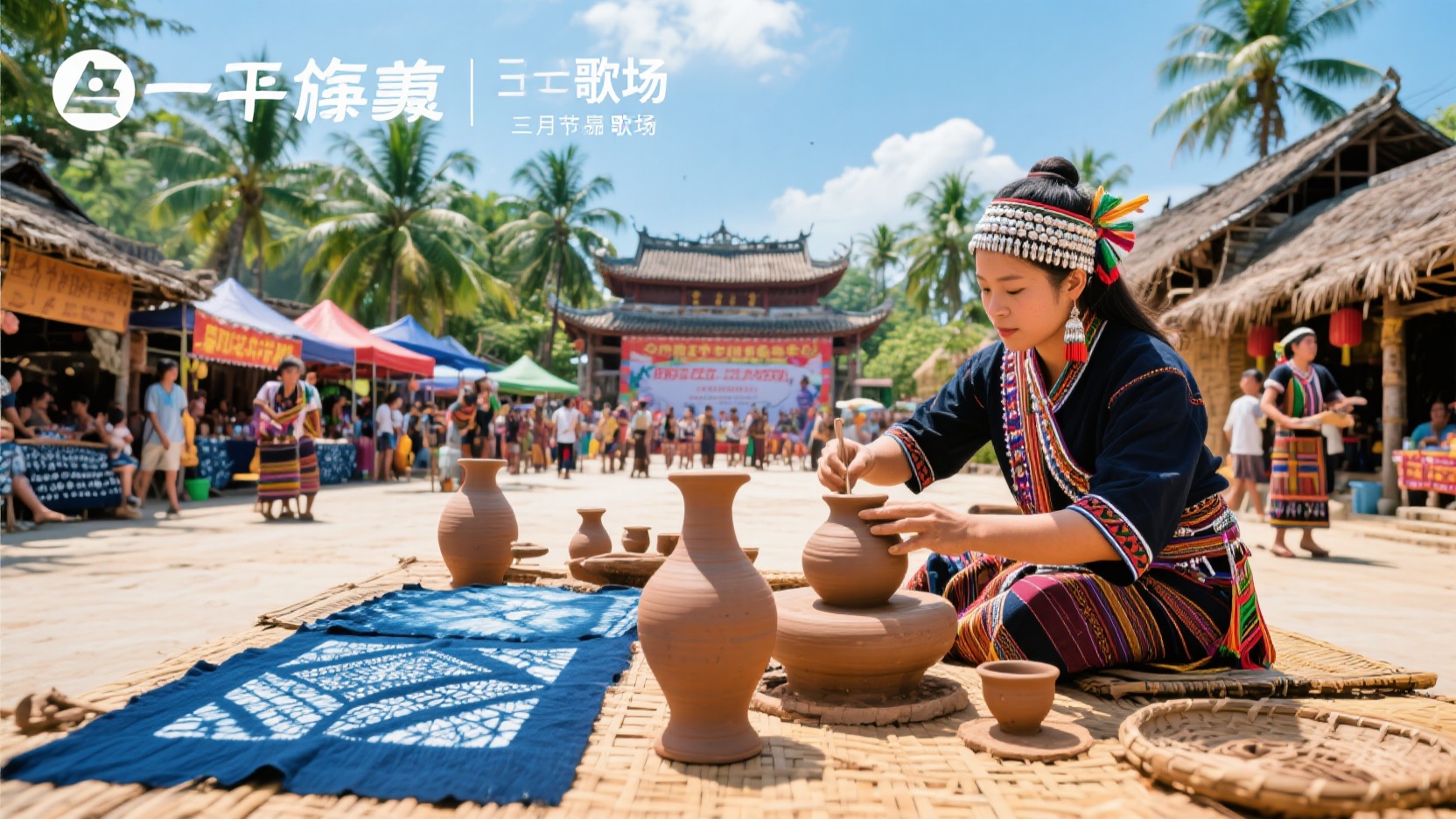
The cultural and artistic experiences in Sanya aren't found at the main scenic area gates, but rather at the song fair on the third day of the third lunar month, the temple fair in Yazhou Ancient City, the pottery workshops in Li ethnic villages, and the Miao indigo dyeing workshops. The following four scenarios unfold according to the sequence of "time—experience—cultural story," and are perfect for setting aside half a day to sit back and experience life as a local.
I. March 3rd Song Festival: Listen to a Li and Miao antiphonal singing performance without a stage.
Around the third day of the third lunar month each year, spontaneous or organized song festivals take place in Tianya District, Yazhou District, Yucai Ecological Zone, and other areas of Sanya. The experience begins in the afternoon, starting with watching the Li ethnic group's wood-chopping dance. Dancers weave between two long bamboo poles on the ground, the rhythm gradually increasing, often drawing the audience into the performance. This is followed by impromptu duets by Li and Miao singers, with varied themes including welcoming guests, narratives, and love. After nightfall, a long table banquet unfolds along the village road, featuring bamboo rice, mountain orchid wine, and sour fish, among other dishes. Don't worry about eating everything; the focus is on listening to the toasting songs and the elders' stories of ancestral migrations.
In Li ethnic legends, the third day of the third lunar month is associated with commemorating the ancestor Paolongkou, and there is also a version of a love story associated with it. The song festival has no fixed stage; village entrances, riverbanks, and threshing grounds can all serve as singing venues. Singing requires improvisation; those who cannot rhyme or stay in tune will be playfully teased, which is proof that oral traditions are still alive.
II. Yazhou Ancient City Temple Fair: Connecting a Cultural Heritage Between the Confucian Temple and the Old Street
The Yazhou Ancient City Temple Fair is held from the Lantern Festival to the second day of the second lunar month, taking place around the ancient city of Yazhou and the Yazhou Confucian Temple. During the day, visitors can first witness the Confucian ceremony at the Confucian Temple; the ceremony is simple but provides a direct glimpse into Yazhou's historical position as a major cultural and educational center in southern Hainan. The fair is most lively in the evening, with carp lanterns and bamboo horse lanterns parading along the old streets, and Yazhou folk song performances often taking place under the arcades or city walls. Yazhou folk songs are sung in Hainan dialect, characterized by improvisational storytelling, a high-pitched vocal style, and content ranging from prayers and moral admonitions to amusing anecdotes gathered on the spot.
Yazhou folk songs are a national intangible cultural heritage item, and in the past, they were an important expression for the people of Yazhou during weddings, funerals, fieldwork, and festival sacrifices. Listening to a folk song at the temple fair is not just watching a performance, but understanding how this ancient city preserves local memories through sound. If someone hands you a carp lantern during the parade, you might as well join the procession for a while; this is a way for tourists to share the festive order with locals.
III. Li Pottery Workshop: Spend half a day exploring the veins of clay and fire.
The traditional pottery-making techniques of the Li ethnic group are still preserved in Li villages in Sanya, and an experience typically takes half a day. The first step is not throwing, but kneading and coiling the clay. The inheritor will first repeatedly tread on the clay, then demonstrate how to coil the clay strips into the body of the pot, shaping it with bamboo strips and pebbles. Pottery making does not use a wheel; the thickness and curvature of the vessel are entirely controlled by hand. After completion, the pottery blanks are piled up in the open air, covered with straw and firewood, and fired. The firing temperature is affected by the weather, and the finished product often has uneven kiln-transformation colors.
In traditional Li society, pottery making was largely a female artisan tradition, passed down from mother to daughter. The main vessel types were pots, jars, and bowls, directly serving rice cultivation, brewing, and cooking. While the pottery, fired in open-air kilns, was not suitable for long-distance transport, it was highly adapted to local life. When making a pottery jar by hand, it's best not to strive for perfect uniformity, as the palm lines and patting marks are precisely what distinguish Li pottery from industrialized ceramics.
IV. Indigo-dyed cloth: Wearing the history of migration on your body
Batik and tie-dyeing experiences in Miao villages in Sanya are mostly concentrated during festivals, markets, or intangible cultural heritage learning activities. The process begins with drawing patterns on homespun cloth using a wax knife dipped in beeswax. The patterns are often floral, bird, fish, or geometric borders. The cloth is then repeatedly immersed in an indigo dye vat for repeated dyeing and oxidation. Finally, the wax is removed and the cloth is rinsed, gradually revealing the white flowers against a blue background. The entire process takes two to four hours; patience is more important than skill.
Miao batik patterns are not merely decorations. Elders often say that their ancestors migrated across mountains and seas, and without written records of their routes, they depicted rivers as wavy lines, mountains as zigzag lines, and rice paddies as squares, leaving these patterns on clothing and headscarves generation after generation. The depth of the indigo dye and the thickness of the beeswax also record the aesthetics and living conditions of different branches of the Miao people. Therefore, sitting down to complete a piece of dyed fabric the size of a handkerchief is, in effect, reading a family memory written with plants and homespun cloth.
The common thread in all four scenarios is the need for "slowing down." By not rushing to tourist attractions or chasing after check-ins, and by dedicating half a day to the impromptu performances of the song festival, the parades at the temple fair, the clay strips of Li pottery, or the indigo dyeing vats, another layer of Sanya's charm will slowly emerge.