
Experience the traditional customs of Yuzhang | Spend half a day as a local in Nanchang temple fairs and intangible cultural heritage workshops
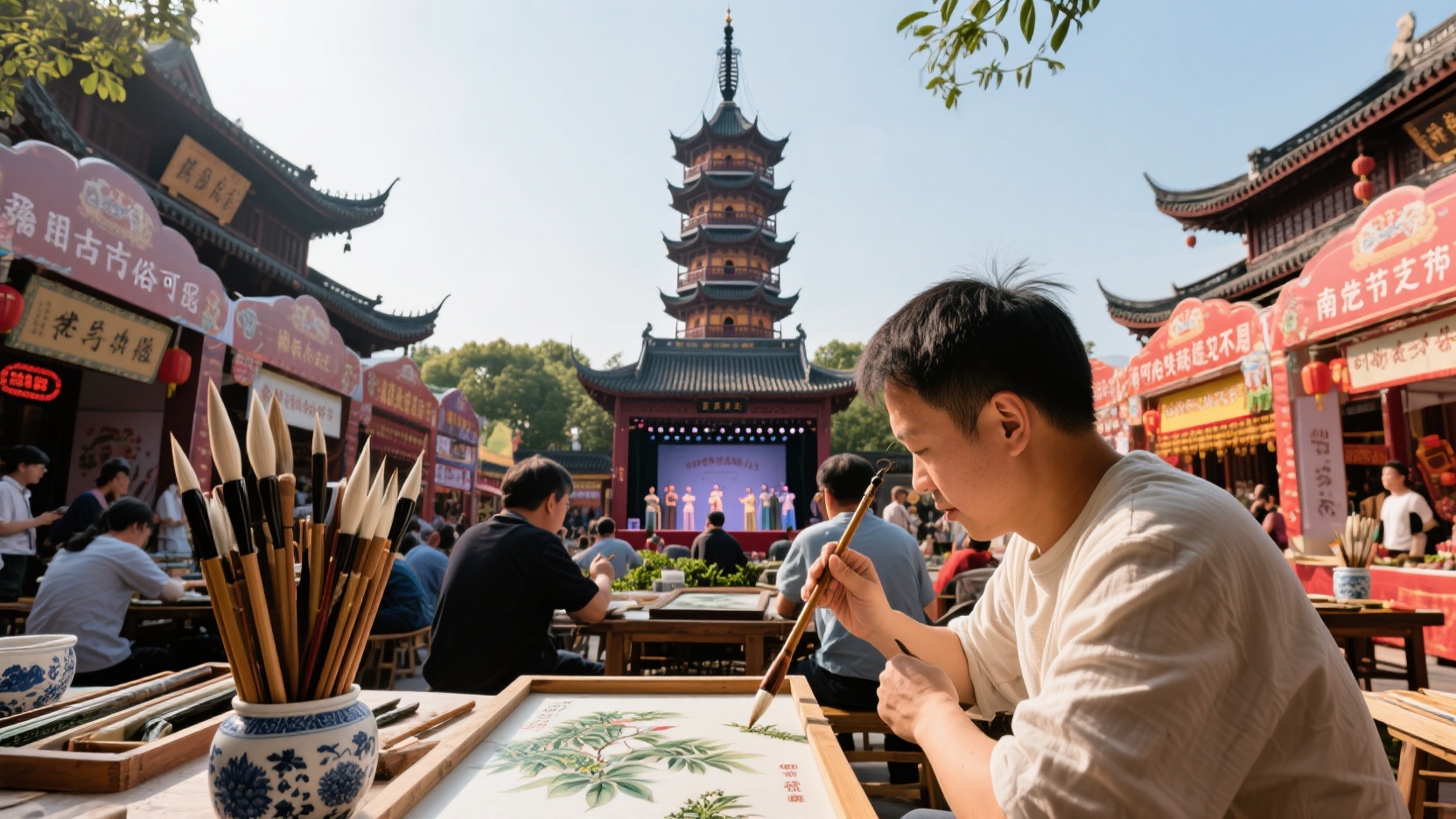
The most direct way to bring Nanchang's cultural experience from display cases to the palm of your hand is to follow the seasons. As the ancient capital of Yuzhang, Nanchang's intangible cultural heritage isn't confined to museums, but rather found in temple fairs, tea-picking opera stages, and calligraphy brush workshops. Even with just a day, you can walk from temple fairs to workshops and experience the old customs of Yuzhang as a tangible part of daily life. This article selects four aspects—the Shengjinta Temple Fair, the Xishan Wanshou Palace Temple Fair, Nanchang porcelain painting, and Wengang calligraphy brush making—to create a half-day to full-day "local itinerary."
Shengjinta Temple Fair: A Yuzhang Market Amidst Lanterns and Stages
Every year from the Spring Festival to the Lantern Festival and around National Day, a temple fair lasting several days takes place around Shengjin Pagoda. The streets and alleys below the pagoda are adorned with lanterns, and the main stage hosts performances of tea-picking opera and Nanchang folk songs. Stalls on both sides showcase Nanchang paper-cutting, sugar painting, lanterns, and clay pot stew. It is recommended to arrive in the evening, first walking around the pagoda to admire the lanterns, and then finding a bench to sit on in front of the stage.
Don't rush when visiting a temple fair. First, stop at the intangible cultural heritage stalls to watch the artisans carve lines on red paper with carving knives, then have a bowl of hot soup and stand in the crowd to listen to a segment of the traditional tea-picking opera. If you encounter a bench dragon or lantern parade, follow the procession for half a street to experience the rhythm of old Nanchang's "market day at the pagoda".
The Shengjin Pagoda was first built during the Tianyou period of the Tang Dynasty. Legend has it that four coils of golden rope and three ancient swords were unearthed during the construction of the pagoda, hence the name "Shengjin Pagoda" (meaning "Golden Rope Pagoda"). The temple fair tradition arose alongside Nanchang's commercial markets. In the past, merchants, pilgrims, and opera troupes would gather at the foot of the pagoda, and it remains the most vibrant folk custom scene in the city to this day.
Xishan Wanshou Palace Temple Fair: Understanding Jiangxi's Beliefs Amidst the "Pilgrimage" Crowds in the Eighth Lunar Month
From the first to the fifteenth day of the eighth lunar month each year, the Xishan Wanshou Palace in Xinjian District of Nanchang enters its busiest "pilgrimage season." Pilgrims walk from surrounding counties and towns, and a market is set up in the square in front of the palace, selling bamboo weaving, wood carvings, and local pastries. Gan opera is performed on the stage.
Arrive in the morning, but don't go into the main hall yet. Walk along the path of the worshippers, observing the rituals of carrying yellow cloth bags and holding small flags. Afterward, watch the bamboo weaving artisans at the market in front of the palace, weaving bamboo strips and baskets – this is more interesting than buying anything. If there's a Gan opera excerpt in the afternoon, sit and listen for half the performance, paying attention to the backing vocals in the high-pitched parts.
The Xishan Wanshou Palace is dedicated to Xu Xun, also known as "Xu Zhenjun," a figure widely worshipped in the Ganpo region. Legend has it that Xu Xun controlled floods, subdued a dragon, and brought blessings to the local people. Later generations built a shrine at the site of his ascension. The custom of paying homage to the immortals in the eighth lunar month has continued for hundreds of years. It is essentially a collective memory of flood control and harvest in an agrarian society, and it still retains a strong sense of community organization today.
Nanchang Porcelain Painting: Fusing the Old Scenes of Yuzhang into White Porcelain
Porcelain painting experiences in Nanchang are mostly offered in cultural venues or intangible cultural heritage workshops in the city, and a single experience usually takes more than two hours. The workshops often display porcelain paintings of old Nanchang street scenes, Tengwang Pavilion, and portraits, with mineral pigments, fine brushes, and plain white porcelain slabs on the painting table.
Beginners typically start with outlining or filling in colors. The smooth surface of porcelain makes it more difficult to control the brushstrokes than on paper, requiring the initial application of light ink for positioning, followed by the mixing of oil-based paints. After completing small-sized pieces, the workshop fires them in a kiln, and the pieces are retrieved the following day. The most intuitive feeling during the process is "reverse thinking": the colors will deepen after firing, so the initial strokes must be lighter than expected.
Nanchang porcelain painting evolved from portrait porcelain painting in the late Qing Dynasty and the Republic of China period. In its early years, it was often used to paint portraits of ancestors or commemorative portraits, and was considered "photography on porcelain." It integrates the porcelain painting techniques of Jingdezhen with the local portrait tradition of Nanchang, and was listed as a national intangible cultural heritage extension project around 2010. Today, its subject matter has expanded from figures to urban architecture, becoming a unique medium for recording the changes in Nanchang.
Wengang calligraphy brush making: Half a day of brush making between a bamboo tube and millions of hairs.
Wengang Town in Jinxian County is known as the "Hometown of Chinese Writing Brushes," and some old workshops still retain the layout of a front shop and a back workshop. The experience usually takes place in front of the workbench, which is decorated with a water basin, ox bone combs, yarn balls, brush handles, and various kinds of brushes. The air is filled with a faint smell of animal hair and pine smoke.
You can start with the "water basin process," learning to repeatedly comb, even out, and remove downy hairs from the degreased brush in clean water, then group them into brush heads according to the length of the tips. This process is extremely demanding on patience; beginners often sit in front of the water basin for a full hour. Next, experience "binding the brush head" and "sleeving the handle," fixing the loose hairs into a cone shape and inserting them into the brush handle after dipping them in rosin. After making a small calligraphy brush, your hand will feel noticeably sore, but you will have a personal understanding of the four qualities of "sharp, even, round, and resilient."
The history of brush making in Wengang can be traced back to the Tang Dynasty. Due to the convenient water transportation and distribution of raw materials, a brush-making cluster gradually formed in the area of Jinxian County, Nanchang Prefecture. During the Ming and Qing Dynasties, Wengang brushes were sold throughout the north and south by Jiangxi merchants, and many calligraphy and painting brushes still come from here today. Sitting in the workshop for half a day as a brush maker, you not only touch the process, but also the memory of the industrial chain of the brush as the most important stationery item in Jiangxi.
If you come during the eighth month of the lunar calendar, prioritize the Xishan Wanshou Palace Temple Fair; if you come during the Spring Festival or National Day, you can combine the Shengjinta Temple Fair with the city market; leave the remaining half day for porcelain painting or Wengang calligraphy. There's no need to rush; choose a craft to sit down with, and when you leave, you'll take away not souvenirs, but the tactile experience of local craftsmanship.