
Urumqi Night Tour Secret Route | Tested and tested from 6:00 PM to 11:30 PM: Light Show + Night Market + Old Teahouse, avoiding the crowds
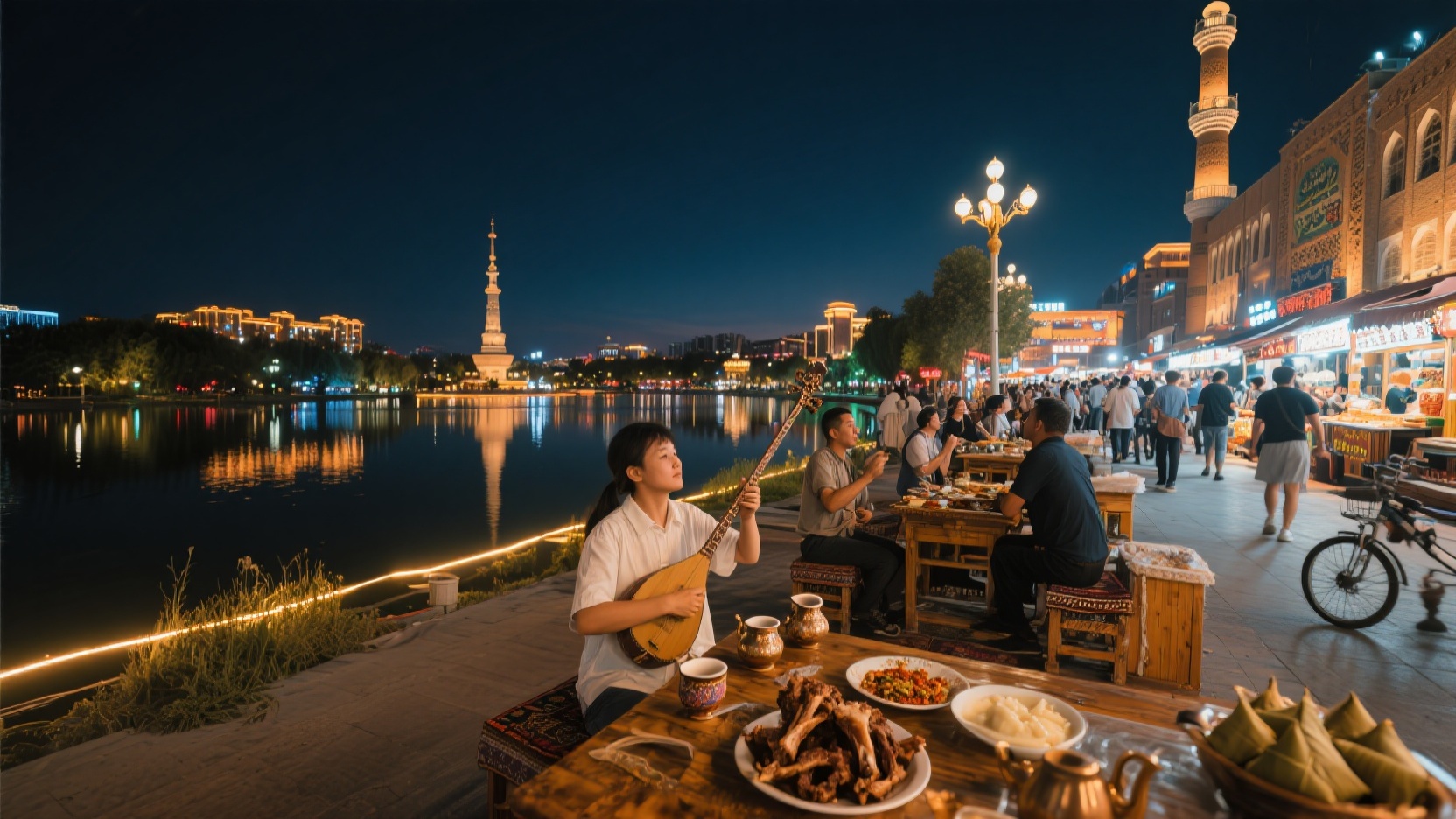
I had to revisit this route four times before I finally got the hang of it. The first time, I followed online guides and plunged into the Grand Bazaar at night, only to be swept along by the crowds the entire time. Forget taking photos, even buying a cup of kvass required queuing. The next three times, I changed my starting point to Nanhu Civic Square, and discovered that there's a local's default way of experiencing Urumqi at night: first, watch the lights on the lake, then explore the alleyways and night markets, and finally sit in an old teahouse to listen to a piece of Muqam. From 6:00 PM to 11:30 PM, I didn't rush or backtrack.
18:00-19:20 Nanhu Civic Square: Immerse city lights in the lake water for viewing.
Nanhu Civic Square is simply called "Nanhu" by the locals. At six o'clock in the evening, while it was still light, people were already walking briskly along the lakeside path. The artificial lake in the center of the square isn't large, but it perfectly reflects the lights from the glass curtain walls of the surrounding high-rise buildings onto its surface. I usually enter from the north gate of Nanhu Square, walk half a circle counterclockwise, and stop at the long stone bench on the east side of the lake. The angle here is very low; by holding my phone close to the water's surface, the lights of the buildings and the afterglow of the sunset overlap, creating a more layered effect than photos taken from the viewing platform.
Both of my previous visits involved staying in the Friendship Shopping District, and it only took ten minutes by taxi to get to Nanhu Square. The square isn't large, but it boasts the cleanest artificial lake lighting I've seen in Urumqi. The lakeshore isn't overly lit with colored lights; instead, it's dominated by warm and cool white light, which, combined with the wooden boardwalk, prevents the photos from having that tacky, touristy feel. If you time it right, around 7 PM you can capture the transition of the sky from deep blue to black, which is my most recommended time for taking photos along the entire route.
After 7:00 PM, as darkness falls, the lakeside landscape lights and building facades are fully illuminated. Don't just stare at the lake; look back towards Nanhu East Road, where the streetlights are just beginning to appear. This time is also peak for locals taking their after-dinner strolls; walking slowly with the crowd is safer than going alone.
Exit from the east gate of Nanhu Square and walk towards Nanhu East Road. Along the way, you'll pass a row of carts selling roasted sweet potatoes and hot milk tea. Don't rush to buy anything; the night market is just ahead.
19:20-21:00 Nanhu East Road Night Market: Locals line up for roasted lamb trotters and yogurt rice dumplings.
Nanhu East Road Night Market isn't your typical "tourist-only food street"; it's more like a night market that's sprung up from a narrow alleyway in a residential area. At 7:20 PM, the vendors have already stoked the charcoal fires. Every time I come, the first thing I do isn't find a seat, but rather head over to the middle stalls selling roasted lamb trotters to check the heat. The spicy lamb trotters are stewed until tender, sprinkled with salt and pepper and chili powder—perfect for eating while they're hot. Next to it is a cart selling yogurt-filled rice dumplings. The yogurt is homemade, much more acidic than supermarket brands, and it pairs perfectly with the warm glutinous rice dumplings, cutting through the richness.
One time I arrived at 8:00 AM, and the most popular roasted lamb trotter stall was already sold out. Later, I learned my lesson and arrived around 7:20 AM, just in time for the first batch to come out of the oven. The stalls here are quite mobile, with many vendors only operating during the summer and autumn seasons, so the atmosphere is very seasonal. In summer, it's still slightly light at 9:00 PM, while winter offers a completely different experience. You can pair your roasted lamb trotters with a glass of kvass, but don't drink it too quickly, as you'll be sitting at the teahouse for a long time afterward.
This night market isn't very long, only about 400-500 meters, but you can walk around it twice in about 20 minutes. I recommend a strategy of "quickly browse around first, then come back and buy what you really want to eat." Don't let the first stall stop you at the entrance steal your food. Further in, the stalls are denser, and the prices are more affordable. You can find lung noodles, rice sausage, baked buns, and kvass here. A person can eat their fill for about a few dozen yuan per person, and two people can share several different items.
Around 9 PM, the night market reaches its busiest time. If you don't want to be squeezed in the crowds, you can leave at this point. Walking west from the middle of the night market to the next spot takes about ten minutes.
21:10-23:30 Uyghur Old Teahouse: A pot of rose tea, half a dutar singing performance.
Emerging from the Nanhu East Road night market, I turned into a nearby residential alley and walked for about seven or eight minutes until I saw several old apartment buildings. On the ground floor was a small teahouse with no neon lights, just a dark cloth curtain hanging at the entrance. I only noticed it on my second visit. Pushing open the door, I saw warm yellow wall lamps, low tables, and colorful cushions on a wooden bed. They didn't sell alcohol, only brick tea, flower tea, and dried fruit platters. The average cost per person was low, but there was enough room to sit.
I chose this place instead of a bustling tavern in the city center because it retained a very "Urumqi" nighttime rhythm. After 10 p.m., elderly people from the neighborhood would bring their dutars over and sit in a corner tuning them. After tuning, there was no formal start; whoever wanted to sing would sing a section of Muqam or hum a few lines of an old song. It was the first time I had heard the dutar sound so close up; it was a completely different experience from the sound system in the theater. That night, I sat there for two hours, only refilling my tea once.
Urumqi's nightlife isn't just about bars and KTVs. The old Uyghur teahouses here are less like places to eat and more like community living rooms. The wooden beds, the rawap (a type of Tibetan pastry) hanging on the walls, the dusty television in the corner—none of these are just for tourists. The owners remember the tea-drinking habits of their regular customers; some come in and order only a pot of brick tea and two naan breads, and they can sit for half the night. I suggest leaving it as the last stop on your night tour, so that the lights and food you've already enjoyed have a satisfying conclusion.
Photography is allowed in the teahouse, but always ask first. Don't use flash when they're playing music. It's best to sit against the wall; this way you can photograph the teapot and teacups without blocking anyone's view. After 11 PM, the owner starts clearing the tables; that's when I leave. I take a taxi or ride a shared bike back to my accommodation; the night air is already cool.
A review of the night tour route and alternative plans
The entire route, from the east gate of Nanhu Square to the night market and then to the old teahouse, can be connected by walking and shared bicycles. The distance from Nanhu Square to the Nanhu East Road night market is about 1.2 kilometers, a 15-minute walk or a 5-minute bike ride; the distance from the night market to the teahouse is less than 1 kilometer, a 10-minute walk. The entire route avoids backtracking and the core area of the Grand Bazaar, bypassing the most crowded tour group routes.
If you don't want to ride a shared bike, you can walk the whole way; the three sections combined take about 30 minutes. The walk from Nanhu Square to the night market is a gentle downhill slope and easy; from the night market to the old teahouse, you need to cross a small alley, and the lighting is poor at night, so it's recommended to go in a group. Shared bike coverage in Urumqi is good, but some parking spots may be temporarily adjusted at night, so make sure you're within the electronic fence before locking the bike to avoid being charged extra.
If it rains or is too cold in autumn or winter, you can still visit the lights at Nanhu Square and the old teahouses. For the night market, it's recommended to visit the small restaurants along the street that are still open. In winter, it gets dark early in Urumqi, so you can start the whole route at 5:30 pm. However, the live music performances at the old teahouses usually don't start until after 10 pm, so you'll need to sit for a while.
Five camera positions for night photography, tested and no shots were wasted.
First, take a low-angle shot of the lake reflection from the long stone bench on the east side of Nanhu Square, around 7:00 PM. Second, at the entrance of the Nanhu East Road night market, use the warm light from the stalls as a foreground to capture the depth of the streets and alleys. Third, next to the yogurt and rice dumpling stall in the middle of the night market, you can capture steam, charcoal fire, and people's silhouettes. Fourth, at the right-hand side of the old teahouse entrance, against the wall, take a low-angle shot of the copper kettle, teacups, and dried fruit dishes; this is suitable for still life photography. Fifth, at the alley diagonally opposite the old teahouse, around 11:00 PM, you can capture the silhouettes of old buildings and pedestrians under the streetlights; use a telephoto lens if possible, and avoid disturbing residents.
Four safety tips, especially for women and those traveling alone.
First, Urumqi experiences significant temperature differences between day and night. Even from June to October, it's advisable to bring a light jacket at night and avoid wearing only short sleeves until late. Second, night markets are crowded; put your phone and camera back in your bag after use, and don't hang them on your wrist. Third, when photographing performers or other customers in old teahouses, always ask verbally for permission before taking a picture. Fourth, when leaving late at night, try to take main roads and use a ride-hailing app to locate a brightly lit supermarket or bank entrance; don't wait for a car in dark alleyways.
The blogger summarizes: This night tour doesn't rely on tourist attractions; instead, it captures three slices of Urumqi's nighttime life for the locals—the city lights reflected in the lake, the aroma of charcoal grills in the alleyways, and the sounds of the dutar from old teahouses. If you want to avoid the crowds at the Grand Bazaar but don't want to miss a truly authentic "Xinjiang night," this tour is perfect for your first or last night in Urumqi—the pace is just right.