
Cooking Spring into Porridge: An Immersive Experience of Nowruz Festival, Mulberry Paper, Atlas Tie-dye, and Xinjiang Music in Urumqi
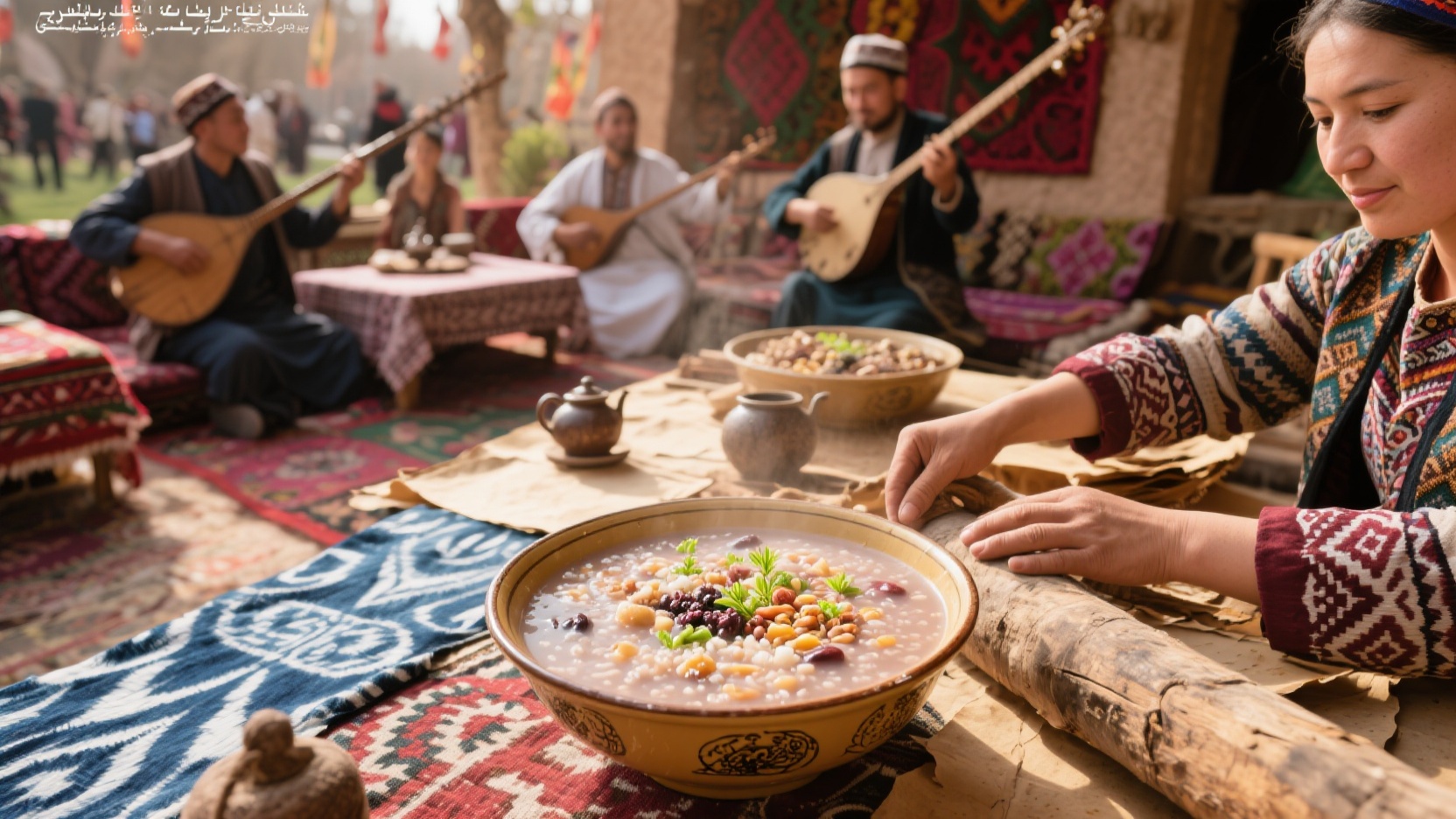
The culture and art of Urumqi are not behind glass cases, but in a bowl of porridge on a spring equinox morning, a piece of still-wet mulberry paper, or a silk scarf with a knot just untied. The most effective way to avoid the standard tourist routes is to follow the festivals and crafts, and dedicate half a day to the daily lives of the locals.
Nowruz: On the spring equinox, a pot of New Year's food is cooked with seven kinds of grains.
Around March 21st each year, Kazakh, Uyghur, and other ethnic communities in Urumqi celebrate Nowruz. In Nanshan Pasture, Dabancheng, and other multi-ethnic neighborhoods in the city, the festival lasts from dawn until dusk. The experience begins in the kitchen: seven grains—wheat, millet, corn, red beans, mung beans, chickpeas, and rice—are cooked with meat, each grain added one at a time. After cooking, people sit around and share the meal, accompanied by baursak or naan. After the meal, the crowd moves to an open space where dombra playing and singing, wrestling, and the Kazakh "girl chase" dance take turns. If you're pulled into the dance circle, don't refuse; just move your feet to the beat. This festival originates from the spring equinox when day and night are of equal length, and the seven grains symbolize bidding farewell to the old year and welcoming the new. It's also a celebration of "surviving the winter" in nomadic tradition. Locals greet each other with their right hand on their chest, and tourists can learn to say "Happy Nowruz"—a more effective way to connect than taking photos.
Mulberry bark paper: From pounding tree bark to peeling off a sheet of paper that breathes.
The art of making mulberry bark paper in Xinjiang has been passed down for generations in Moyu County, Hotan Prefecture. Some intangible cultural heritage workshops in Urumqi have brought the entire process into the city. The experience begins with processing the mulberry bark: peeling off the outer green bark, retaining the tough outer layer, and soaking it in water to soften it. The most laborious step is pounding, using a wooden mallet to repeatedly beat the bark fibers until they become flocculent, then adding water and stirring to form a pulp. Visitors can hold a bamboo screen and gently swirl it to spread the pulp, allowing the fibers to intertwine and form a film. After covering it with a cloth to press out the water, it is hung to dry against a wall. Holding your breath while peeling off the paper completes the process. Workshops usually provide pre-soaked bark; the focus is on the three key steps of pounding, pouring the paper, and peeling off the paper, taking about two hours. Mulberry bark paper was once used for ancient documents, scriptures, and land deeds. Due to its long fibers and resistance to insects, it is said to last a thousand years. In the past, in the Hotan area, mulberry bark was used for papermaking, and mulberry leaves were used for silkworm rearing; the same tree supported two livelihoods: paper and silk.
Tie-dyeing of Adras silk: leaving almond grain and water ripple patterns on the fabric.
In the vicinity of Erdaoqiao in Urumqi or in the suburbs, there are simplified versions of Atlas tie-dyeing experiences. Choose a plain white silk scarf or cotton handkerchief, and tie it with rubber bands and wooden clips according to your desired pattern. Almond grain, pomegranate patterns, and water ripple patterns can all be achieved through folding and tightening. After the dye is applied, it needs to be left to oxidize and fix. The moment the knots are untied, the knife-like color washes and abstract patterns will naturally appear. Unlike the blue and white contrast of Jiangnan tie-dyeing, the traditional Atlas process mainly uses warp tie-dyeing. First, knots are tied on the warp threads, then the colors are separated and dyed, and then the fabric is woven. Due to the displacement of the warp threads, natural flow occurs, resulting in soft pattern boundaries and color transitions like the wind. In Uyghur, "Atlas" is related to "flowing," and the patterns often draw inspiration from the sun, moon, stars, flowers, and fruits. A piece of fabric often represents the understanding of natural order in the oases of southern Xinjiang. Visitors can dry their finished plain-colored fabrics and take them home, but more important than the finished product is that unpredictable moment before the threads are untied.
Xinjiang folk songs: a covered bowl of tea paired with a short opera about a Silk Road town.
If you'd like to experience a performance that doesn't require formality, look for Xinjiang folk songs in teahouses in and around Urumqi. These are local operas that blend Shaanxi Meihu and Lanzhou drum music with local ethnic music, often featuring lyrics about everyday life in Silk Road towns. Square tables, long benches, and covered teacups are the settings. Actors focus less on costumes and more on their singing, with young male and female leads singing in harmony, accompanied primarily by the sanxian, erhu, and banhu. Folk troupes from Midong District and Changji often perform in teahouses in the evenings, with the audience clapping along during lively moments. During intermissions, audience members are often invited on stage to learn excerpts from "Picking Flowers" or "Flying Kites." Even if they don't sing perfectly, the troupe leader will guide them through the singing with clappers. If you arrive early, you can even see the actors applying makeup, rehearsing their lines, and tuning their instruments. While Xinjiang folk songs lack the grandeur of large theaters, they preserve the most vibrant folk art ecosystem of a multi-ethnic region and are a national intangible cultural heritage.
Most of the experiences mentioned above are concentrated during festivals and regular workshop hours. Nowruz Festival is held annually around the spring equinox, while handicraft workshops can be booked year-round. Before you go, you can ask the local cultural center or the intangible cultural heritage stalls in the bazaar for their opening hours. There's no need to rush to do everything in one day; choose two or three activities and set aside half a day. Your hands will remember Urumqi better than your camera.