
Tianjin Art and Culture: A Journey to Explore Tianjin's Century-Old Splendor and Intangible Cultural Heritage Craftsmanship
Tianjin, a city that combines the grandeur of northern China with the elegance of the Haihe River, boasts a cultural and artistic landscape that extends far beyond its superficial prosperity. It bears the imprint of modern China's opening up while preserving its rich traditional folk customs. This article will plan a slow-paced travel route centered on culture and art for travelers seeking a deeper cultural experience, aiming to reveal Tianjin's unique historical fabric and artistic charm.
Modern architectural complexes: a silent narrative of history
Tianjin's modern history begins with its opening to foreign trade and the establishment of concessions. The architectural complexes left behind in these areas are an indispensable chapter in understanding the city's evolution. It is recommended to start with the Five Avenues Cultural Tourism Area . Known as the "World Architecture Expo," this area boasts a collection of Western-style buildings in various styles, including British, French, Italian, German, and Spanish. Strolling through it, each building may hold the story of a historical figure or be a microcosm of an era. For example, the Minyuan Stadium on Munan Road was once the largest stadium in the Far East, witnessing the development of modern sports in Tianjin. It's not simply about admiring the exterior of the buildings, but also about paying attention to their design concepts, historical functions, and connections to the city's development, experiencing that unique period of Sino-Western cultural fusion.
Adjacent to the Five Avenues is the Italian Style District , the only well-preserved Italian concession architectural complex in Asia. It boasts not only Romanesque and Gothic buildings, but also a rich cultural atmosphere due to its status as the former residence of cultural figures such as Cao Yu and Liang Qichao. In contrast to the grandeur of the Five Avenues, the Italian Style District exudes refinement and romance. These architectural complexes are not only a visual feast, but also a testament to Tianjin's historical role as an important gateway to northern China in modern times. They silently narrate how the city transitioned from tradition to modernity, and how diverse cultures collided and merged here.
Museums: A Grand Chapter in Urban Memory
To gain a deeper understanding of Tianjin, the Tianjin Museum is an essential stop. As a national first-class museum, it systematically showcases Tianjin's historical development from prehistoric times to modern times, its regional cultural characteristics, and its rich art collection. The museum's collection covers multiple categories, including bronzes, ceramics, jade, and calligraphy and paintings, and is particularly renowned for its important artifacts such as the Western Zhou Dynasty's "Ke He" and "Ke Lei," and the Qing Dynasty's "Qianlong-marked enamel-painted peony and pheasant-patterned jade vase." Here, visitors can clearly see the historical evolution of Tianjin as a major northern city, a maritime hub, and a cultural center, as well as its unique contributions to the progress of Chinese civilization. The museum does not simply display artifacts; rather, through careful curation, it places these artifacts within their historical context, making them a bridge connecting the past and the present.
Another art space worth visiting is the Porcelain House . This private museum, converted from the former residence of a French missionary, is decorated with hundreds of millions of pieces of ancient porcelain, thousands of antique porcelain artifacts, and tens of thousands of crystals and agates, covering its exterior walls, roof, doors, windows, and even interior decorations. It's not a museum in the traditional sense, but rather a performance art piece, a definitive expression of traditional Chinese porcelain culture by collector Zhang Lianzhi. With its unique and stunning art form, the Porcelain House challenges traditional perceptions of architecture and art, showcasing the passion and creativity of Tianjin residents for art and life.
Intangible Cultural Heritage Experience: The Ingenuity of Tianjin Craftsmen Flowing Through Your Fingertips
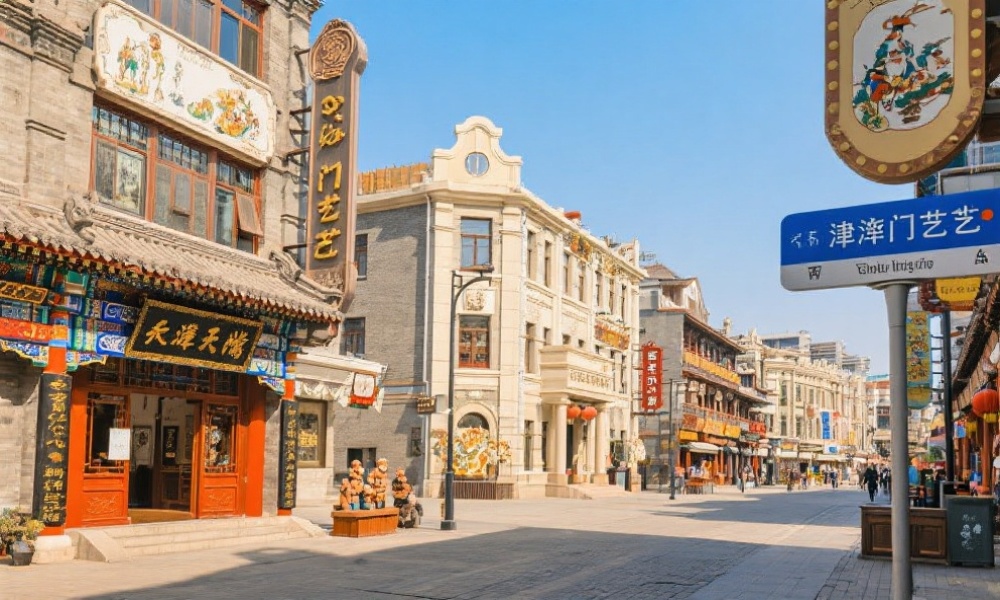
To truly experience Tianjin's cultural heritage, its rich intangible cultural heritage is a must-see. The Ancient Culture Street is the ideal place to experience traditional folk customs and handicrafts. It's home to many time-honored shops and serves as a window into Tianjin's intangible cultural heritage.
Among them, the most representative is the clay figurine sculpture of Zhang . This national intangible cultural heritage originated in the Daoguang period of the Qing Dynasty and is famous for its exquisite realistic techniques and vivid character portrayals. Zhang's clay figurines not only capture the form and spirit of the figures but also focus on revealing the inner world of the characters, reflecting the daily life and folk customs of Tianjin. At the Zhang family shop in the Ancient Culture Street, visitors can not only admire the exquisite clay figurines but also have the opportunity to learn about its history and production process, and even participate in simple hands-on activities to experience the art at their fingertips.
Also located in the Ancient Culture Street, visitors can explore Yangliuqing New Year paintings . As one of the representatives of Chinese woodblock New Year paintings, Yangliuqing New Year paintings are unique for their five major processes of "outlining, carving, printing, painting, and mounting" and their artistic characteristic of "drama within the painting." Their themes are mostly auspicious and festive, historical stories, and folk tales, characterized by vibrant colors and full compositions, expressing people's yearning for a better life. A deeper understanding of Yangliuqing New Year paintings is not only about appreciating exquisite works of art, but also an important way to understand traditional Chinese folk culture and aesthetic tastes. In related experience shops, visitors can try their hand at making rubbings and experience the charm of traditional woodblock New Year paintings.
Furthermore, crosstalk (xiangsheng) is an important part of Tianjin's urban culture. While there aren't fixed "experience points," watching an authentic crosstalk performance in a teahouse or theater, and listening to the charm and humor of the Tianjin dialect, is an excellent way to experience the local culture and linguistic art of Tianjin. Crosstalk is not only entertainment but also an observation and critique of social phenomena, reflecting the optimistic and open-minded attitude of Tianjin people.
Conclusion
A cultural and artistic journey through Tianjin is a dialogue across time. From the grand narratives of modern architecture to the profound collections of museums, and the fingertip transmission of intangible cultural heritage, every link carries the unique imprint of this city. Visitors are encouraged to slow down, delve into each site, listen to the echoes of history, and feel the warmth of art, rather than merely engaging in superficial sightseeing. Only in this way can one truly appreciate the profoundness and unique charm of Tianjin's culture.