
Spend half a day with Nantong artisans: From blue-dyed cloth and kites to Rugao puppets and Rudong horse-jumping temple fair.
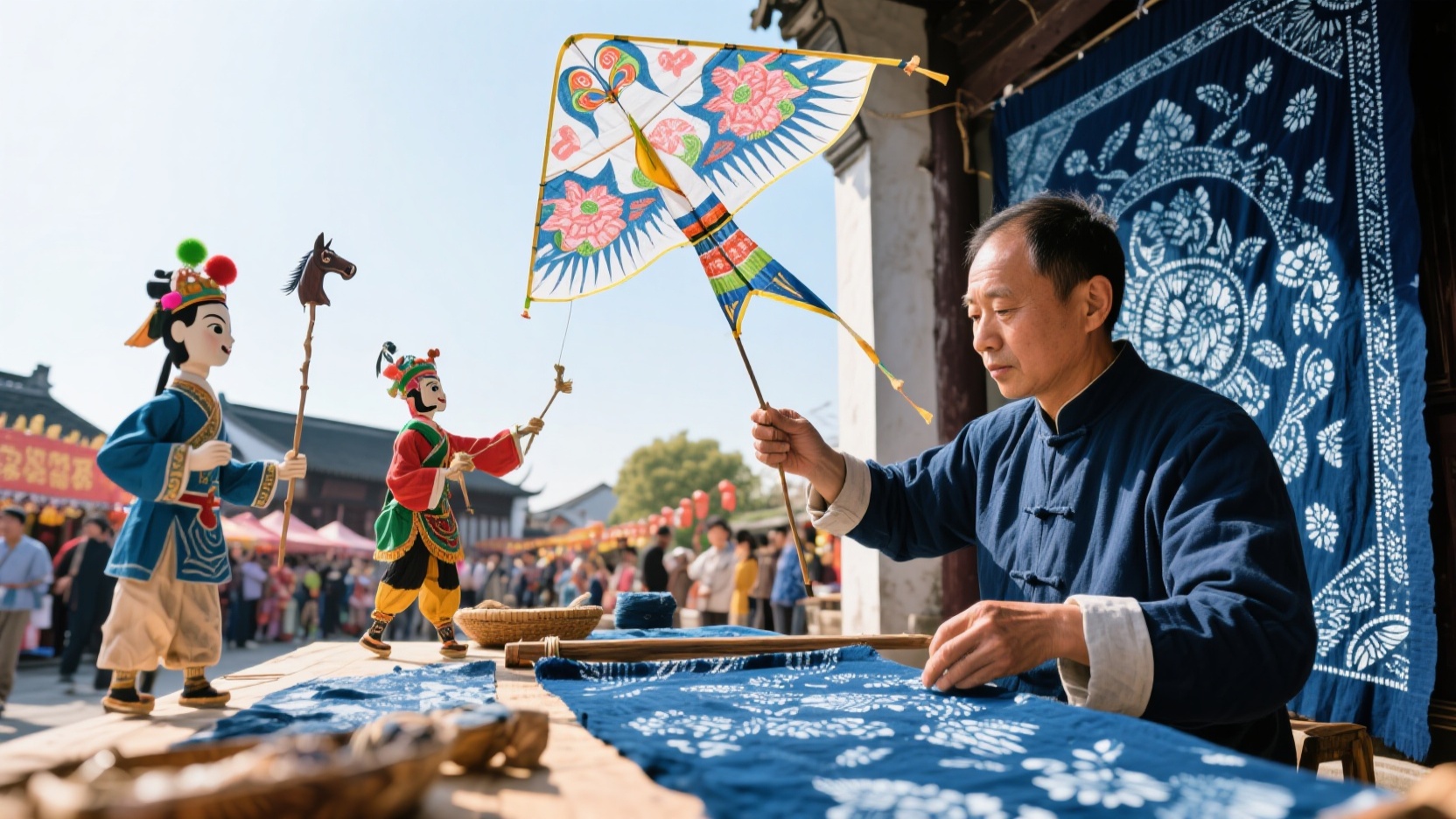
Nantong's intangible cultural heritage isn't displayed in glass cases, but rather found in dye vats, kite frames, puppet strings, and the drumbeats of temple fairs. The following four experiences correspond to spring, summer, autumn, and festival scenes, making it ideal to dedicate half a day to a traditional craft.
I. Spring and Autumn: Dyeing Your Own "Blue and White Floral Fabric" with Blue Calico
The dyeing technique of Nantong blue calico can be traced back to the Tang and Song dynasties. During the Ming and Qing dynasties, dyeing workshops were concentrated in the Nantong, Rugao, and Haimen areas, and the fabric was popularly known as "medicinal-spotted cloth" or "water-sprinkled cloth." The best time to experience it is in spring and autumn, when the temperature is suitable for indigo fermentation and drying is convenient. The first step is carving the pattern: using a carving knife, patterns are carved into a paper stencil coated with tung oil, commonly featuring "Phoenix Playing with Peonies," "Abundant Blessings," and "Lion Playing with an Embroidered Ball." The second step is preparing the resist paste: soybean powder and lime are mixed with water in a specific ratio to form a paste, which is then scraped onto the cotton fabric through the stencil. The paste must be applied evenly, otherwise the edges of the white patterns will be unclear. The third step is dyeing: after drying, the fabric is immersed in an indigo dye vat, repeatedly dyed and oxidized, the color gradually changing from yellowish-green to blue. A deeper blue requires several dyeing passes. Finally, the resist paste is scraped off, revealing the white patterns. The entire process takes about four hours; the blue stains on your hands are difficult to wash off, but they are the most direct memory of "Nantong blue." Culturally, Nantong is located at the confluence of the Yangtze River and the sea. From the Ming Dynasty onwards, cotton planting and textile production flourished. Indigo cultivation and dyeing workshops together supported the traditional textile industry that "clothed the world." A vat of indigo often supported several generations of artisans.
II. Around Qingming Festival: Equip a kite with a "singing whistle".
Nantong flat kites differ from northern soft-winged kites, renowned for their hard, flat wings, colorful designs, and rows of whistles. When flown, the kites produce a melodious, varied sound, often referred to as an "aerial symphony." The period from Qingming to Guyu (around April 5th to April 1st) sees stable southeasterly winds, making it the peak season for kite flying in areas like Liuqiao in Tongzhou and Xiaoyangkou in Rudong. The experience typically begins with building the frame. Bamboo is split into thin strips and tied into hexagonal or octagonal shapes, ensuring perfect symmetry to prevent the kite from tipping over in the air. Next, Nantong homespun cloth or silk is pasted on the frame, decorated with designs such as "Eight Immortals Crossing the Sea" or "Auspicious Beasts and Clouds." The most crucial step is attaching the whistles. Round and row whistles are made from gourds, ginkgo shells, bamboo tubes, or silkworm cocoons, and fixed to the kite surface according to size; larger whistles produce a lower pitch. During test flights, a muffled sound on one side often indicates poor airflow, requiring adjustment of the whistle's direction. Culturally, the hawk is a tool used by fishermen along the coast of Nantong to measure the wind and transmit messages. Large hawks require the combined efforts of several people to pull them. Once airborne, they are like "horns in the sky" and are also a folk signal to pray for favorable weather before spring plowing.
3. The 18th day of the fifth lunar month: Perform the Nuo dance drumbeats at the Rudong Tiaomafu Temple Fair.
The "Horse-Jumping Dance" in the Rudong Fengli area is a traditional sacrificial ritual that retains characteristics of Nuo dance. It takes place around the 18th day of the fifth lunar month, coinciding with the Dutian Temple Fair. The dancers, bare-chested and adorned with horse bells, hold iron spikes and act as divine horses clearing the way for the Dutian Bodhisattva. While tourists don't need to participate fully, they can learn basic horse stances under the guidance of a master: feet spread in a V-shape, heels landing first in a half-squat, knees bouncing to the rhythm of gongs and drums; hands holding spikes, first practicing the "whip-waving" and "reining in the horse" movements, then trying to follow the "dragon tail swing" and "figure-eight" formations. The dance is vigorous and requires a lot of sweating, so it's recommended to wear thin-soled shoes and bring water. This folk custom originates from the story of Zhang Xun's loyalty in defending Suiyang during the Tang Dynasty, and later merged with the local Dutian belief. The horse-jumping dancers use their bodies to simulate warhorses, the sounds of bells and iron spikes blending together, creating a more primitive sacrificial atmosphere than a stage performance. When photographing, respect the ritual and avoid close-up shots of faces.
IV. Festivals and Weekends: Learning a Line of "Puppet Tune" from Rugao Rod Puppet Show
Rugao is an important center for the inheritance of rod puppetry, with troupes performing along the Grand Canal as early as the Qing Dynasty. Today, excerpts such as "Yu the Great Tames the Flood" and "The Legend of the White Snake" can still be seen on the old town stage of Rugao or at the Lantern Festival and Mid-Autumn Festival markets. Watching the performance is just the beginning; the real experience lies in learning how to manipulate the puppets. The rod puppets have three internal rods: a main rod supports the body, and two side rods control the hands. The performer first demonstrates "raising the hand," "turning around," and "flicking the sleeve," which appear light and agile but actually require coordinated arm and wrist strength. Visitors can try to make the puppets serve tea, bow, and even learn a line of Rugao dialect singing to experience the pronunciation and sustained notes of the "puppet style." The puppets' "hands, eyes, body, techniques, and steps" are no different from those of live-action opera, but they are more difficult to express emotions because the face cannot move; everything relies on the angle and rhythm of the body. Culturally, Rugao puppetry blends Kunqu Opera and local folk songs. In the past, performers used to set up stages in the Lixiahe water towns using awning boats, a practice known as "floating stage troupes." After half a day, I could at least understand one sentence: "The soul of a puppet show is in the hands, not the face."
Arranged by season: fly kites and listen to whistles around Qingming Festival, go to Rudong to follow the Nuo dance drumbeats on the 18th day of the fifth lunar month, dye a piece of blue cloth in spring and autumn, and learn puppetry in Rugao on weekends or festivals. Only by slowing down and moving your hands or following the drumbeats can you truly enter Nantong.