
5-Hour Night Tour of Nanchang | A Blogger's Personally Tested Route from Riverside Lights to Old Alley Tea-Picking Opera (with Photo Spot List)
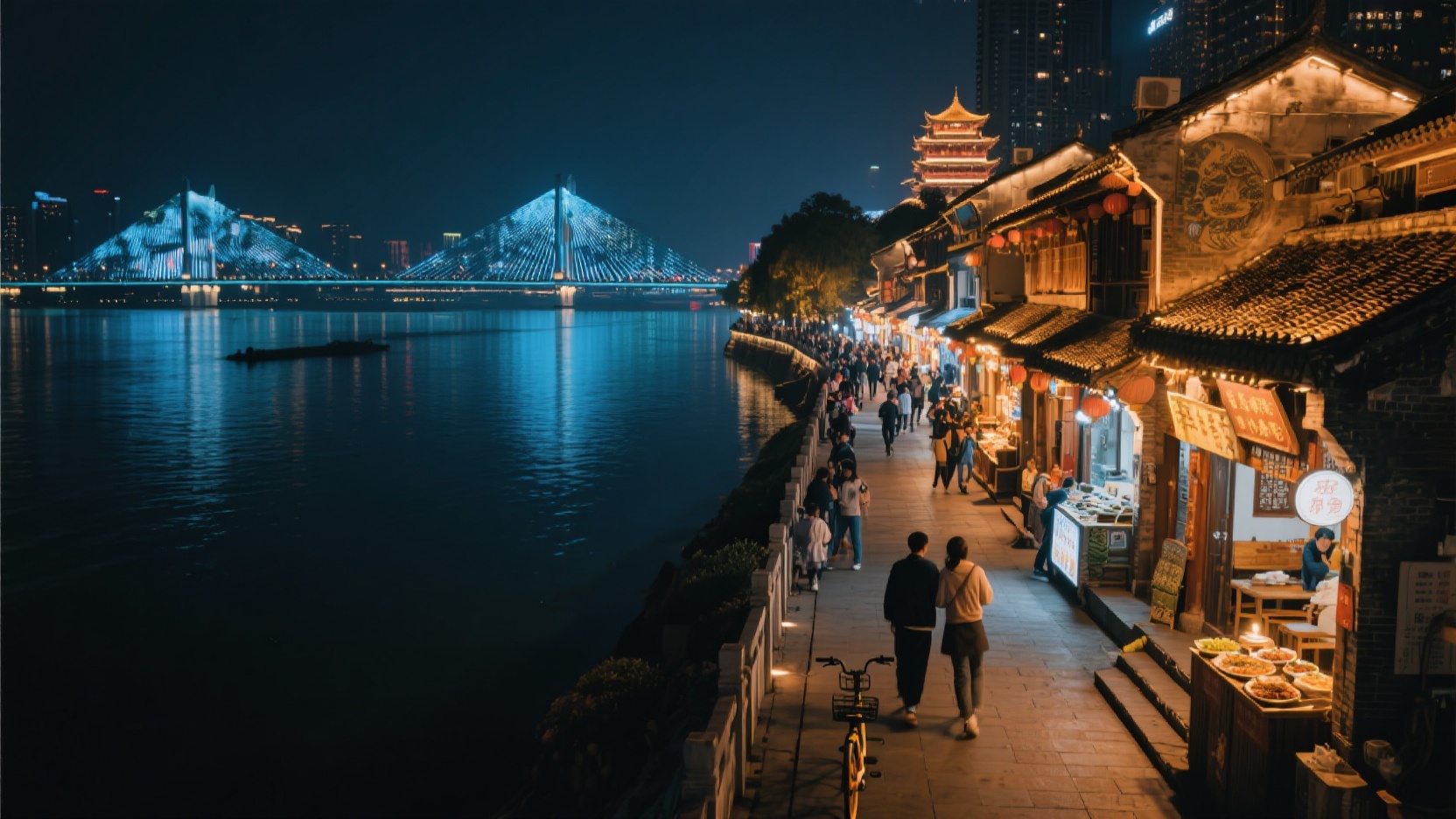
Many people think that a night tour in Nanchang is simply going to Qiushui Square to watch a fountain show and then going back to the hotel to sleep. I did the same on my first three visits to Nanchang, until my fourth time when I finally found out from a long-time tea drinker who had lived on Rongmen Road for thirty years that the night tour route, stretching from the east bank of the Gan River all the way to the old city alleys, was truly meaningful. I've walked over twenty night routes in Nanchang, from Honggutan to the old city, and discovered that the most photogenic part isn't the lights themselves, but rather the line where the lights meet the old city. The entire route is walkable and can be completed by foot or shared bicycle, perfect for the cooler autumn and winter evenings when there are fewer tourists.
I personally tested this route over two weekends, and the most comfortable way to walk it is to start around 6 PM, blending the lights, night market, small theater, and river breeze into one evening. I'll break it down by time below; you can just copy my advice.
1. 18:00-19:20 Lantern Viewing on the East Bank of the Ganjiang River: Avoid Qiushui Square and stand in the area where the lights are in the same frame.
Avoid the crowds on the steps of Qiushui Square. After exiting from the south gate of Tengwang Pavilion, walk directly to the riverside promenade near Xinzhou Cultural Square. Here, you'll see the Honggutan skyline with the illuminated Tengwang Pavilion behind you. Around 6 PM in autumn and winter, when the sky is still tinged with blue, the high-rise buildings on the opposite bank gradually light up, and reflections begin to appear on the Ganjiang River, creating a more layered view than seeing the fountain directly.
I've learned my lesson the hard way: the first time, I was afraid of missing the lights, so I arrived too early, and the river wind blew me right through; the second time, I arrived too late, and the blues were gone, leaving only darkness. I recommend arriving around 6:00 PM, walking along the path towards the Bayi Bridge for a while, and waiting until around 6:15 PM when all the lights are on, then slowly turning south back. This walk takes about 15 minutes. Shared bikes can be ridden outside the path, but you must lock them in the marked areas; otherwise, the dispatch fee will be higher than the riding fee. The lighting duration differs slightly between weekdays and weekends, but the blues time is fixed, so don't arrive right on time.
2. 19:20-20:40 Wanshou Palace Historical and Cultural Block: Explore the alleys first, then eat, avoiding the long queues at popular spots.
It's about a 5-minute bike ride by shared bicycle from the south side of the riverside promenade, or a 15-minute walk along Rongmen Road, to reach the Wanshou Palace Historical and Cultural District. This area is even more suitable for a nighttime visit than the Shengjin Pagoda: the blue brick walls, horse-head walls, and red lanterns, once lit up, seem to rekindle the memories of Nanchang's old city. Don't rush to queue on the main entrance street; turn directly into the side alleys, where there are half the number of tourists, and the lanterns under the eaves are perfect for taking photos.
I was deterred by a popular restaurant on the main street with a line of over thirty people, so I turned into a side alley and found a small shop that only served mixed rice noodles and clay pot soup. The owner, speaking in Nanchang dialect, asked if I wanted it spicy; that wok hei (wok aroma) was the authentic local flavor I was looking for. I recommend eating in the order of "salty first, then sweet": mixed rice noodles, clay pot soup, thick soup, and finally a white sugar cake to enjoy while strolling around. It costs a few dozen yuan per person. Don't eat too much at the first shop; save room for tea and snacks at the teahouse later.
Some exhibition halls in the Wanshou Palace area close in the evening, but there are occasional impromptu performances or small markets on the open-air stage, so keep an eye out for them. About an hour and a half is enough time to explore the main alley and the two side alleys thoroughly.
III. 21:00-22:20 Tea-Picking Opera Teahouse: The Ultimate Guide to Nanchang's Nightlife
Walking about 8 minutes from Wanshou Palace towards Zhongshan Road, turn into an old alley, and you'll find a teahouse specializing in Nanchang tea-picking opera. Nanchang tea-picking opera is a local intangible cultural heritage, more down-to-earth than Gan opera, with its singing style carrying the rustic flavor of the Gan dialect. Outsiders enjoy the lively atmosphere, while locals experience a sense of nostalgia. The teahouse is small, with square tables and long benches, and the covered teacups can be refilled indefinitely. The price is a few dozen yuan per person.
To determine if a performance venue is authentic, check for a handwritten sign at the entrance or see experienced performers carrying thermos cups inside. My personal experience: performances start after 9 PM. There's no formal stage; the actors begin their routine around tables, singing and responding to each other, with occasional experienced performers joining in. There are very few tourists; it's mostly local residents. I recommend sitting against the wall. When taking photos of the teacups and costumes, avoid using flash. The performance lasts about an hour; you can listen for a while before leaving.
If you're not into traditional opera, there are also bars and livehouses nearby, but this route is chosen because the Cai Cha Opera Tea House is the closest to Wanshou Palace Old Street, allowing you to connect with the essence of Nanchang's local culture.
IV. 22:30-23:30 Walk back to the riverbank to wrap things up; blogger's summary and practical tips.
After leaving the teahouse, walk back along the same route for about 10 minutes to reach the Gan River. By then, the lights are gradually going out, the river is calm again, and most of the tourists have left. Walk along Rongmen Road to the east side of the south gate of Tengwang Pavilion; the view is very clear, perfect for night portraits or long exposures. There's no turning back throughout the night, and you should be able to get back to the main road to catch a taxi by 11:30 PM at the latest.
Night Shooting Spots Summary: Spot 1: Stone steps of Xinzhou Cultural Square, offering a view of Tengwang Pavilion and the Honggutan architectural complex in the same frame; Spot 2: Lantern wall in a side alley of Wanshou Palace Street, looking up to avoid crowds; Spot 3: Seats against the wall in the Cai Cha Opera teahouse, capturing details of teacups and costumes, using your phone's night mode; Spot 4: Overpass at the intersection of Zhongshan Road and Rongmen Road, using a telephoto lens to compress the old city and high-rise buildings; Spot 5: Riverside railing east of the south gate of Tengwang Pavilion, capturing the reflection in the river during blue hour, using the railing as a tripod for long exposures.
Four safety tips: 1. It's windy by the river in autumn and winter, and the temperature is two or three degrees lower than in the city. Remember to wear a light jacket after 8:00 PM. 2. Shared bikes cannot be ridden on the riverside promenade. Lock your bike in the designated area, otherwise the dispatch fee may be higher than the riding fee. 3. Night markets are crowded. Wear your bag in front of you and don't put your phone in the shallow pockets of your jacket. 4. Tea houses and teahouses are mostly in alleys. When leaving late at night, try to go in groups or walk along the main road. After 11:30 PM, some sections of the road are dimly lit.
This route doesn't follow the logic of checking off tourist attractions, but rather follows the relaxed feeling of Nanchang residents after get off work. If you only have one night, don't just go to Qiushui Square to wait for the fountain. Try walking from the east bank of the Gan River to the old alleys and listen to a tea-picking opera. Only then will Nanchang's night truly begin.