
Spend half a day as a craftsman in Qingcheng Mountain: An immersive journey into intangible cultural heritage, from the Dazhao Temple Fair to Helingeer paper-cutting.
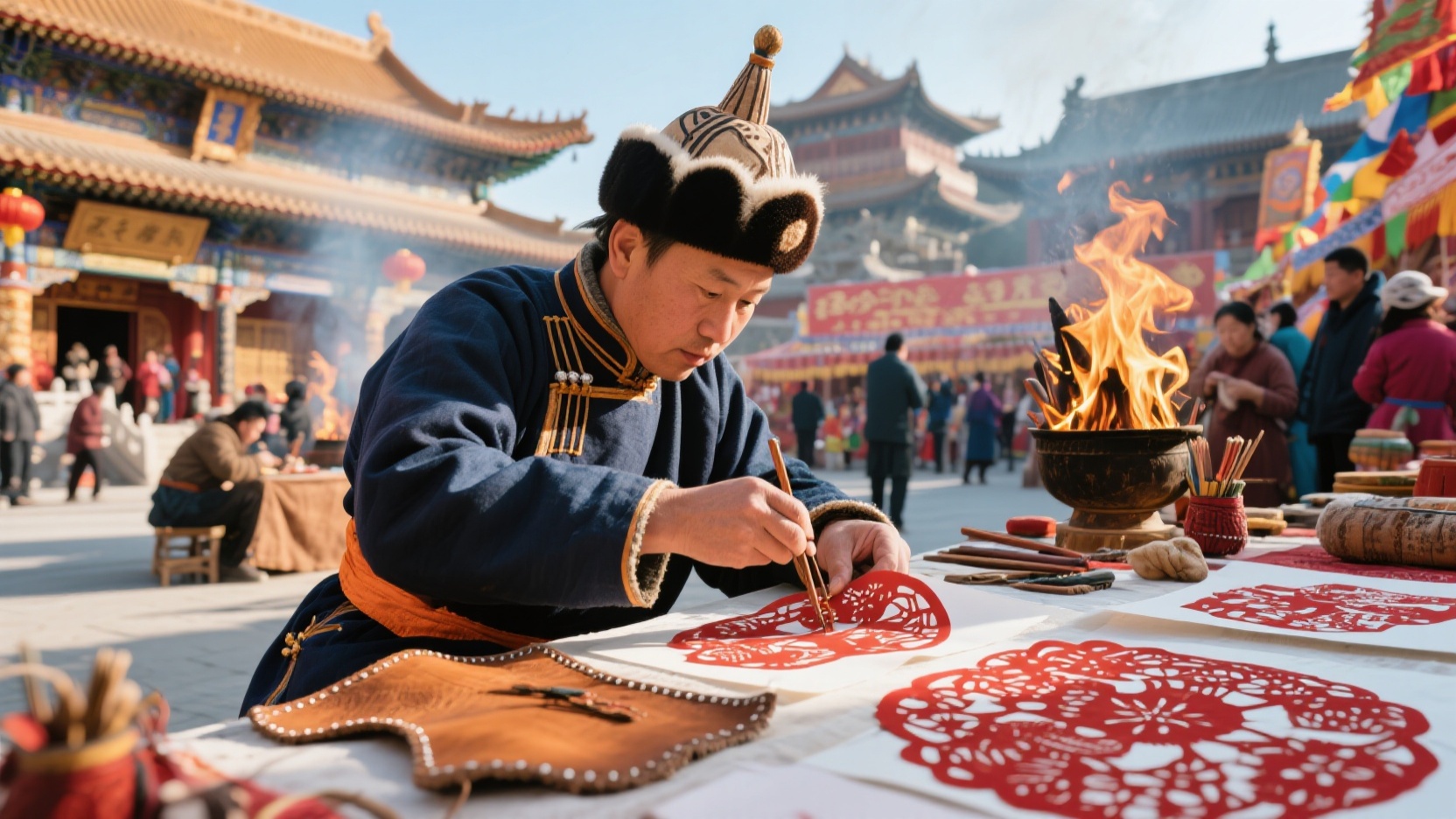
To truly understand Hohhot's cultural and artistic journey, one must extend beyond temples and museums to tangible workshops and festivals. Visiting Dazhao Temple, Wuta Temple, and the General's Office is best done in the morning, while afternoons and evenings can be reserved for temple fairs, folk performances, red paper crafts, and fire-worship ceremonies. The following four experiences, though not in the same season, all point to one principle: don't just rush through; sit back and experience life as a local.
Dazhao Cultural Temple Fair: Understanding the Narrative of the New Year through Naoge and Shehuo (traditional folk performances)
The fair takes place from the first to the fifteenth day of the first lunar month, with Dazhao Square, Sai Shang Old Street, and Jiujiu Street forming the main venues. The core attraction of the fair is the "Naoge," an autonomous region-level intangible cultural heritage. In the Jin dialect, "nao" means "to carry." During the performance, a strong man has a metal frame strapped to his shoulder, on which one or two children aged three to six are fixed. The children wear theatrical costumes and face paint, and swing their water sleeves to the beat of gongs and drums. The height often exceeds five meters. The stories are mostly taken from "The Legend of the White Snake," "Journey to the West," and "Splitting the Mountain to Save Mother." Each Naoge is a flowing drama. When the audience looks up, they see not only the skill but also the locals' blessings for the children's health and safety. Experience suggestion: It is not advisable to follow the entire daytime parade for filming. Instead, set aside time in the afternoon to sit down at the intangible cultural heritage stalls in Sai Shang Old Street, learn to sculpt a zodiac animal from a dough sculptor, or watch a sugar painting artist use a copper spoon as a brush and sugar syrup as ink to create saddles, carts, and intricate patterns. The highlight of the Lantern Festival is the lighting and turning of the bonfire and the lantern riddle guessing game. When participating, simply walk around the crowd and do not throw wrapping paper into the fire.
Horinger paper-cutting: No drafts required, just cutting directly from the local soil and water.
Helinger paper-cutting is a national intangible cultural heritage, and the experience is not limited by season, mainly taking place in the Helinger County workshops and some cultural spaces in the city. If you visit in December, you can see farmers pasting newly cut paper-cuts all over their wooden lattice windows. The most unique aspect of this technique is "maojiao," which means cutting directly after folding the paper without a draft or outline, relying on experience. Therefore, each piece has a unique and unrepeatable cut. Common symbols include a doll with a topknot, deer, horse, tree of life, and upside-down bowl, which are products of the long-term integration of agricultural and nomadic cultures in the Chulechuan region. The process: Choose a large piece of red paper, fold it in half or quarters, and cut out the outline from the inside. Use your wrist to rotate more than the scissors to open and close; the sawtooth, crescent, and spiral patterns you cut will naturally form ram's horns, pomegranates, or flowers. Beginners can start by completing a "round flower," which can be unfolded in about half an hour. Do not open and check the paper frequently before it is finished. This is a point that local veteran artists often remind you of—frequent unfolding will "break the rhythm." The scraps of paper are usually not swept away immediately after cutting, as this is meant to preserve good fortune. They are collected and disposed of after the artwork is completed.
Mongolian leather craftsmanship: Two hours to hammer out the intestinal patterns of the grasslands
Mongolian leather craft can be experienced in several workshops in Hohhot, and it's advisable to set aside two to three hours. Contrary to the common misconception that "leather carving is simply carving patterns," the practical process involves six steps: selecting the leather, wetting it, sketching, carving lines, edge trimming, and dyeing. The vegetable-tanned leather is softened in warm water, and then a rotating carving knife is used to carve smooth main lines along cloud, horn, or coiled patterns. A stamping punch is then used to hammer out dotted, radial, or mat-like textures along the edges. The hammering force must be even; too much force will pierce the leather, while too little will not create an indentation. During the dyeing process, camel brown, brick red, and dark green—three commonly used colors on the grasslands—will seep into the carving marks, creating a more three-dimensional effect than flat printing. Participants can complete a coaster, a keychain, or a small leather carving painting. Cultural Tip: The coiled intestine pattern on traditional Mongolian artifacts symbolizes "continuousness," the horn pattern represents the prosperity of livestock, and the cloud pattern echoes the blue sky and the fluidity of life. These patterns are not just simple decorations, but rather prayers for abundance and peace in nomadic life. Therefore, when sketching, the lines should not be broken.
Fire worship on the 23rd day of the twelfth lunar month: A New Year's Eve ceremony is held around a bonfire with blessings and prayers.
If you arrive before the 23rd day of the twelfth lunar month, you can look forward to a small-scale fire-worshiping ceremony. Fire worship is an ancient Mongolian custom, with fire considered a symbol of purity, prosperity, and the continuation of family business. The ceremony usually begins in the evening. The chief officiant recites the "Praise to the Fire Worshiping Ceremony" facing the fire, and family members take turns throwing lamb breast forks, milk curd, red dates, and butter into the fire, then walk around the fire three times clockwise. The entire process is not lengthy, but the taboos are clear: do not throw objects into the fire, do not step over the fire, do not walk in the opposite direction, and do not kick away the ashes. Visitors can quietly observe the ceremony from the sidelines, or after the ceremony, receive a pine branch tied with a blue hada (ceremonial scarf) and lightly touch it towards the fire to express their wishes for a peaceful year ahead. If you miss the twelfth lunar month fire worship ceremony, you can see a similar process at the fire-worshiping performance before the summer Naadam festival, but it lacks the solemnity of the fire illuminating the snow-covered ground in the dead of winter.
By incorporating these experiences into a two- to three-day itinerary, a cultural tour of Hohhot will shift from mere sightseeing to active participation. Temple fairs offer glimpses into flowing folk narratives, paper-cutting hones hand-eye coordination, leather crafting reveals the textures of grassland symbols, and fire worship showcases the ancient relationship between humans and fire. Each experience leaves you with more than just souvenirs; it means that for at least half a day, you've experienced Hohhot as a local.