
A 4km Artsy Route in Beijing | A List of Strolls in Dongsi Compiled After Three Trips (Avoiding Nanluoguxiang)
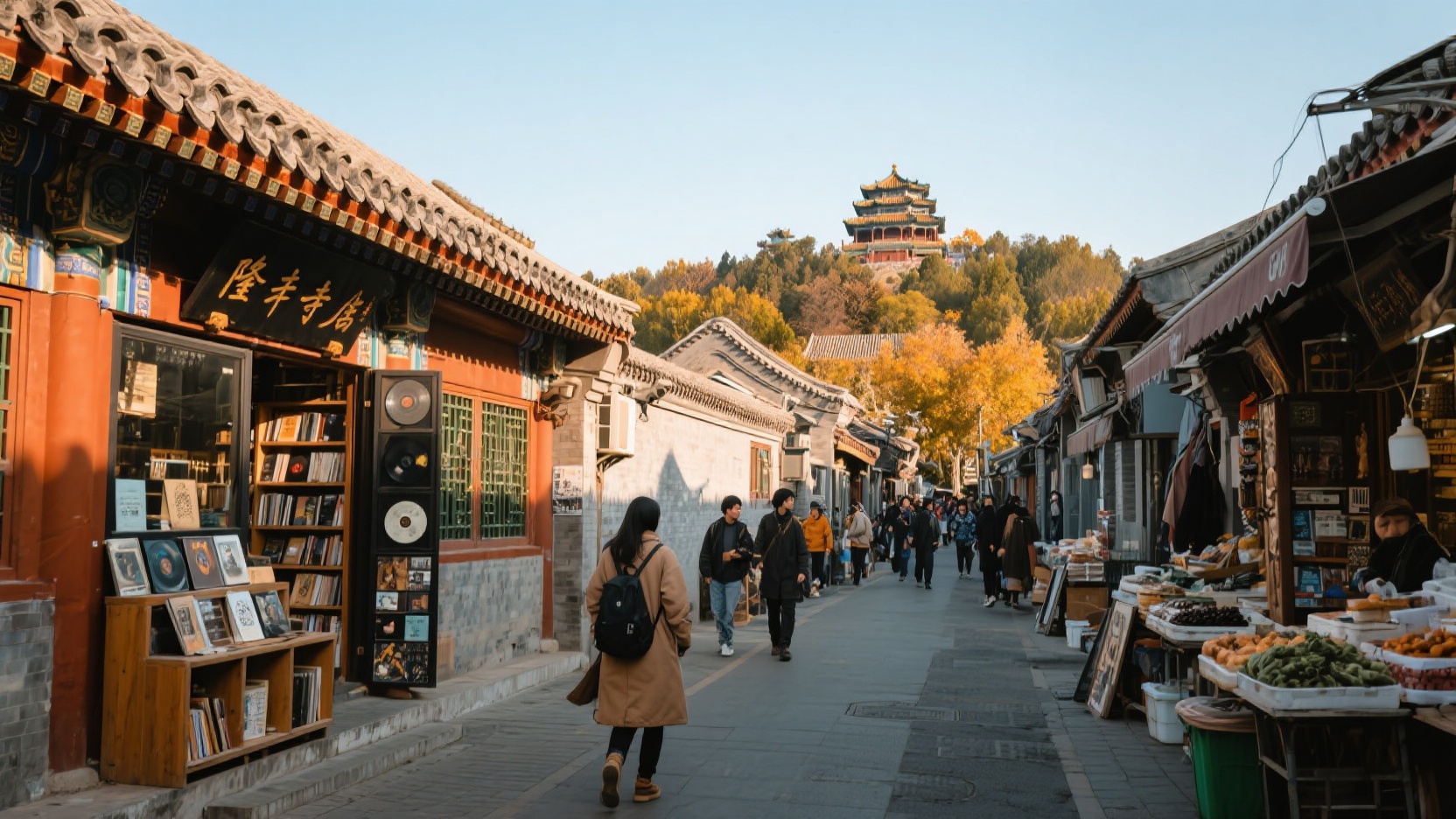
When I exited the Zhang Zizhong Road subway station for the third time from the north side, I was certain that Beijing's most worthwhile art route for leisurely walking wasn't in Nanluoguxiang, but rather the 4 kilometers from Dongsi to Jingshan Park. I walked this route three times before daring to write about it—the first time, the navigation led me into a dead end; the second time, the farmers' market was closed; and only on the third time did I manage to walk the old buildings, independent bookstores, vinyl record shops, and pocket parks in the correct order. The entire route is about 4 kilometers long, requiring at least 3 hours of walking, with 5-minute stops at each point; I recommend allowing at least 5 hours.
Starting on Zhang Zizhong Road, first slow down your vehicle by letting the Republican-era buildings make you feel like you're moving slowly.
Exiting from the north side of Zhang Zizhong Road subway station and walking west for about 200 meters, the gray brick buildings of the former Duan Qirui government will suddenly come into view. This was once the site of the Qing Dynasty's Ministry of the Army and Ministry of the Navy. The architecture is a typical example of Western eclecticism, with the stone lions and brick carvings in front of the main building retaining a rare roughness. The blogger's camera angle: Standing on the sidewalk diagonally opposite the main gate, using a telephoto lens to compress the main building's archway and the roadside plane trees into a single frame. Why it's worth spending 5 minutes looking: Most tourists take a picture and leave, but if you stare at the brick seams, you can see traces of repairs from different eras, like layers of historical stickers that haven't been peeled off. The walk takes about 3 minutes, but you can stay for 10 to 15 minutes.
Continue west past the intersection of Dongsi North Street, and after a 5-minute walk, you'll enter the east entrance of Dongsi Fourth Alley. Don't walk too fast here; on the north side of the road, there are several shops from the Republican era with terrazzo facades, the inscriptions on the lintels worn away by wind and rain, leaving only outlines. Around three or four in the afternoon, the setting sun casts its softest sidelight on the walls.
Dongsi Fourth to Sixth Alleys are home to Ming and Qing dynasty gate towers and vegetable market corners.
It's about an 8-minute walk from Dongsi Sitiao. The highlight isn't any single protected courtyard, but the continuous changes in the gate towers—the Guangliang Gate, the Jinzhu Gate, and the Ruyi Gate appear alternately, with almost no two door piers and door studs being the same. The blogger's camera angle: Find a screen wall with an eight-character pattern, wait for a resident to pass by on a bicycle, use the gate tower as the foreground, the person's shadow as the middle ground, and the depths of the hutong as the background. Why it's worth watching for 5 minutes: The social hierarchy and traces of life in Beijing's hutongs are written on the gate towers. Understanding the concept of "matching social status" is more rewarding than browsing ten antique-style shops.
Walking to the middle of Fourth Street, you'll pass a corner of a community vegetable market, half-hidden by locust trees. It's most vibrant before 10 AM: vendors stack tomatoes into pyramids, elderly people carry cloth bags picking out green beans, and occasionally a cat scurries past the vegetable baskets. The blogger's camera angle: Standing slightly in front of the market entrance, shooting from a slightly upward angle to capture the relationship between the stalls and the alleyway signs, avoiding shooting the vendors' faces directly. Why it's worth watching for 5 minutes: This is everyday life in a community within the Second Ring Road that hasn't yet been fully refined, closer to local life than any creative market. Walking time: Approximately 12 minutes from Fourth Street to Sixth Street.
Branch Road A: From the west entrance of Dongsi Sitiao, walk south along Dongsi Beidajie for about 6 minutes. After reaching the Dongsi intersection, turn right. You can go around into the old residential area around Ganmian Hutong to take pictures of the old community windows, mailboxes and unit door paintings. Then turn back to Dongsi Liutiao. The one-way trip is about 1 kilometer longer.
Longfusi Beili: Bookstores, vinyl records, and vintage clothing in old factory buildings
Walking from the west entrance of Dongsi Liutiao through Dongsi Beidajie towards Longfusi Street for about 8 minutes, you'll find Longfusi Beili, a renovated area of old red-brick factory buildings. Its atmosphere is completely different from the hutongs; it's more like a compressed artistic island. You can stand and browse art books in the independent bookstore for an entire afternoon; the vinyl record shop only sells secondhand and vintage prints, with the owner nodding as they show you sample prints; the vintage clothing store is tucked away on the second floor, its staircase as narrow as a darkroom from the film era.
The blogger's camera angle: On the second-floor corridor of the old factory building, use a wide-angle lens to capture the contrast between the warm light and the gray brick walls of the first-floor bookstore; the best time is during the blues of dusk. Why it's worth spending 5 minutes there: These shops aren't suddenly appearing pop-up shops; they've coexisted with the old factory buildings and chimneys for many years. The age of the space itself and the vintage items people choose create a dual sense of time. A 40-60 minute visit is recommended.
Branch Road B: From Longfusi Street, head west through the north entrance of Wangfujing Street. It's about a 7-minute walk to Wusi Street. If you want to see the old neighborhood and the farmers' market first, you can turn into Nanyang Hutong halfway there to experience the most relaxed part before the market closes in the evening, and then return to the main road.
From the National Art Museum of China to Wusi Street, a street that connects a century of art and the Red Mansion.
About a 10-minute walk from Longfusi Beili, you'll find the glazed tile roof of the National Art Museum of China. The permanent exhibitions are free, but even without going inside, the building itself is worth lingering over. The blogger's camera angle: Standing at the east entrance of the museum, framing the main building's facade with plane trees, and showing a few blurry pedestrians in the foreground. Why it's worth spending 5 minutes looking at: This late 1950s building in a traditional Chinese style has a yellow glazed tile roof that's as captivating as the exhibits themselves.
Continue walking west for 5 minutes, and the Peking University Red Building on the north side of Wusi Street will tell you why this street is called Wusi. Its red brick and concrete structure stands out strikingly against the gray urban backdrop, and as the evening light shifts from orange-red to dark red, it's one of the most photogenic building facades along the entire route. Walking time: Approximately 5 minutes from the Art Museum to the Red Building, then another 15 minutes to Jingshan Qianjie.
The Jingshan Qianjie Pocket Park is nearing completion, showcasing how the corner tower and everyday life unfold simultaneously.
Walking west along Wusi Street from Peking University's Red Building for about 10 minutes, you'll reach Jingshanqian Street. On the north side of the street are several unassuming pocket parks, with benches facing the corner tower of the Forbidden City. After 4 PM, the shadows of the trees cast long shadows, and you'll often see elderly people playing chess or young people sitting on the steps eating steamed buns. The blogger's camera angle: sitting on the easternmost bench, using a wide-angle lens on their phone to capture the corner tower, willow branches, and the silhouettes of those playing chess in the same frame. Why it's worth watching for 5 minutes: The World Heritage Site becomes a backdrop for community life, but it doesn't feel out of place at all.
If you still have energy, you can continue walking west along Jingshanqian Street for 5 minutes to the vicinity of Beihai Tuancheng. The entire route is about 4 kilometers, including two branch lines totaling about 6 kilometers. Even slow walkers can explore the entire area within 5 hours.
Blogger's Summary and Practical Tips
This route is recommended for those who want to experience Beijing as a city worth reading, especially on sunny autumn and winter days when the temperature is low but the sunlight is clean, and the light and shadow on the old buildings are sharper than in summer. If you only choose one section, the section from Dongsi Sitiao to Longfusi Beili is the highlight, where you can seamlessly switch between a vegetable market, old gate towers, bookstores, vinyl records, and vintage clothing within 1 kilometer.
Practical Tips: 1. Avoid Mondays as some art galleries are closed; 2. Wear soft-soled shoes as there are many stone slabs on the alleyways; 3. The wet market is most lively before 10 am; 4. Most vinyl record stores and vintage clothing stores open in the afternoon; 5. It can be windy in the evenings during autumn and winter, so gloves are recommended for taking photos of the corner tower; 6. There are not many restrooms throughout the trip, so it is recommended to use the facilities in Longfusi Beili beforehand.