
A 5-hour night tour of Wuxi | My personally tested route from the lakeside lights to Nanchang Street Pingtan (with photo spot list)
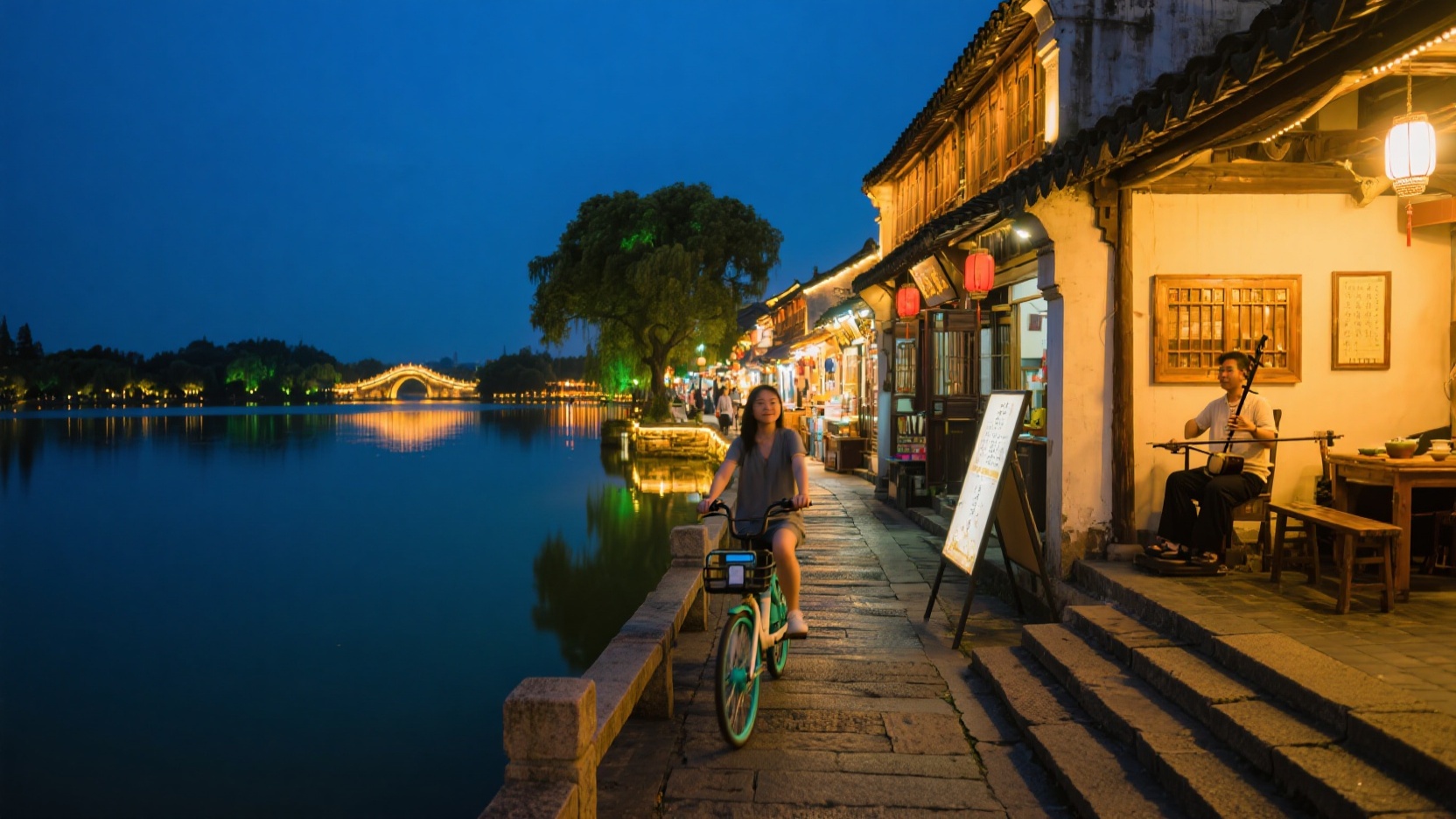
I made three trips to Wuxi. During the day, I only visited gardens and museums, and at night I specifically chose a night route from the lakeside to the Grand Canal. This route wasn't something I figured out on my first try: the first time, I lazily took a taxi and was stuck in traffic at the entrance to Nanchang Street for a full twenty minutes; the second time, I took the wrong road and turned into an unlit alley. The third time, I finally managed to organize the time, locations, and entrances into a route that wasn't rushed: starting from the Lihu Lake shoreline lights at 6:00 PM, arriving at the Nanchang Street night market at 7:50 PM, heading to the Shumatou Pingtan Teahouse at 9:30 PM, and finishing at Qingming Bridge at 11:30 PM. The entire route was taken on foot and by shared bicycles, without backtracking.
18:00-19:10 | Lihu Lake shoreline lighting: Don't rush into the street yet, the blues hour is the best for taking photos.
Wuxi isn't on the coast, but this stretch of Lihu Lake has a wide shoreline. In the evening, the breeze carries moisture, creating a visual effect reminiscent of the sea. I navigated directly to the wooden boardwalk near Lihu Light, arriving around 6:00 PM, which was perfect. Before it got completely dark, I could capture the afterglow of the sunset over the lake. Around 6:45 PM, as the blue hour arrived, the city skyline on the opposite shore and the lights from the 100-meter-high fountains began to illuminate, creating a much better sense of depth in the water's reflections than during the day.
On my first trip, I only stopped here for ten minutes, rushing to Nanchang Street. I found that the night market lights weren't as pleasing to the eye as the blue hues of the lakeside. On my second trip, I started here again, concluding that, weather permitting, the first forty minutes should definitely be dedicated to the lakeside. For portrait photography, standing at the corner of the boardwalk with the lake as a backdrop is more natural than standing in front of a lamppost.
Another advantage here is that there are fewer tourists; most visitors are locals taking an evening stroll. The lakeside path is gentle, so there's no need to rush. You can let your eyes adjust to the night before heading towards the narrow South Long Street.
19:10-19:50 | Shared bikes travel through the city to Nanchang Street; avoid taking a taxi for this route.
The straight-line distance from Lihu Lake to Nanchang Street isn't far, but taking a taxi during the evening rush hour can easily lead to traffic jams on Qingyang Road. A test showed that scanning a shared bicycle, following Taihu Avenue and then turning onto Qingyang Road, with non-motorized vehicle lanes throughout, takes about 35 to 40 minutes. This ride isn't just about rushing; after passing Taihu Square, the streetlights and shops of the old city gradually transform from urban scenery into the everyday atmosphere of old Wuxi, offering a more ceremonial "entering the city" experience than taking a car.
I made a mistake on my first trip here: I took the wrong turn under the Lihu Bridge and ended up riding for over ten minutes longer before getting back to the main road. I recommend using "cycling" mode on your navigation app, not "walking," as some pedestrian routes through alleys lack lighting at night and are unsuitable for solo riding. Always turn on your headlights when cycling at night. There's a section of Taihu Avenue where the non-motorized vehicle lane suddenly narrows, so be careful near bus stops.
No need to take photos along the way; save your energy for Nanchang Street and the ancient canal. This bike ride will help you recover from the evening chill, and you'll be ready to eat when you arrive at the night market.
19:50-21:30 | Nanchang Street Night Market: Enter from the side of Kuatang Bridge to avoid the main street crowds.
Many people enter through the main gate of Nanchang Street, only to find themselves jostled and pushed around. My personal experience suggests the most comfortable entrance is the side near Kuatang Bridge. Walk slowly along the ancient canal and start eating from the outer edges. The night market here is concentrated near several bridge arches; the stalls are small, but the atmosphere is more vibrant and lively than on the main street.
Locals queue for magnolia cakes and osmanthus-flavored taro. The freshly fried magnolia cakes have a crispy exterior and are juicy inside, while the osmanthus-flavored taro is subtly sweet, making them a good snack during a night stroll. Wuxi-style steamed buns are on the sweeter side, so it's recommended to save them for last to avoid feeling overwhelmed by the sweetness. A disappointment for me was the "trendy cherry blossom pudding" stall in the middle of the main street; it's only good for taking pictures, and the taste doesn't justify the long queues.
After leaving the night market, take a walk along the riverbank first, but don't go into the teahouse immediately. After 9:00 PM, the crowds on Nanchang Street will spread from the main street to both sides of the riverbank. At this time, it's a good time to go around to the north side of Qingming Bridge to watch the cruise ships slowly pass under the bridge. Find a good spot in advance to take slow shutter speed photos at night.
21:30-23:00 | Step into the Book Wharf Pingtan Teahouse and experience the Jiangnan charm of Wuxi at night.
After finishing my meal, I walked to the east side of Qingming Bridge. In the alley, there was a Pingtan teahouse with only a small lamp hanging at the entrance and no large signboard. This wasn't a performance venue, but a popular spot for local listeners. I ordered a pot of tea, sat down, and listened to the opening of a Pingtan performance or a selection from a Wuxi opera. The stage wasn't electrified; the sound of the gavel pushed away all the noise outside.
I recommend first-timers choose the "Introductory Highlights"—the timing is right and it won't be too boring. Flash photography is discouraged in the teahouse, so please silence your phone. Leave around 10:45 PM, just in time for the quietest period when the river lights are on.
Wuxi's nightlife isn't just about bar streets; these old teahouses are the true embodiment of local culture. Of the three types of nighttime venues, I ultimately chose the Pingtan teahouse because its ambiance best matches this lakeside-canal area—it's quiet and perfect for calming down after a long day.
23:00-23:30 | Finish along the ancient canal, walking three times between Qingming Bridge and Bodou Bridge.
After leaving the teahouse, don't navigate directly to the hotel. Walk south along the river to Qingming Bridge, then circle around to Bodou Bridge. This section is only a few hundred meters long, but you'll find different photo spots every time you walk it. After 11 PM, the boat tours stop, the water level returns to normal, and the reflections of the lights under the bridge arches are perfectly clear. You can take your time wrapping up here; there's no need to rush.
I usually leave before 11:30 PM. Later, the wind gets strong by the river, and it becomes harder to catch the last bus or hail a taxi. If you're not staying near Nanchang Street on your return trip, I suggest walking to the main road, Yongle Road, to hail a taxi; it saves more time than waiting at the alley entrance.
The blogger summarizes: This route is suitable for those who don't like rushing around like they're checking off a list of attractions. It offers a more layered experience than simply strolling along Nan Chang Street. Allow ample time for nighttime photography and music performances; rushing will only hinder your progress. The best time to visit is during the clear summer or autumn months, when the lakeside and canal areas offer the best photo opportunities.
Five camera angles for night photography: 1. Low angle shot of the lake reflection and 100-meter high fountain on the west side of the Lihu boardwalk; 2. Shot of the curve of the lakeside lights in the middle section of the Lihu Bridge pedestrian walkway; 3. Shot of the red lanterns, boats and bridge arches on the steps north of Qingming Bridge; 4. Shot of the starlight-like lights of the old houses on the opposite bank under the Bodou Bridge arch; 5. Shot of the crowds with a slow shutter speed along the river stone slabs in the middle section of Nanchang Street, requiring the phone to be held steady.
Safety Tips (4): 1. When riding a shared bicycle at night, turn on your headlights, as the non-motorized vehicle lane may suddenly narrow on some sections of Taihu Avenue; 2. There are no guardrails on the stone embankment along the ancient canal, so do not back up when taking pictures of reflections; 3. After the Pingtan teahouse performance, the queue for taxis on Nanchang Street is long, so it is recommended to book a taxi in advance or walk to the main intersection to wait; 4. It is windy at the lakeside during Bluestime, so bring a light jacket, and remember that mobile phone batteries drain quickly when taking pictures, so have spare batteries.