
A Culinary Exploration of Yinchuan's Markets: 10 Authentic Local Delicacies from Xinyi Market and Tongxin Road Market
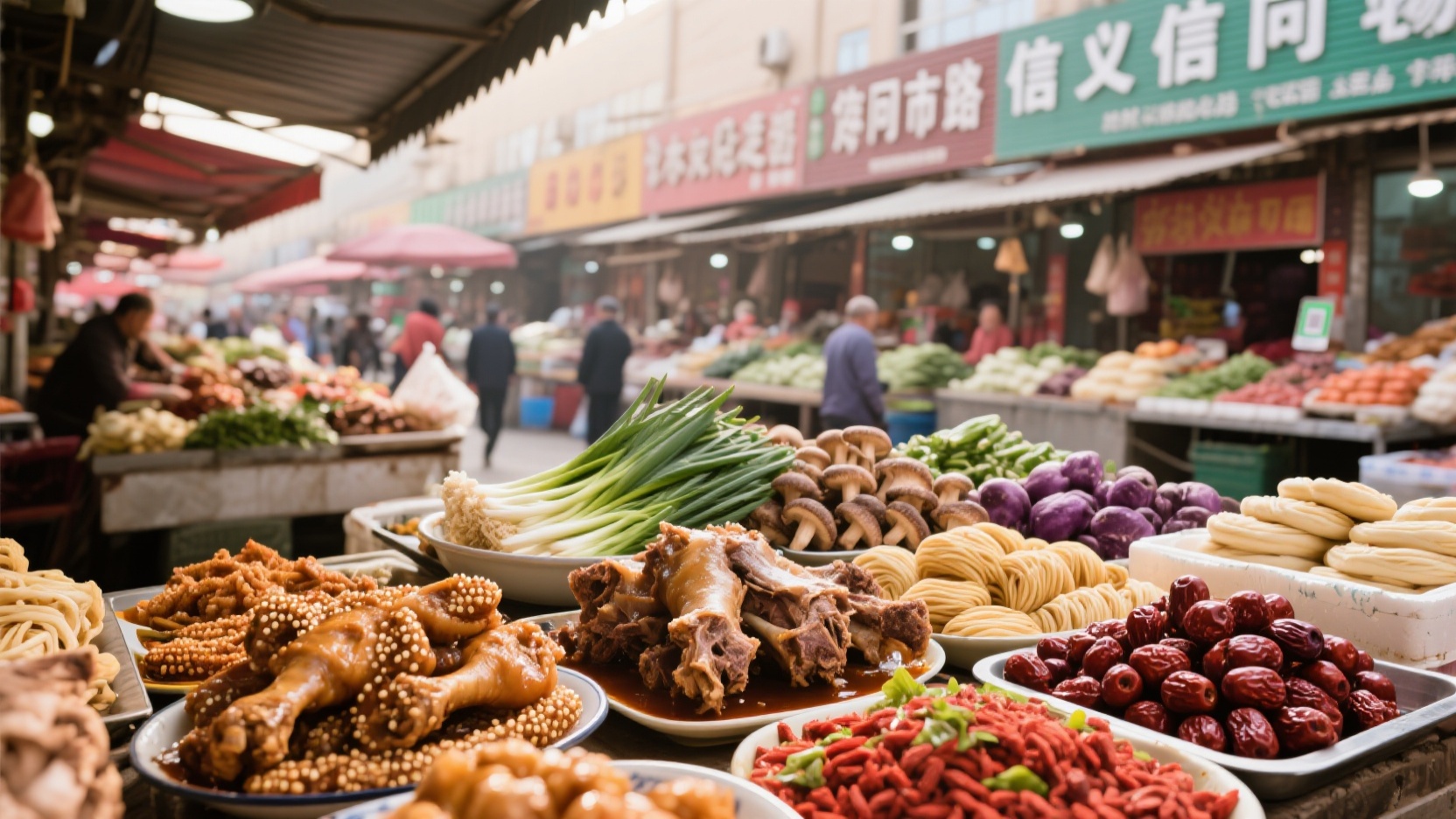
The true culinary essence of Yinchuan lies not in the restaurants of its commercial districts, but in the Xinyi Market in Xingqing District and the Tongxin Road Market in Xixia District. These two long-standing markets are the oldest and most enduring daily shopping destinations in Yinchuan's urban area. The stall owners are mostly local Hui and Han families, and the goods directly reflect the seasonal changes of the Yinchuan Plain and the eastern foothills of the Helan Mountains. The following ten items, categorized into cooked food, handmade pastries, and dried and fresh pickles, are all suitable for tourists to buy in small quantities, take home, or have cooked on-site.
Deli stall: Braised lamb trotters, lamb offal, and braised beef
At the cooked food stalls in Xinyi Market, braised lamb trotters are the most skillfully prepared local cold dish. When choosing them, first check if the tendons are intact, then examine the color of the sauce; it should be a natural reddish-brown from soy sauce and caramel coloring. Avoid those that are too bright red or black. The aroma should be a blend of Sichuan peppercorns, fennel seeds, and lamb fat, without any sourness. For eating, braised lamb trotters are best enjoyed cooled and torn apart by hand. The texture is firm and chewy, and a side of minced garlic and vinegar can cut through the richness. When cut open, observe that the tendons are translucent and there is no blood in the bone crevices, indicating that the braising was done fresh that day.
The semi-finished lamb offal at the fresh food stalls is a shortcut to recreating a Yinchuan breakfast at home. The lamb tripe, head meat, and lungs at the market have already been pre-blanched and cleaned. When buying, choose lamb tripe that is grayish-white, elastic, and not sticky; select lamb lungs that are smooth and well-inflated. At home, put them in a pot of cold water with ginger slices, dried chili peppers, and Sichuan peppercorns, simmer for forty minutes, then add salt. Serve with a flatbread or mixed with potato noodles—it's closer to the local taste than many ready-made packaged meals.
Some long-established stalls still retain the traditional method of making Yinchuan braised beef, using the fore shank of yellow cattle, which is braised, cooled, and then sliced, with the tendons and lean meat showing a transparent pattern. When choosing, it is best to select slices that do not fall apart after slicing and have a gelatinous texture in the middle, which is suitable for stuffing into hot water noodles or serving with cold sand onions.
Handmade pastries: Sugar-coated sesame cakes, scalded dough fried dough, and fennel cakes
Sugar-coated sesame cakes are a type of fried pastry made by the Hui people of Yinchuan for both festivals and daily life. They are shaped like the Chinese character "丫" (ya) and coated with brown sugar and honey. The handmade stalls in the market usually start frying them in the early morning and sell out by noon. When choosing them, select those with a bright red color, a sugar coating that doesn't become damp, and clear internal layers that haven't absorbed too much oil. They should be crisp at first and then soft, with a slight sesame oil aroma. It's recommended to eat them with eight-treasure tea, or break them into small pieces and soak them in unsweetened milk.
Hot water dough fried dough is a staple food on family tables in Yinchuan. It's made by kneading the dough with boiling water and then pan-frying it, resulting in a soft yet chewy texture. Good hot water dough fried dough should have irregular small bubbles on the surface, slightly crispy edges, and a quick spring-back motion when pressed in the center. It can be refrigerated after purchase and can be reheated in a dry pan over low heat before eating. It's suitable for wrapping with braised beef, pickled shallots, or chili sauce.
Fennel cakes are commonly found at handmade pastry stalls in Tongxin Road Market, and come in two varieties: baked and pan-fried. The baked ones have a crispier crust, while the pan-fried ones are softer inside. Both require a generous amount of chopped fennel, and you should be able to smell a distinct pungent aroma when you break one open. When choosing a cake, gently press it; if it springs back quickly, it indicates proper fermentation. If it only smells of flour and lacks fennel, it usually means the fennel wasn't used enough.
Pickled Vegetables and Dried/Fresh Products: Pickled Sand Onions, Helan Mountain Purple Mushrooms, Lingwu Long Jujubes, and Fresh Goji Berries
Pickled sand onions are a unique wild vegetable pickled in Ningxia and the surrounding arid regions. They have a crisp and tender texture, with a sour and spicy flavor and the aroma of wild onions. Pickled sand onions are sold in bottles and in bulk at market stalls. When choosing, check if the color is deep green and the broth is clear; if the broth is cloudy or the onions are yellow, it means they have been pickled for too long. They are mainly eaten cold, and are more flavorful than ordinary pickled vegetables when mixed with noodles, sandwiched in flatbread, or served with congee.
Helan Mountain purple mushrooms are a local ingredient for stewing chicken and mutton. They are wild-harvested and sun-dried, resulting in a rich aroma. When buying dried mushrooms, choose those with intact caps, light yellow gills on the underside, and no insect damage. They should have a dry, earthy aroma reminiscent of pine needles. Before soaking, quickly rinse with cold water, then soak in warm water. After the soaking water settles, it can be added to the pot for stewing.
Lingwu jujubes are one of the most worthwhile fruits to buy in Yinchuan in autumn, generally available from early September to mid-October. When choosing jujubes, look for those with smooth skin, a red and yellow color, and a firm, crisp texture; jujubes with dry stems are usually not fresh. Jujubes can be eaten directly as a snack, or they can be steamed for ten minutes, peeled, and given to the elderly or children for a sweeter taste.
Fresh goji berries are available briefly from June to August. Their taste is completely different from dried goji berries; they have thin skin, are juicy, and have a slightly bitter aftertaste. They are usually sold in small baskets in the market. When choosing fresh berries, look for plump berries that are orange-red without turning black, and whose stems are still green. Fresh berries do not keep well and are recommended to be consumed on the same day, or frozen and used for juice or yogurt.
Exploring the local markets is the best way to experience a city. Xinyi Market and Tongxin Road Market lack structured tourist routes and stalls set up for photo opportunities, yet they preserve the most authentic seasonal rhythm of Yinchuan: spring brings the first harvest of wild onions, summer offers selenium-rich melons and fresh goji berries, autumn boasts jujubes and purple mushrooms, and winter's hearty braised lamb trotters and offal soup exude a comforting warmth. A simple question at a stall, "How do I eat this?" often yields the most direct and insightful local advice. A trip that treats the market as a destination leaves a more lasting impression of a city's character than simply visiting tourist attractions.