
How can I schedule a day at Xi'an's cultural and artistic venues without feeling rushed or empty? I went through the schedule based on lighting and opening hours.
Many readers who come to Xi'an for a cultural and artistic trip don't start with "Where to go?" but rather with "How to plan a day?" A loose schedule leaves two or three hours unsettled; a tight schedule means constant travel, making it difficult to even properly appreciate the inscriptions in the Stele Forest. This guide, based on the changing light throughout the day and the opening and closing times of various venues, connects six time slots into a followable route. For each location, I'll explain why a particular time is chosen over another.
6:30 | Shuyuanmen and the outer wall of the Stele Forest: Before the tourists arrive, let's see the unadorned side of the street.
Shuyuanmen may not be on anyone's "must-see" list, but it's one of the few cultural districts in Xi'an's old city where you can stroll quietly in the early morning. At this time, most shops are closed, and only local elderly people taking a walk and a few students pass by on the stone-paved streets. What you should appreciate is the street itself: the shadows of old locust trees fall on the antique-style facades, and the Ming and Qing style buildings along the street are not yet obscured by vendors' parasols, allowing for clean street photography. Another advantage is the light. In Xi'an during the summer, the light becomes quite harsh after 10 am, but the soft, slanting morning light creates the clearest sense of depth on the blue brick walls and wooden doors and windows.
Don't plan to buy stationery during this time, as the shops are closed. Instead, walk for 15 to 20 minutes, enter from the south gate, and stroll slowly to the entrance of the Stele Forest Museum. This way, you'll be among the first customers when the museum opens.
8:00 AM | Xi'an Beilin Museum: Enter as soon as it opens to stand still in front of the famous steles.
The Beilin Museum opens at 8:00 AM, and this time must be taken advantage of. Most tour groups arrive after 9:00 AM, allowing you to stand in front of the *Stone Classic of Filial Piety*, the *Kaicheng Stone Classics*, or the *Preface to the Sacred Teachings of the King of Calligraphy* within the first hour of opening, without having to see the inscriptions through layers of people. This is crucial because the essence of the Beilin Museum isn't simply "having been there," but "being able to see clearly." The details of the stone inscriptions are entirely different when viewed through a crowd versus when viewed up close.
Additionally, the exhibition halls in the Stele Forest are mostly semi-open spaces. In the early morning, the light shines obliquely in from the east, making the shadows on the characters more pronounced and easier to read than under the direct midday sun. It's recommended to start with the first room and proceed to the Stone Carving Art Gallery in order, taking about an hour and a half. Once the crowds pick up around 9:30 AM, you can leave.
10:30 | Xi'an Museum and Small Wild Goose Pagoda: Taking over from the Forest of Steles during the museum's quiet hours.
Many people struggle to decide between the Shaanxi History Museum and the Xi'an Museum. If you only have one day and have already seen a lot of stone carvings and calligraphy at the Stele Forest Museum, the Xi'an Museum is a more convenient alternative. It opens at 9:00 AM, and by the time you arrive at 10:30 AM, the first wave of visitors has already moved deeper into the museum, and the entrance area is no longer congested. The museum's model of Chang'an during the Tang Dynasty, Buddhist statues, and jade artifacts are all well-displayed. The exhibition lines are not long, but each item has a clear explanation.
The lighting at this time of day is perfect for viewing the Small Wild Goose Pagoda. The pagoda is located within the park, sharing space with the museum. Before 11:00 AM, the sun isn't too intense, and standing on the north side of the pagoda offers a clean composition of the pagoda against the greenery. Walking through the entire park takes about 40 minutes, without feeling overwhelmed by a packed schedule.
13:00 | Gao Family Courtyard, Beiyuanmen, west of the Muslim Quarter: Watch indoor performances during the hottest part of the day.
1 PM is the most unbearable time of day in Xi'an's summer, making it unsuitable for strenuous outdoor walking. The Gao Family Courtyard, located near the Muslim Quarter, is one of Xi'an's best-preserved Ming and Qing dynasty residences. Its biggest advantage is its indoor performance space and shaded courtyard. Shadow puppetry and Huayin Laoqiang opera performances are held here regularly, for short durations, allowing you to sit down and rest while appreciating Shaanxi folk art. While Beiyuanmen Main Street is bustling with people, the Gao Family Courtyard, situated in a side alley, is several levels quieter than the main street.
After the performance, sit for a while under the corridor in the courtyard, watching the sunlight shine on the blue brick walls—it's much better than scrolling through your phone. This isn't a "luxury tourist attraction," but its strength lies in its authenticity and relaxed pace. Don't go to the city wall at this time; save that for the evening.
16:00 | Big Wild Goose Pagoda and Da Ci'en Temple: Avoid the midday sun overhead and wait for a suitable side light for the pagoda.
The area around the Big Wild Goose Pagoda is packed with tour groups in the morning, and the midday sun makes the pagoda look flat and lack depth. After 4 PM, the sun begins to set, and the light comes from the southwest side of the pagoda, creating a pleasant shadow on the southeast side, resulting in much better detail than at midday. Entering the park at this time avoids the peak hours between 3 PM and 4 PM. The Da Ci'en Temple itself isn't very large; the main attractions are the Mahavira Hall, exhibits related to Xuanzang's life, and climbing or walking around the pagoda to see the details of the brickwork.
Climbing the tower is unnecessary. The interior is cramped, the stairs are steep, and the queues are long, offering little benefit to your cultural and artistic itinerary. Walking around the tower to see the Tang Dynasty line carvings on the west lintel is far more worthwhile than squeezing inside. Aim to leave the park before 5:30 PM, allowing for a leisurely stroll towards the plaza.
18:30 | The skyline of sculptures and buildings surrounding the Tang Paradise: Arrive before or after the lights come on, don't wait until late at night.
The essence of the Tang Dynasty Never Sleeping City isn't the small shops lining the streets, but rather the Tang Dynasty-themed sculptures and architectural outlines along the street. Between 6:30 PM and 7:00 PM, before it's completely dark, the lights are already on, the sky is a deep blue, and the architectural outlines and lights simultaneously become part of the scene. At this time, the crowds haven't reached their peak, so you can walk south from the South Square of the Wild Goose Pagoda to see the details of the "Reign of Zhenguan" and "Kaiyuan Prosperity" sculpture groups.
I don't recommend eating here, nor do I recommend waiting until after 8 or 9 pm. As night falls, the crowd density increases dramatically, making walking difficult and rapidly diminishing the cultural experience. You only need this half-hour "blues hour" to see the most worthwhile parts of this street. After that, you can leave and let the city walls enjoy the night.
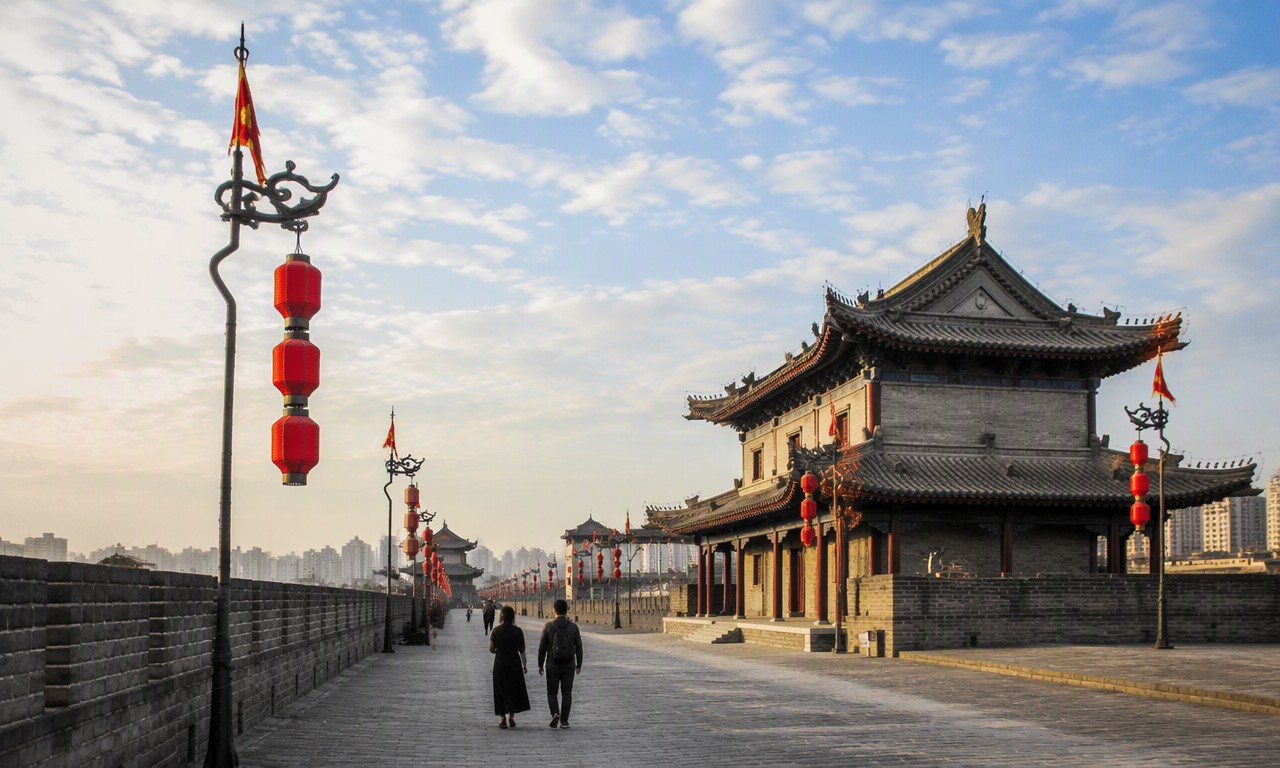
20:30 | South Gate Section of Xi'an City Wall: The city at night is more like Chang'an than during the day.
Entry to the city wall closes at 10 PM, so arriving at the South Gate at 8:30 PM will give you ample time for a nighttime stroll. This time is chosen because the ground temperature has already dropped in the summer night, and the city wall's nighttime lighting makes its outline clearer, creating a stronger contrast between the ancient-style streets inside the city and the modern buildings outside compared to daytime. Starting from the South Gate, walk east to the Heping Gate section and then back; a leisurely walk with photos can be completed in under an hour and a half.
It's not recommended to go up the city wall in the afternoon. In summer, there's no shade on the wall in the afternoon; it's scorching hot and the air is dry. Between 9 am and 4 pm is not a good time to go. What you see from the wall at night is the city's most distinctive cultural silhouette, not the daytime traffic and heat.