
Half-Day Craftsmanship in Shaoxing: The Water Town Secrets of the December Festival, Yue Kiln Throwing, and Yue Opera Water Sleeves
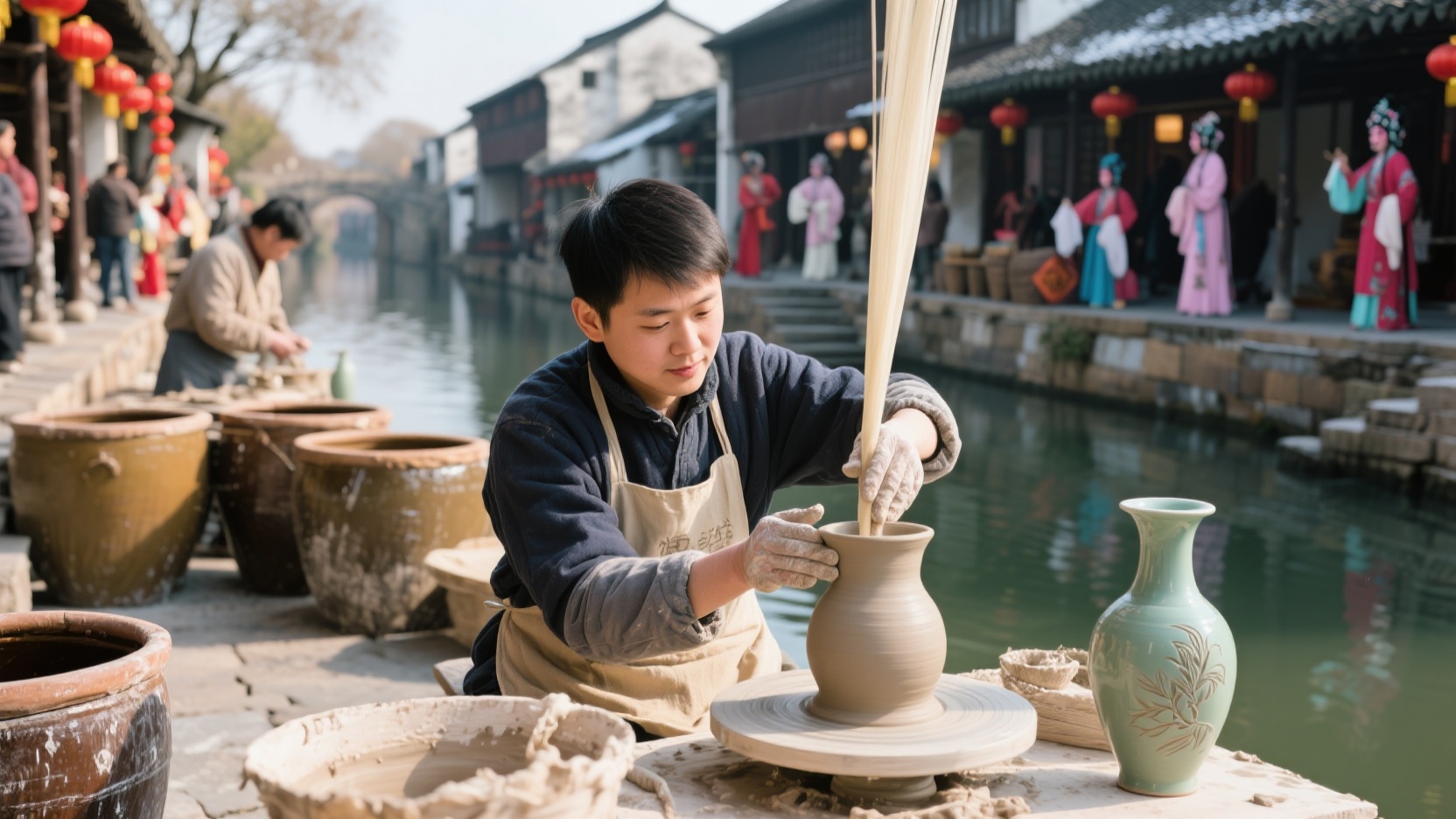
A cultural trip to Shaoxing can extend beyond Lu Xun's former residence and the Orchid Pavilion Preface. To truly capture the "literary spirit" of this water town, a more substantial approach is to immerse yourself in a festival, a ceramic bowl, or a line of opera. The following four events correspond to the December Folk Festival, Yue Kiln Celadon, Yue Opera Water Sleeves, and Winter Brewing on the Beginning of Winter, each requiring half a day. Sit down and become a local for a while.
Anchang December Folk Festival: Encountering "Blessings" Amidst the Aroma of Soy Sauce and Traditional Opera
Every year in the twelfth lunar month, the three-mile-long old street along the river in Anchang Ancient Town is adorned with freshly made braised ducks, sausages, and dried bluefish, providing the most direct visual opening to the December Festival. The experience doesn't have to start with shopping; first, watch the craftsmen at the riverbank demonstrate "pulling white sugar": the scalding syrup is repeatedly pulled on a pillar, changing from amber to milky white, and you can hear the crisp sound of the sugar granules bursting when cut into pieces. Learn to "pound rice cakes" with the locals; the glutinous rice in the stone mortar requires two people working together, one turning and the other pounding, and the freshly pounded rice cakes are best dipped in white sugar for maximum stickiness. In the evening, there are traditional water town operas and Shaoxing lotus flower ballads along the riverbank. Performers wearing black felt hats sing and recite in their local dialect; even if you don't understand the language, you can still feel the local flavor in their singing. Anchang is the hometown of the "Shaoxing scribes," and the December Festival preserves the New Year's rituals of "blessing" described by Lu Xun. The braised goods hanging under the eaves are not just food, but also the most honest preparations of old Shaoxing for the "New Year."
Yue Kiln Celadon Workshop: Understanding "Mother Porcelain" from a Lump of Clay
There are many Yue ware celadon studios in Shangyu and Keqiao areas of Shaoxing, where you can book a half-day experience of throwing, carving, and glazing. Yue ware is the origin of mature celadon in China. By the late Eastern Han Dynasty, it was already able to fire vessels with delicate bodies and lustrous blue glazes. Lu Yu of the Tang Dynasty praised Yue ware celadon as "like jade" and "like ice" in his "The Classic of Tea". During the experience, you first watch the master throw the clay on the wheel, shaping it into cups, bowls, and plates. When it's your turn, you'll realize that "unstable center" is the most common failure. After learning the basics of throwing, you can try carving with a bamboo knife, creating simple lotus petals or water ripples on the clay. Finally, a thin layer of glaze is applied, and the finished product can be taken home after firing in the kiln. The value of this half-day experience lies not in creating perfect vessels, but in understanding why Yue ware celadon influenced Longquan, Yaozhou, and even Goryeo celadon—starting from the clay beneath your feet, a history of ceramics is in your hands.
Shengzhou Yue Opera Town: Wear a costume and learn half a line of "Lin Daiyu"
Yue Opera originated in Shengzhou, Shaoxing. From its humble beginnings as a small troupe of storytelling to its current popularity in Shanghai, it has only been a little over a century. The ancient theaters and rehearsal halls of Shengzhou Yue Opera Town often offer hands-on experience sessions for beginners. These sessions include costume fitting, basic water sleeve exercises, and the recitation and singing styles of young male or female leads. The experience doesn't focus on completing a full song; instead, participants first learn the pronunciation and breathing of a line like "A Lin Sister fell from the sky," then put on the water sleeves and follow the teacher for two rounds of "stage walking." Once in costume, one unconsciously straightens their back—a physical constraint imposed by the costume and part of the opera's ritualistic aspects. Yue Opera is known for its "lyrical beauty," and many lyrics are embellished versions of the local Zhejiang dialect, such as the words "侬" (nong) and "伊" (yi). Understanding these colloquial origins makes it easier to immerse oneself in the role than simply memorizing the lyrics.
Dongpu Shaoxing Wine Winter Brewing: Watch the master craftsman "listen" to the wine and draw a carved jar.
Shaoxing rice wine emphasizes "winter brewing." Around the time of the Beginning of Winter (Lidong), the distilleries in Dongpu Rice Wine Town begin their most crucial year of production. Visitors can observe processes such as soaking rice, steaming rice, transferring it to vats, and stirring. Among these, "stirring" is the most skillful: experienced distillers reach into the fermented mash, judging the fermentation rhythm by temperature and sound, and deciding when to stir it. This isn't a performance, but the daily judgment of the rice wine's "master craftsmen." During winter brewing, many distilleries offer a hands-on experience of painting on carved rice jars. Using mineral pigments, visitors can paint flowers, birds, figures, or auspicious patterns on plain jars, write "Shaoxing Carved Rice Wine," and add a date. After the jars dry, they can be displayed as ornaments. Shaoxing rice wine is brewed using Jianhu Lake water, glutinous rice, and wheat koji. The core of winter brewing is low-temperature, long-time fermentation, which allows the wine to produce more amino acids and aromatic substances. Sitting by the distillery watching the steam rise provides a direct understanding of how "favorable weather" shapes the flavor.
There's no need to rush through any of the four destinations; half a day is sufficient for each. Visit Anchang in the twelfth lunar month, Dongpu at the beginning of winter, or at any time go to Shangyu to pick up a celadon cup, or try on the water sleeves in Shengzhou. The "literary atmosphere" of Shaoxing will then become a visceral memory, rather than just a tourist attraction description. A quick visit to Shaoxing is just a whirlwind tour; sitting down and experiencing half-local life allows you to take away the lingering warmth of its craftsmanship and the echoes of its operas.