
Should you go to Shanghai during peak season or off-season? Let me break it down for you using three scenarios.
Peak season vs. off-season: It's not a question of "whether you can go," it's a question of "what to see."
Most travel guides will tell you that Shanghai doesn't have a distinct peak or off-peak season, and you can come anytime. In reality, the difference between "peak season" and "off-peak season" in Shanghai isn't about the scenery, but about your daily pace of movement and patience in queues. During peak seasons like National Day, Spring Festival, and summer vacation, places like the Bund, Yu Garden, Nanjing Road, and Wukang Road are packed with people. With dialects from all over the country mixed together, all you'll see when you raise your phone to take a picture is the back of someone's head.
If you only have one chance to visit Shanghai, I would suggest avoiding long holidays, but not the so-called "off-season" of midwinter. Late January and early February in Shanghai are damp and cold, the plane trees are bare, and the sky turns gray by 4 pm. Spend two days there, and you'll understand why Shanghainese people love to hide in cafes. The truly comfortable times are late April to mid-May and mid-October to mid-November—the weather is stable, not too crowded, and you can stroll through the streets without feeling uncomfortable. These periods aren't cheap, but they're worth the time you take.
Weekends vs. Weekdays: It's not a difference in "how many people are there," it's a difference in "whether you can get a meal."
Most travel guides will tell you to avoid weekends and go to popular cafes on weekdays instead. Actually, that's only half true. Places like Wukang Road, Anfu Road, and Yuyuan Road are just as crowded on weekday lunchtimes, with people from nearby offices coming out for lunch and a stroll, and cafes are usually packed. The real downtime on weekdays is from 2:30 pm to 4:30 pm. During this time, walking around the area, taking photos, trying on clothes in stores, and sitting by the window offers a significantly better experience.
However, if your main purpose for coming to Shanghai is to eat local cuisine, xiaolongbao (soup dumplings), and noodle shops, then weekday lunchtimes will be a major problem. Established restaurants and neighborhood noodle shops are packed with local office workers and long-time residents during lunchtime, and queuing and sharing tables is the norm. Weekends are actually a bit better because locals don't come out to compete with tourists. If you visit some old shops in Ximen, Hongkou, or Yangpu on weekends, the pace will actually slow down. So my advice is: spend your shopping and architectural explorations on weekdays, and your time at established restaurants on weekends—don't do it the other way around.
Group tours vs. independent travel: It's not a question of "which is more hassle-free," but rather a question of "what depth you can see."
Most travel guides will tell you that independent travel in Shanghai is perfectly fine, with convenient transportation and no language barrier. I agree with that assessment, but I have to add a twist: Shanghai's most valuable asset isn't its tourist attractions, but the layered texture of its urban fabric. Walking from the Bund to Sichuan North Road, turning from Shaoxing Road to Yongkang Road—this kind of "you only understand it by walking" urban experience is something tour buses can't provide. Group tours move quickly, and all you remember are a string of place names.
However, there's one scenario I partially agree with regarding group tours: if you only have a day and a half in Shanghai and want to see the Bund, Yu Garden, Oriental Pearl Tower, and Xintiandi all at once, then joining a half-day or full-day small group tour can indeed save a lot of travel and queuing. The trade-off is that you'll have virtually no free time to explore. The cost of independent travel isn't money, but the need for advance planning. Shanghai's subway is convenient, but some transfer stations are incredibly difficult to navigate, and without route planning, you can easily waste half a day in the transfer corridors. Therefore, small group tours are acceptable for stays of one and a half days or less, but for stays of two days or more, I 100% recommend independent travel.
Living on Nanjing Road vs. living in the French Concession: It's not a question of "which is more lively," but rather "where to go out at night."
Most travel guides will tell you that staying near People's Square or Nanjing East Road is convenient, with the subway right outside. That's true, but it depends on what kind of nightlife you want to enjoy. If you stay on Nanjing East Road, you'll be surrounded by crowds, neon lights, and chain stores at night, and the late-night food options are mostly tourist trap quality. The streets are still noisy after 10 pm. After a day of sightseeing, you won't want to take a walk around your hotel.
In reality, if you're willing to be a little more generous with your accommodation budget, staying in the side streets around the French Concession or Jing'an Temple area is a true reflection of the Shanghai local lifestyle. Leaving your hotel at 10 pm, you'll find small bars, 24-hour noodle shops, and brightly lit Japanese izakayas just a few steps away. This value of "experiencing the neighborhood right from your stay" far outweighs the savings on travel time. The real advantage of staying on Nanjing Road is the convenience of going to the Bund for morning and evening shows, but it's only two or three subway stops to the Bund, so it's not worth sacrificing accommodation quality for that.
Enjoying local Shanghai cuisine: Going to a fancy restaurant vs. finding a time-honored brand vs. sitting in a private kitchen.
Most travel guides will tell you to eat local Shanghai cuisine when you come to Shanghai, and then give you the names of a few big restaurants. In reality, big restaurants are all about the prestige and standardization, with rich and heavy sauces, but you can easily get a sense of security from the "tourist restaurants." The problem with established restaurants is that the quality varies. Some branches are just maintaining a facade, while others still preserve the skills of the master chefs. You have to know how to choose.
My practical advice is twofold: For your first visit, find a long-established or reputable mid-range Shanghainese restaurant and order dishes like braised pork belly, braised pork with bamboo shoots, braised pork belly with shredded pork and vegetables, and stir-fried eel with hot oil. You can get a taste of the local cuisine for around 100 RMB per person. For your second visit, look for those small, private restaurants that require advance reservations. They're more upscale, but worth it because that's what real Shanghainese families eat during holidays. Don't go for the expensive stuff on your first meal; you haven't established a taste reference point yet, and you might end up wasting money.
Viewing the Bund at night: Crowding along the riverbank vs. climbing to a high-rise building vs. switching to the other side.
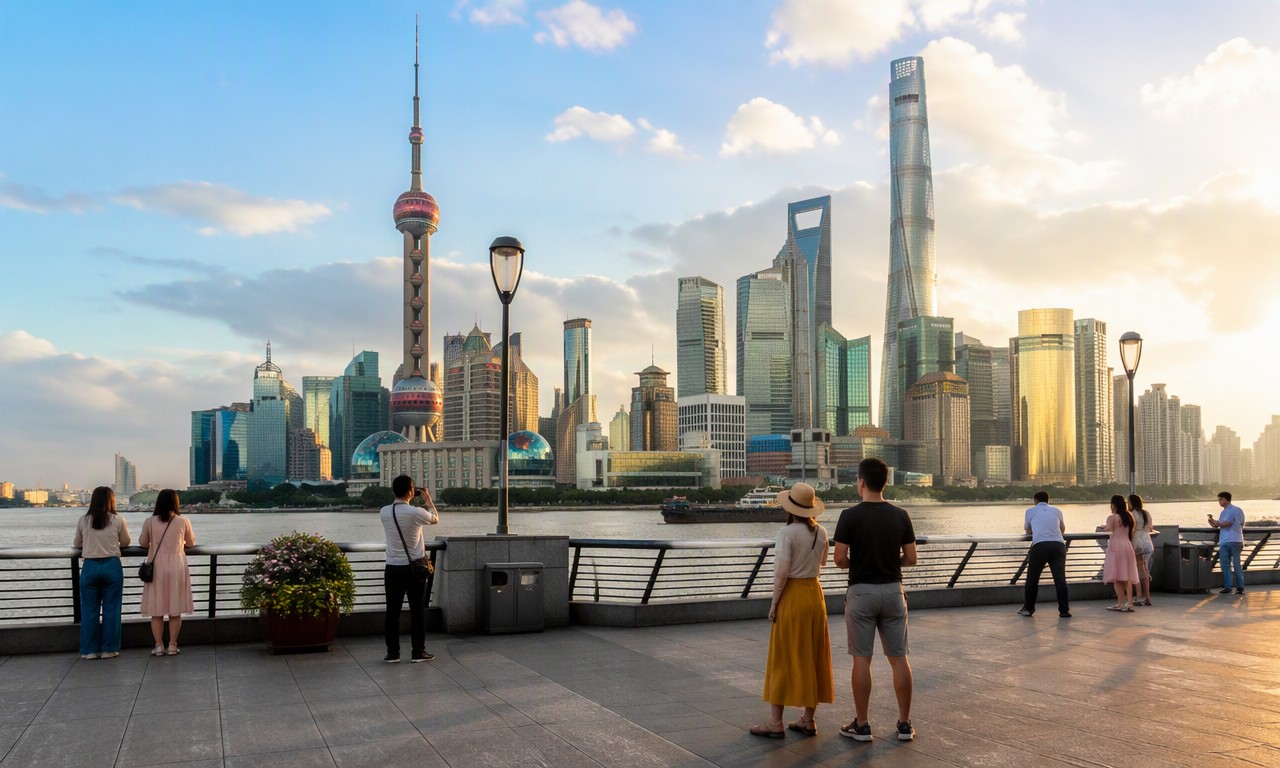
Most travel guides will tell you that the Bund's night view is a must-see, and that it's best to go around 7 pm. In reality, 7 pm is when you'll be pushed along by the crowds. What you need to do is arrive at the Bund about half an hour early, around 5:30 pm, to watch the sky change from blue to purple and then to black. This transition of light and shadow is far more beautiful than a pure night view. After you've seen it, don't linger; you should leave when the crowds start to thicken.
Going to a high-rise building for a night view might seem like a "God's-eye view," but the glare from the glass and the long queues diminish the experience. My alternative is to go to the North Bund or Pudong Bund waterfront if you prefer quiet; there are far fewer people, and the views of the Lujiazui skyline are just as good. If you absolutely must go up high, go after 9 pm on a weekday; the queues are much shorter, allowing you to enjoy the view in peace. Also, the view of the Bund from the opposite bank and from the old Bund offers two completely different experiences: the former is a view of a capitalist jungle, while the latter is a view of a century-old architectural complex. It depends on your preference.
Buying souvenirs: Going to a specialty store vs. going to a grocery store vs. buying nothing
Most travel guides will tell you to bring back Shanghai specialties from brands like Lao Xiang Zhai, Shen Da Cheng, and Harbin Food Factory. However, in reality, the only things your family can clearly tell whether they taste good or not are freshly made pastries and freshly baked butterfly cookies. Those vacuum-packed items with long shelf lives generally lose some of their flavor.
My approach is this: if you're giving gifts, prioritize freshly baked or short-shelf-life pastries, and buy them the day before you leave. The butterfly cookies at the International Hotel have long queues, but it's much shorter on weekday afternoons. If you really don't want to queue, sea salt or caramel butterfly cookies from mid-range or higher bakeries are also quite good. If you find it troublesome, not giving a gift is perfectly acceptable. Shanghainese don't necessarily insist on giving local specialties; bringing a box of freshly baked pastries is much more respectable than carrying a bag of "Old Shanghai Snow Cream" from Yiwu.
How many days is enough to play: Two days for a quick check-in vs. three and a half days to "stay overnight"
Most travel guides will tell you that two days is enough for Shanghai. In reality, two days is only enough to get a general idea: one day for the Bund, Nanjing Road, and Yu Garden, and one day for the French Concession or Pudong. This itinerary is extremely packed; you'll basically be rushing around, and all you want to do when you get back to the hotel is collapse.
If your goal in coming to Shanghai is to "check off landmarks," then two to three days is enough. But if you want to experience Shanghai's daily life, I suggest allocating three and a half to four days. Use that extra half-day to a full day without planning any sightseeing; just wander through the neighborhoods, take the bus, browse the market, eat a bowl of noodles, or sit in a café admiring the plane trees. This one day will help you truly understand why Shanghai is called Shanghai, and it's the most important piece of advice I always give to people before their trips.