
Lanzhou Slow Travel 5 Days 4 Nights | A Checklist to Avoid for Seniors with Parents (Elevator/Toilet/Lunch Break All Marked)
How to choose accommodation: Being close to the hospital is more practical than being close to Zhongshan Bridge.
This time, we chose a location in Qilihe District near the Gansu Provincial Museum and the center of Lanzhou, instead of staying by the Yellow River. The reasons are straightforward: there's a large shopping mall downstairs, plenty of restrooms, elevators, and plenty of places to sit and have a hot drink; it's about a 15-minute walk to the Provincial Museum, and the road is relatively flat; and a taxi ride to a nearby level-two or higher general hospital takes about 15 to 20 minutes. When traveling with elderly people, the availability of accessible sidewalks, shopping mall restrooms, and community clinics within 500 meters of the accommodation is far more important than whether the view of the Yellow River at night is from the window.
I almost booked a high-rise river-view guesthouse near Zhongshan Bridge for my first night, but when I arrived, the elevator was old and there were two steps in the hallway, so I promptly cancelled and went to Qilihe District instead. Avoid the trendy guesthouses in the old city's pedestrian streets; many don't have elevators or the elevators are too narrow, making it difficult for wheelchairs and walkers to get in and out. I recommend choosing a four-star or mid-range chain hotel, and call ahead to confirm "whether there's a direct elevator from the underground parking garage, whether the rooms have non-slip mats, and whether the public restrooms are open." Lanzhou winters have a large temperature difference between indoors and outdoors, and hotel heating is too strong, so remember to bring a humidifier or ask the front desk for a couple of extra bottles of water.
Days 1-2: The Yellow River Scenic Route will be split into two half-day trips.
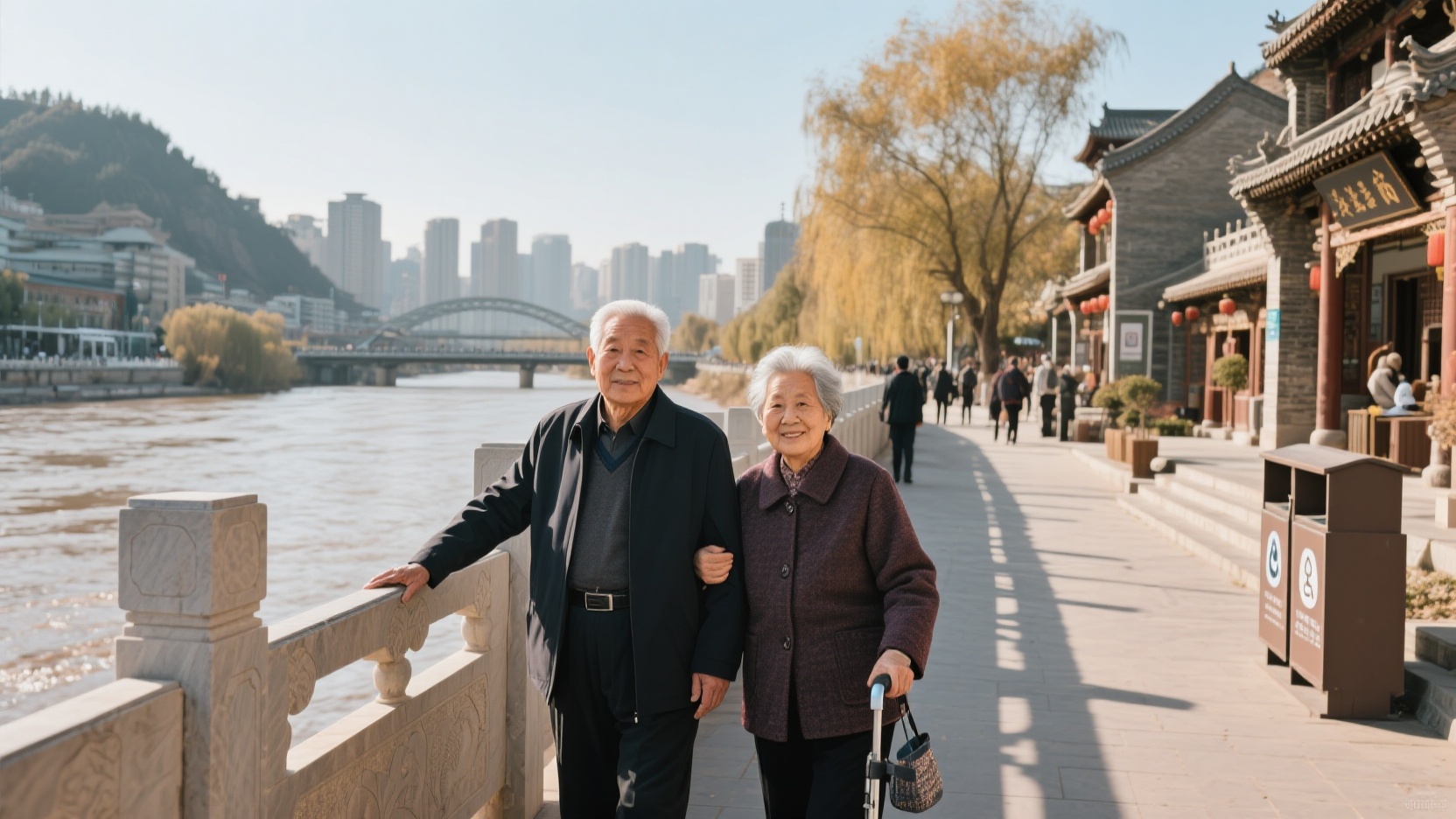
The Yellow River Scenic Belt appears to be a flat road, but the one-way distance from Zhongshan Bridge to the Waterwheel Expo Park is over two kilometers, which is too long for the elderly. I split it into two half-days: the first afternoon, I only walked the section from Zhongshan Bridge to the Yellow River Mother Sculpture, about 1.2 kilometers long, with at least three public restrooms and several stone benches along the way. Zhongshan Bridge is crowded, especially in the evening, and the elderly are easily pushed to the railings; it's recommended to go in the morning when it's less crowded. The railings at Zhongshan Bridge are quite low, so someone should definitely help you when taking photos. The small square next to the Yellow River Mother Sculpture has a flat surface, and wheelchairs can be pushed, but the riverside path has steps, so don't go down them.
The next morning, visit the Waterwheel Expo Park. Enter from the east gate, not the south gate steps. There are wooden walkways in the waterwheel area, but some planks are warped; if you're pushing a wheelchair, choose the concrete path on the inner side. The restrooms are conveniently located, with one near the main entrance, suitable for the elderly. Leave before 11:30 AM, take a taxi back to the hotel for lunch and a rest. No outings planned for the afternoon; just a stroll in the nearby shopping mall, buying some fruit and yogurt. Note: Lanzhou has strong sunshine, even in autumn and winter, wear a hat and sunglasses. The wind is strong along the Yellow River, so a scarf is essential.
Day 3: Which to choose between Hekou Ancient Town and Dunhu Hot Springs?
On the third day, two options are provided, depending on the elderly person's condition before departure. Option A: Hekou Ancient Town: About an hour's drive from the city center. The main street of the ancient town is paved with stone slabs, slightly sloping but generally flat. There is a visitor center and public restrooms at the entrance. It is not recommended to push a wheelchair through the entire town; you can walk to the Bell and Drum Tower and turn back, which is about 600 meters one way. Some old houses in the ancient town have high thresholds, so just look at them from the outside. The return trip is scheduled before 3 pm to avoid interfering with the afternoon rest. Option B: Dunhu Hot Spring: More suitable for elderly people who are sensitive to cold. The indoor changing area has benches and non-slip mats. An elevator goes directly to the hot spring pool level. There are many restrooms in the hot spring area, and the staff will proactively remind you to walk slowly. Blood pressure should be checked before and after soaking in the hot spring. Each soak should not exceed 15 minutes, and a towel should be put on immediately after getting out of the water.
The key to choosing between the two options isn't "which is more fun," but rather the elderly person's blood pressure and knee condition on the day of the visit. If they didn't sleep well the night before or it's raining and cold, definitely choose the hot springs; if the weather is fine and the elderly person wants to move around, the Hekou Ancient Town offers a more authentic Lanzhou atmosphere. For both options, it's recommended to hire a car or ride-hailing service directly, avoiding public transportation transfers. If hiring a car, choose a spacious vehicle and tell the driver beforehand, "There are elderly people with us, please be careful getting them on and off." If the elderly person has high blood pressure, they must sit quietly in the changing area for ten minutes before entering the hot springs.
Days 4-5: Museum and old street, only choose the side with the elevator.
On the morning of the fourth day, visit the Gansu Provincial Museum. Remember to make a reservation in advance, choosing a time slot between 9:00 and 10:00 AM to avoid crowds and allow for a more leisurely visit. Use the accessible entrance at the North Gate. Each floor has elevators and accessible restrooms, and the display cases are wheelchair-friendly. Focus on the Bronze Galloping Horse and Painted Pottery exhibits, limiting your time to within 40 minutes, with a short break in the second-floor rest area. After the museum, walk to Lanzhou Center. The entire walkway is connected by indoor corridors and elevators. Each floor of the shopping mall has family restrooms, suitable for seniors. On the morning of the fifth day, visit Lanzhou Old Street. Do not enter from the west-side staircase entrance; instead, enter from the east-side flat entrance. The street is spacious, and the antique-style buildings are photogenic. However, before 10:00 AM, few shops and restrooms are open; it's recommended to arrive after 10:30 AM. Return to the hotel early at noon to pack your luggage. After checking out, store your luggage. Allow ample time to prepare for the afternoon train journey.
Many people would add Wuquan Mountain or Baita Mountain to their itinerary, but I didn't take my parents this time. Although Baita Mountain has a cable car, you still need to walk up some steps to get to the pagoda after getting off the cable car, and it's windy at the top. Some slopes in Wuquan Mountain Park are quite steep, and the toilets are far apart. Taking the elderly on a slow trip and giving up the "we're already here" mentality is the only way to ensure that "Mom and Dad aren't tired."
A summary of pitfalls to avoid during a leisurely trip to Lanzhou for senior citizens.
After 5 days and 4 nights, what my parents were most satisfied with wasn't how many attractions they saw, but rather the fact that they could take a nap every day, the restrooms were easy to find, and walking wasn't rushed. Lanzhou, as a northwestern city, is dry in autumn and winter with large temperature differences between day and night, so it's essential to include indoor buffer zones in the itinerary, such as shopping malls, museums, and hotel lobbies. Also, taking a taxi is more suitable for seniors than the subway. Although the Lanzhou subway has accessible elevators, you often still have to walk a bit after exiting the station, making point-to-point ride-hailing services much more convenient.
Finally, here is a 20-item packing list for seniors traveling and 5 categories of commonly used medications. The 20 items are: 1. Photocopies of ID card and medical insurance card; 2. Two mobile phone chargers; 3. Folding cane; 4. Two pairs of non-slip soft-soled shoes; 5. Warm scarf and hat; 6. Lightweight down vest; 7. Insulated water bottle; 8. Tissues and wet wipes; 9. Individually packaged snacks; 10. Portable folding cushion; 11. Umbrella; 12. Reading glasses and spare glasses; 13. Spare hearing aid batteries; 14. Non-slip slippers; 15. Disposable underwear and socks; 16. Refillable laundry detergent; 17. Resealable bags; 18. Neck pillow and lumbar support; 19. Medical record book and allergy history card; 20. Portable pulse oximeter or blood pressure monitor. Five categories of commonly used medications to remember: Category 1: Antihypertensive and cardiovascular medications; bring a 5-day supply and divide it into smaller portions to carry with you. Category 2: Gastrointestinal medications, for those experiencing water or traveler's diarrhea. Category 3: Cold and flu medications and a thermometer. Category 4: External medications such as band-aids, iodine swabs, and liniments. Category 5: Prescriptions for personal long-term medications; take photos of these prescriptions and save them on your phone, noting the generic names of the medications. Do not check any of these medications in; carry them with you.