
Between Drumbeats and Carving Knives | From Folk Performances to Gourd Carving: Half a Day as a Lanzhou Craftsman
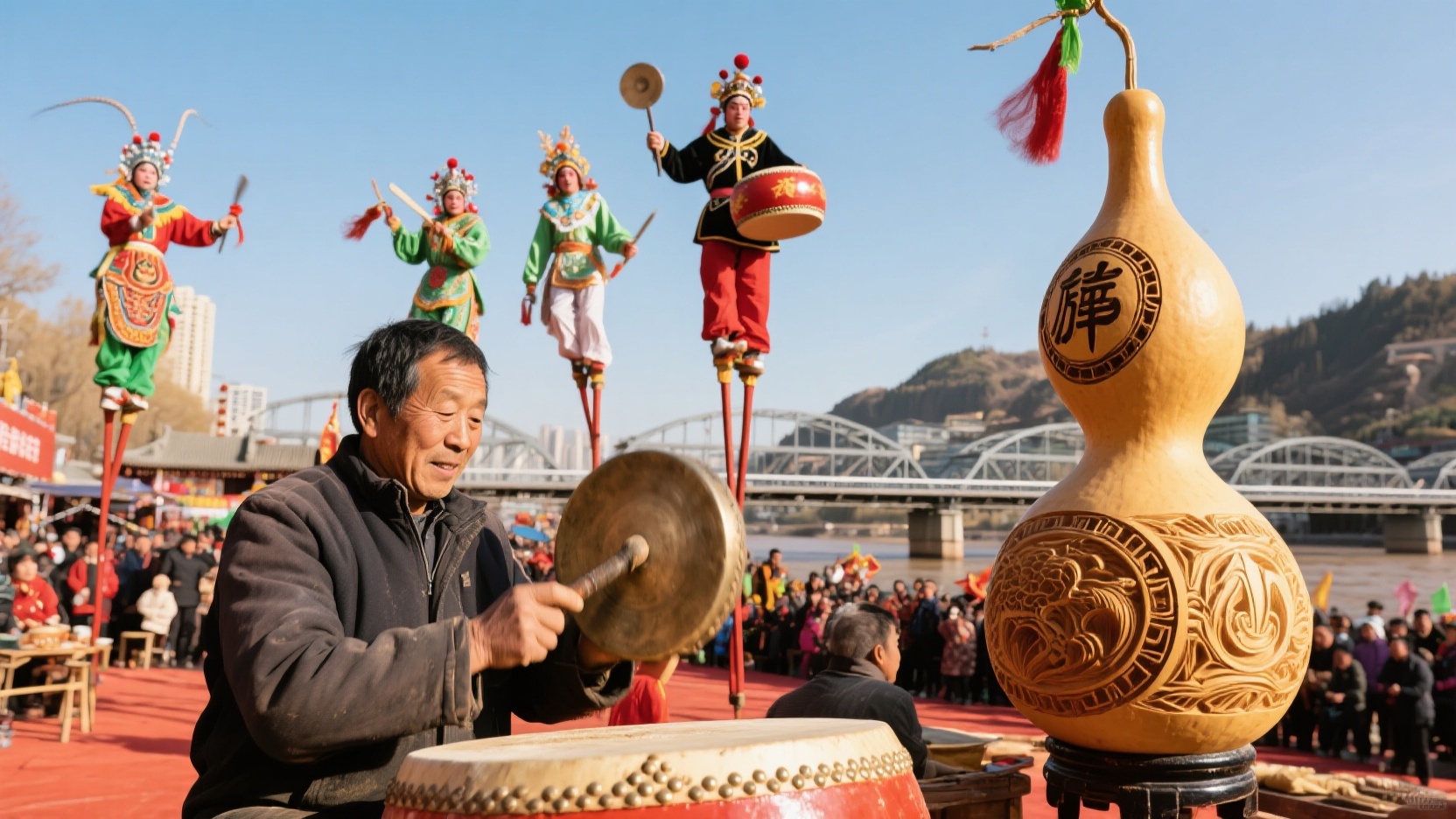
The cultural and artistic experience of Lanzhou isn't limited to museum displays; it extends to the rhythmic drumming of traditional folk performances, the gongs and drums of stilt walkers, the intricate carvings on gourds, and the lively singing and playing at tea stalls. Breaking down your trip into "watching a festival, learning a craft, and listening to an old song" can transform you from a tourist into a semi-local. The following four experiences are categorized into chronological order and flexible options, allowing for creative combinations depending on your month of visit.
I. Lanzhou Taiping Drum and Spring Festival Folk Performances: Following the Drumbeats Through the Streets and Alleys
The festival takes place from the eighth to the fifteenth day of the first lunar month, with the most concentrated Shehuo (folk performances) in Lanzhou city and Kushui Town, Yongdeng County. The Lanzhou Taiping Drum is the "opening drum" in the Shehuo procession. It has a long, narrow body and rapid drumbeats, commonly used in formations such as "Yellow River Raging Waves," "Hawk somersaults," and "Three Yangs Bring Prosperity." When experiencing the performance, don't just stand on the periphery taking photos. As the Shehuo procession parades through the streets, walk a few meters away from the group, focusing on how the drummers secure the drum to their waists with leather ropes, how they swing the drumsticks to strike the drumhead, and how the leader changes the rhythm with a whistle. The cultural story behind the Taiping Drum is related to military garrisons during the Ming Dynasty: legend has it that the Taiping Drum originated from the army using drums to boost morale and transmit signals, later evolving into a folk ritual for praying for blessings and welcoming spring. In the local people's belief, "the New Year isn't over without the Taiping Drum," and the more frequent the drumbeats, the stronger the spirit and energy for the new year.
II. Kushui Stilt Walking: A high-altitude folk performance on the second day of the second lunar month, known as the Dragon Raising its Head.
On the second day of the second lunar month, a stilt-walking performance is held in Kushui Town, Yongdeng County, in conjunction with the Dragon Head Raising Temple Fair. The stilts here are generally over three meters high. Performers, dressed as Qinqiang opera characters, walk along the village lanes and make their grand entrance at the main venue. To see the details, it's recommended to arrive early at the dressing area to observe how the performers sit on the platform, bind their legs, put on their costumes, and finally secure their stilts. After the performance begins, don't rush into the crowd; instead, retreat to the alley entrance to observe the overall flow of the procession before following the crowd to the main venue to see the final formation. Locally, there's a saying that "walking on stilts cures all diseases," and the higher the stilts, the more sincere the prayer. Stilts and Taiping drums often appear in the same temple fair system, but one is judged by its ground formation, and the other by its aerial movements, forming two extremes of Lanzhou Shehuo (a type of folk performance).
III. Lanzhou gourd carving: leaving Yellow River water patterns within a small space.
Gourd carving in Lanzhou can be experienced year-round, especially at cultural markets, intangible cultural heritage workshops, and some museums. The gourds used are mostly local Lanzhou varieties, such as egg-shaped gourds or bumpy gourds, known for their delicate skin and hard texture. The experience typically involves four steps: first, choosing a gourd and determining the design; beginners are advised to start with Yellow River ripples, the outline of White Pagoda Mountain, or the characters "Lanzhou"; then, sketching the design on the gourd's surface with a pencil; next, using a needle knife or carving knife to carve along the lines, controlling the depth to avoid carving through the skin; finally, lightly rubbing with ink or paint to bring the design to life. Gourd carving was already a common activity among Lanzhou literati during the Qing Dynasty, with themes often drawn from the Yellow River, waterwheels, and rafts—symbols of rural life. Unlike paper cutting and clay sculpting, gourd carving involves an irreversible process; a single mistake cannot be corrected. This immediate focus is precisely the value of this intangible cultural heritage experience.
IV. Lanzhou Drumming and Wuquanshan Tea Stalls: Listening to a Story Over a Covered Bowl of Tea
During weekends and festivals, Lanzhou drum ballad performances are frequently held at tea stalls or folk art societies in the Wuquanshan, Baitashan, and Jinchengguan areas. Older tea stalls typically have square tables and serve Sanpaotai (a type of hot pot), with singers playing the sanxian (a three-stringed plucked instrument) or yangqin (a dulcimer), performing in the Lanzhou dialect. It's recommended to order a bowl of Sanpaotai, sit three or four meters away from the singer, and listen to a selection from "Borrowing Arrows with Straw Boats" or "The West Chamber," paying attention to the transitions between the "pingdiao" and "guzidiao" melodies, and how the sanxian corresponds to the lyrics. Lanzhou drum ballad originated in the Qing Dynasty, incorporating elements of Beijing octagonal drum and Shaanxi Meihu opera. It's a product of Lanzhou's urban culture as a Yellow River port city and is now a national intangible cultural heritage. Unlike Qinqiang opera, which is high-pitched and passionate, it emphasizes narrative and rhythm, making it suitable as a way to conclude a trip, allowing the day's folk performances and gourd carving experiences to settle into the lyrics.
If you visit between the 8th and 15th of the first lunar month, you can participate in folk performances during the day, listen to drum music in the afternoon, and try gourd carving in the evening. If you arrive around the 2nd of the second lunar month, prioritize the stilt walking in Kushui Town, and then return to the city to finish at a tea stall. Regardless of the combination, the key is to set aside half a day to "sit down": learn a couple of drumbeats from the drum master, carve a water ripple on a gourd, and listen to half a section of Lanzhou drum music. This way, you won't just leave with photos, but with a cultural thread belonging to the Yellow River region.