
Slow and Relax in Hong Kong | 7 Days 6 Nights Family-Friendly Retirement-Friendly In-Depth Tour, Two Suburban Routes to Choose From, and Practical Tips
Hong Kong is perfect for a leisurely trip, especially for families with parents and children. This guide assumes accommodations along the MTR lines in Central/Sheung Wan or Tsim Sha Tsui, and only covers two to three key locations each day, focusing on flat roads and gentle slopes to minimize transfers. Prepare your Octopus card and download offline maps in advance to reduce the hassle of asking for directions.
Day 1: Slow Walk Through the Old Town of Central and Sheung Wan
Don't wait in long lines upon arrival. Walk from Hong Kong Station to the Central Market, which has air conditioning and a rest area. Then take the Mid-Levels Escalator up to Tai Kwun (former Central Police Station complex). The park is almost entirely flat with elevators. If you have the energy, you can stroll along Hollywood Road to PMQ. In the evening, take a walk along the Central waterfront to view Victoria Harbour.
Day 2 Stanley and Repulse Bay
In the morning, take a bus from Exchange Square in Central to Stanley, a journey of about 30 minutes. The Murray House, Blake Pier, and markets along the Stanley waterfront are perfect for a leisurely stroll, with flat walkways. In the afternoon, take a bus to Repulse Bay. The waterfront boardwalk connects Repulse Bay and Deep Water Bay, with a very gentle slope, suitable for strollers and wheelchairs.
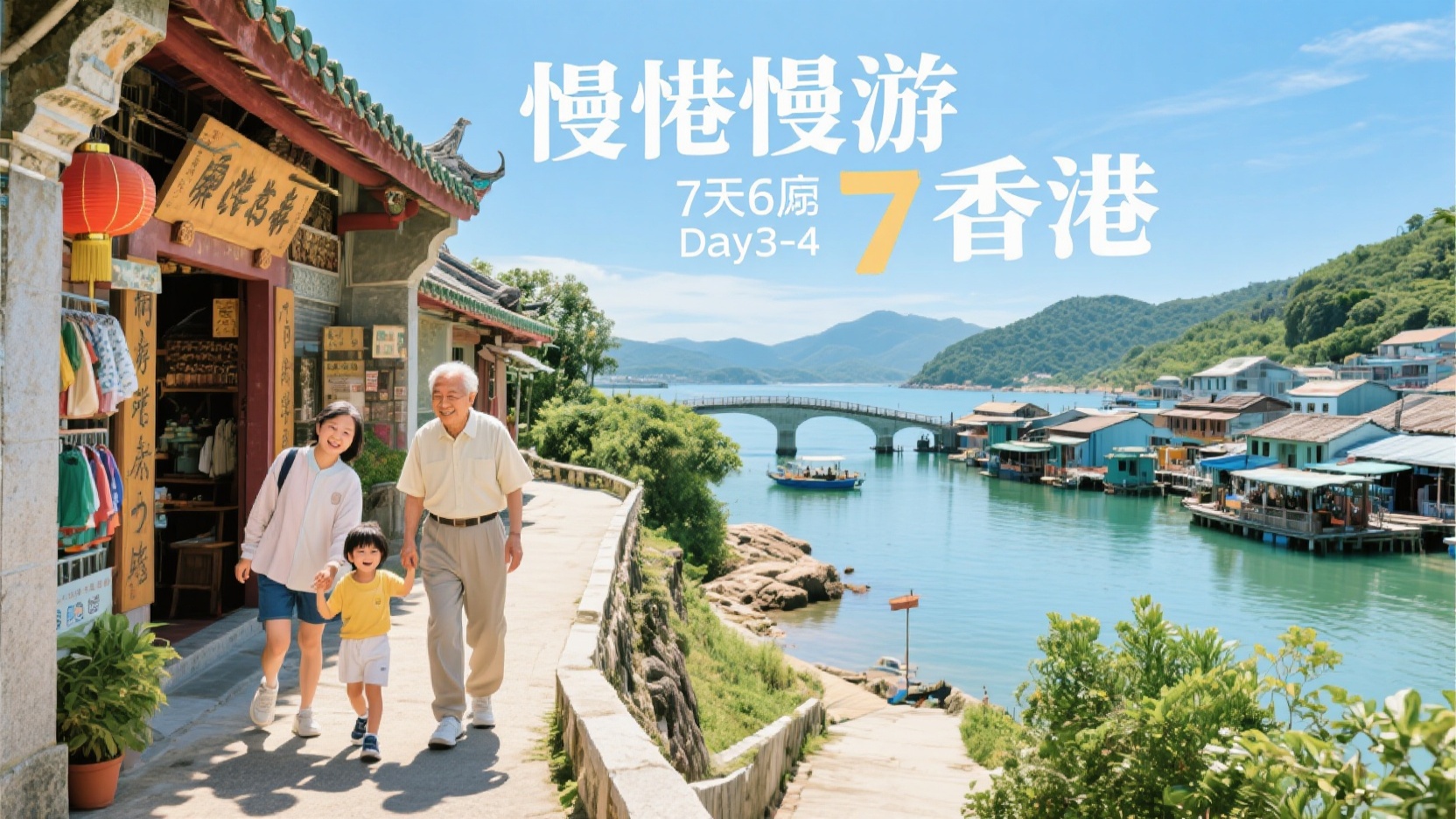
Day 3-Day 4: Choose one of two routes in the suburbs
The following two days feature branch routes: the Ancient Town and Fishing Village route focuses on cultural aspects, while the Nature Reserve route emphasizes geology and coastal ecology. Both routes are suitable for daily commutes to and from the city; on rainy days, prioritize branch A, and on sunny days, prioritize branch B. Natural hot spring resources near Hong Kong are limited; if your trip is specifically for hot springs, it is recommended to use a city hotel spa instead.
Branch A: Ancient Town and Fishing Village Route: Tai O and Ngong Ping
Day 3: Take the MTR Tung Chung Line to Tung Chung, then transfer to a bus to Tai O. Walk slowly along the Tai O Chung Bridge and through the stilt houses. In the afternoon, you can walk to Tiger Hill Viewpoint (about a 20-minute walk uphill) for a distant view of the Hong Kong-Zhuhai-Macau Bridge. Day 4: From Tung Chung, take the Ngong Ping 360 cable car or bus to Ngong Ping. Visit the Tian Tan Buddha and Po Lin Monastery. The trails in the park are gentle. Afterwards, walk through the Heart Sutra Forest (about a 30-minute round trip).
Branch B Nature Reserve Line: Sai Kung and Sharp Island
Day 3: Take the MTR to Diamond Hill Station, then transfer to a bus to Sai Kung Ferry Pier. From there, take a ferry to Sharp Island. Sharp Island features a geological trail and a sandbar connecting to an island. The sandbar is only exposed at low tide, so be sure to check the tides before setting off. There are no supplies on the island, so bring your own water and dry food. Day 4: Visit the Sai Kung Volcanic Rock Park. The hexagonal rock columns and sea caves at the East Dam of the High Island Reservoir are the highlights. Public transportation does not provide direct access, so it is recommended to book a guided tour in advance or take a taxi. The trail is gentle, but some viewpoints have steps.
Day 5 Kowloon Cultural Indoor Day
This day is dedicated to Tsim Sha Tsui. In the morning, first visit the Hong Kong Science Museum or the Hong Kong Museum of History; the two are adjacent and have spacious interiors. In the afternoon, head to the West Kowloon Cultural District and choose between the Hong Kong Palace Museum and M+. In the evening, watch the sunset over Victoria Harbour from the West Kowloon Promenade; the walkway is completely flat.
Day 6 New Territories Wetlands and Walled Villages
In the morning, we visited the Hong Kong Wetland Park in Tin Shui Wai. The park features alternating walking trails and indoor exhibits, and there are seats in the birdwatching huts. In the afternoon, we went to the Ping Shan Heritage Trail, starting from the Tsui Sing House and following the signs to the Tang Clan Ancestral Hall. The entire trail is about 1.5 kilometers long and is almost entirely flat.
Day 7: Farewell to the Blue House in Wan Chai and Victoria Harbour
In the morning, visit the Blue House complex in Wan Chai to see the revitalization of the tenement buildings and the Hong Kong Story Museum. Afterward, walk along the Wan Chai waterfront promenade towards Golden Bauhinia Square. If time permits, you can take the Star Ferry to Tsim Sha Tsui. Arrive at the airport two hours in advance.
Recommended gentle slope routes suitable for the elderly and children
The top choices are the Central Mid-Levels Escalator connecting to Tai Kwun; the Repulse Bay to Deep Water Bay waterfront boardwalk; the Ngong Ping Village to the Heart Sutra Forest; the West Kowloon Waterfront Promenade; the Ping Shan Heritage Trail; and the Wetland Park Trail. These routes generally have a gradient of no more than 5%, and many have benches and accessible restrooms. Some routes also have hot and cold water dispensers, making them suitable for strollers and seniors with mobility issues.
List of frequently used local apps
For travel, use "MTR Mobile" to check MTR routes; "Citybus & New World First Bus" App to see real-time bus arrival times; "HK Taxi" or "Uber" to hail a ride; "OpenRice" to find restaurants; "MyObservatory" to check the weather and tides; and "Toilet Rush" to find nearby restrooms. It's family-friendly.
Clothing suggestions for rainy/dry season
The dry season lasts from approximately November to March of the following year, with temperatures ranging from 15 to 25 degrees Celsius. Mornings and evenings are cool, so a light jacket paired with long sleeves is recommended. The rainy season lasts from approximately April to October, characterized by high temperatures and humidity, with frequent afternoon downpours. Quick-drying clothing, non-slip shoes, and a lightweight raincoat are recommended. Indoor air conditioning is strong, so bring a light jacket. Before departure, pay attention to heavy rain and typhoon signals; ferries and cable cars are often suspended during Typhoon Signal No. 8.