
Five-Hour Night Tour of Harbin: A Local's Secret Route from Songhua River Bridge to Laodaowai Teahouse (Tested and Tested in Summer and Autumn to Avoid Pitfalls)
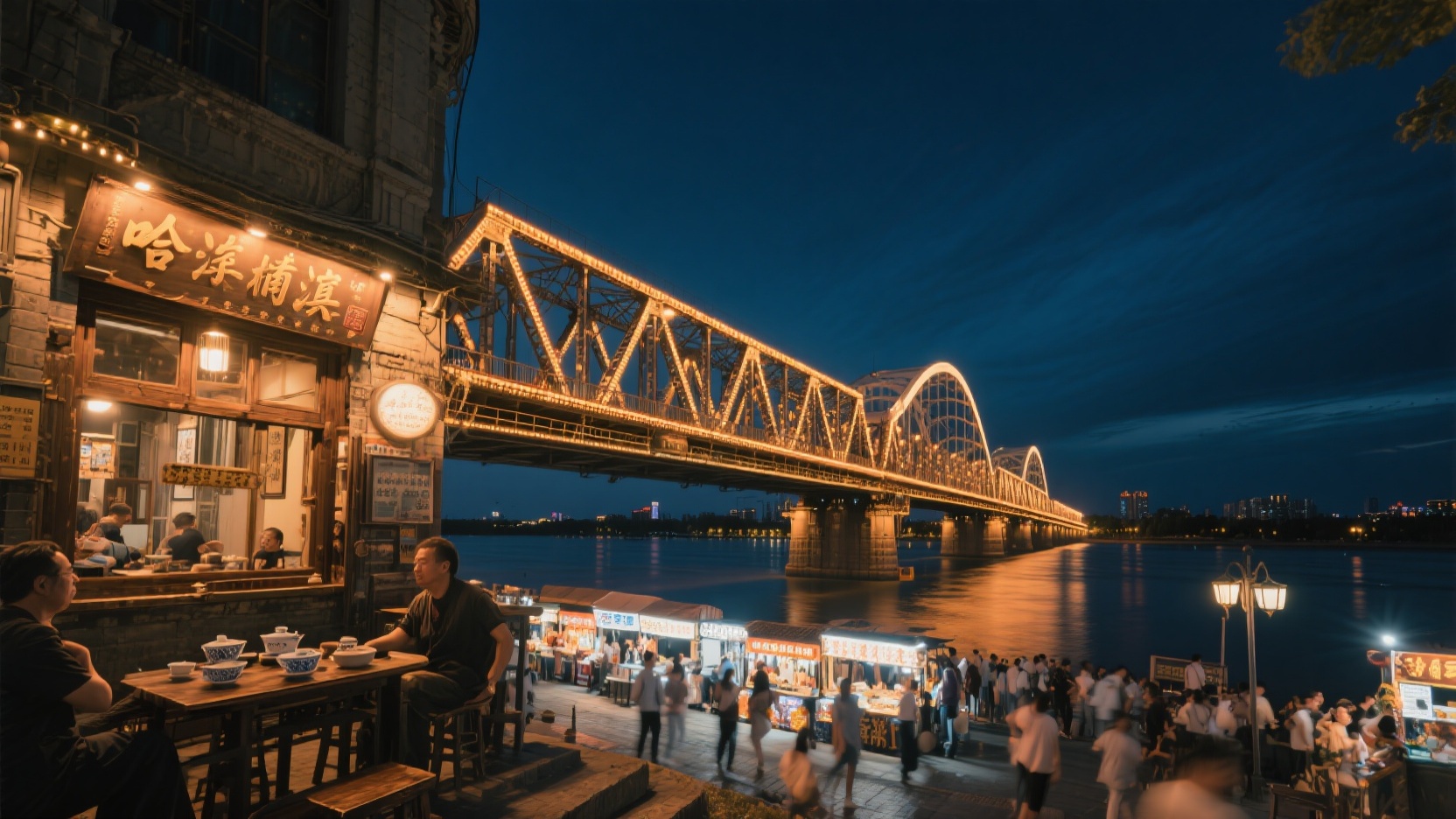
After four trips to Harbin, I discovered that the best time to capture both the "cinematic feel of the Jiangqiao Bridge" and the "authentic Daowai flavor" of the nighttime area is not during the day, but from 6 pm to 11:30 pm.
The first two times I took friends along the "Central Avenue - Shida Night Market" route as recommended online, we ended up wasting half the time getting stuck in traffic and waiting in line, completely missing the twenty minutes when the riverside lights were on. The third time, I switched to the opposite route: first, we'd find a good spot on the river bridge, then head into the old Daowai Baroque district to grab a bite, and finally finish with a pot of tea. I personally tested this route on a weekday in summer or autumn, and it took exactly five hours, accumulating around 13,000 steps. No taxis were needed; we used walking and shared bikes to get between different areas.
18:00-19:20 Songhua River Railway Bridge: Reserve the most valuable "blues moment" for the river surface first.
Don't wait until it's completely dark to go. Six to seven in the evening is the prime time for Harbin's night tour. The sky transitions from gray-blue to deep blue, and the steel structure of the railway bridge and the Songhua River are bathed in a cool, muted light. Navigate directly to the south entrance of either the "China Eastern Railway Bridge" or the "Binzhou Railway Bridge." Once on the bridge, walk towards the middle; the glass walkway beneath your feet is just lit up, making it feel like you're walking on the river.
This bridge comes into view earlier than Central Street, and its longer length and greater sense of depth make it less crowded than the Flood Control Monument Square. I personally tested it on a weekday, arriving before 6:30 PM to have a section of the bridge all to yourself. After viewing the bridge lights, don't rush off. Walk north to the northern end of the bridge to capture the silhouette of the bridge tower and Sun Island. On the way back, walk along Stalin Park towards the Flood Control Monument, which connects to the next section.
19:20-19:40 Cycling or walking: From the riverbank to Laodaowai, it's more convenient than going to the Shida Night Market.
From the Flood Control Monument to the Laodaowai Chinese Baroque Street, it takes about eight to ten minutes by shared bike and a little over twenty minutes on foot. I recommend cycling because the evening breeze along the river and through the side streets is very pleasant, and you can avoid the crowds on the main street of Central Avenue. Don't detour to Central Avenue and try to walk around before turning back; that will add at least half an hour to your walk, and your legs will be exhausted by the second half of the night tour.
This transition is also a "lighting transition": the blue light strips along the Songhua River gradually transform into the warm yellow lanterns in the old streets and alleys of Daowai. When cycling, please stay to the side and ride slowly. Some intersections in Harbin's old city do not have clearly marked non-motorized vehicle lanes, especially when crossing Jingyang Street, do not run the red light.
19:40—21:10 Laodaowai Chinese Baroque: The "real night market" as described by locals, not near the National Taiwan Normal University.
Many tourists consider "Shida Night Market" to be the representative of Harbin's night markets, but locals will urge you to go to Daowai. The Zhonghua Baroque Street is more charming at night than during the day: the Baroque gables on both sides of South Second Street and South Third Street are illuminated by warm lights, and barbecue, smoked and braised dishes, old-fashioned snacks and Russian snacks are mixed on one street, and the lively atmosphere doesn't need loudspeakers to be shouted.
The advantage here is that you can find both street food and restaurant flavors. If you want to eat on the go, you can choose a smoked and braised meat platter, grilled red sausage, or a small portion of sweet and sour pork; if you want to sit down, you can go into an old-fashioned street restaurant and order a bowl of sauerkraut with boiled pork or a steamer of buns. The blogger personally tested it: buy a smoked and braised meat platter to fill your stomach first, then find an old-fashioned restaurant for a hot main dish. You can have a very authentic meal for tens to hundreds of yuan per person, without having to wait outside trendy restaurants. There are paid restrooms in the area, but some are quite dark in the evening, so it is recommended to use a teahouse instead.
21:10-23:00 Hide away in an old teahouse: The second half of Harbin's night tour isn't about bars, but about "listening to the old Harbin."
Harbin's nightlife is easily simplistically categorized as "skewers + bars," but Laodaowai hides an option that better reflects the city's character: old teahouses nestled in Baroque courtyards. These teahouses have no neon signs and unassuming facades; inside, you'll find a courtyard of old houses with wooden windows, square tables, and thermos flasks. Occasionally, local enthusiasts will sing Pingju opera or tell short crosstalk routines.
Choosing an old teahouse over a small pub was my conclusion after comparing three times: while Harbin's Russian-style bars and small live music venues are also good, the old teahouses can pull you out of the "tourist rush" state and are perfect for resting and recharging after walking 10,000 steps. Order a pot of jasmine tea or barley tea and listen to the old gentleman talk in his Northeastern accent about the demolition and preservation of the old Daowai district—it's more like a "city manual" than any travel guide. Teahouses are usually open until around 11 pm, which is just right for ending your nighttime tour.
Five camera angles for night photography and four safety tips
First, let's talk about camera spots: 1. On the glass walkway in the middle of the railway bridge, place your phone against the railing and shoot down onto the river to capture the reflection of the bridge lights; 2. At a low angle near the river embankment in Stalin Park, use a telephoto lens to frame the Flood Control Monument and the cruise ships together; 3. At the corner of Zhonghua Baroque South Second Street, look up at the gable wall and the moon—this is the best angle for taking photos of the old Daowai night view; 4. By the wooden window of the old teahouse, have your companion take a silhouette photo of their profile while drinking tea across the table; 5. On the steps along the river on the way back, take a slow-shutter shot of the lights of Sun Island on the opposite bank and their reflection on the river—a good way to wrap things up.
For safety, remember these four points: First, the riverside breeze is cool in Harbin during summer and autumn nights, especially on bridges and steps. Bringing a light jacket is more practical than relying on shared bikes to keep warm. Second, the old Daowai district has many streets and alleys, and some courtyards are dimly lit. Women are advised to ride in groups and avoid turning into unlit courtyards just to find a good spot for a photo. Third, always turn on your front and rear lights when riding shared bikes at night, and be careful of vehicles turning right at intersections in the old city. Fourth, when dining at teahouses and street stalls in the evening, ask about the pricing method beforehand, whether tea and smoked meats are sold by the portion or by the ounce, to avoid misunderstandings.
The blogger summarizes: This night tour connects Harbin's most easily overlooked daytime attractions—the "cold light of the river bridges" and the "warm light of the old Daowai district"—into a five-hour arc, avoiding rushing, crowds, and trendy spots. The best time to experience it is in summer and autumn; in winter, the bridge surfaces are too windy, so it's not recommended to follow this route. If you only have one night, don't compete with tourists on Central Street; instead, walk in the opposite direction, and old Harbin will slowly reveal itself to you.