
Experience Harbin's Folk Customs: A Half-Day Tour of Festivals, Temple Fairs, and Intangible Cultural Heritage Crafts
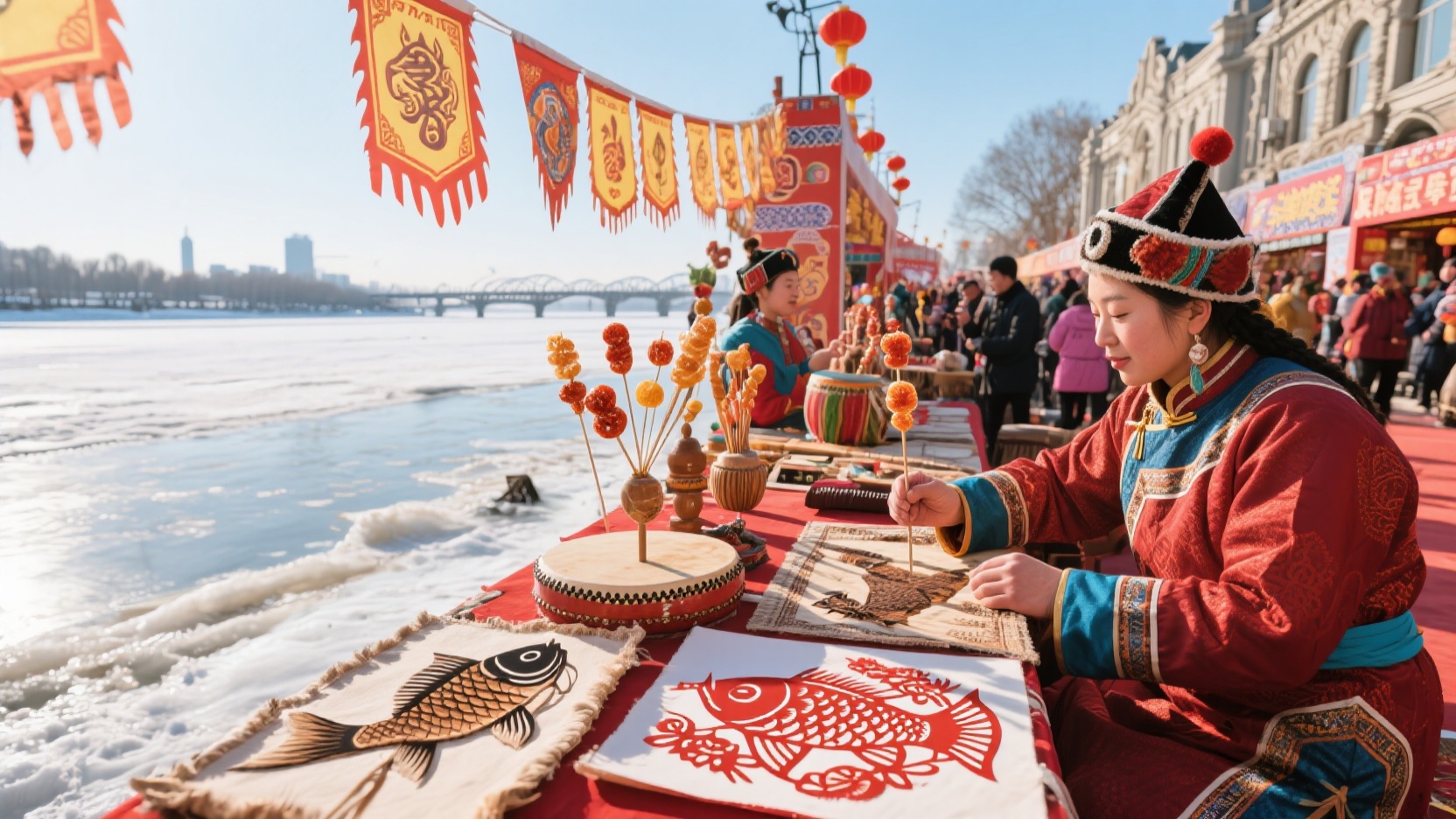
Harbin's association with ice and snow often overshadows its other layers: the fishing and hunting traditions of the Songhua River at its thaw, the Errenzhuan (a traditional folk art form) and sugar figurines at the old Daowai Temple Fair, and the shamanistic chants of the Jin Dynasty. These festive customs and intangible cultural heritage experiences aren't displayed in temperature-controlled showcases, but rather found in the river breeze, on the stage, and in the hands of artisans. Choose the right time, set aside half a day, and you can immerse yourself in a more "warm" Harbin.
Songhua River Opening Festival: Watch the river-awakening ceremony and make a fish skin painting.
Every year in mid-to-late April, the ice on the Songhua River cracks, and the riverside area of Harbin hosts the River Opening Festival. The morning river-worshiping ceremony preserves the core actions of northern fishing and hunting culture: experienced fishermen carry fishing nets tied with red silk to the riverbank, shout "Awaken the net!", and sprinkle wine on the river, praying for safety and a good catch. Tourists standing on the riverbank can see the ice floes drifting downstream up close and hear the crisp sound of ice floes colliding. After the ceremony, the river-opening fish market displays freshly caught crucian carp and carp, and the buying and selling reflects the locals' tacit understanding of seasonal availability.
Even more worthwhile is the Hezhe fish skin painting workshop. The inheritors cut and paste processed fish skin according to its texture into wave or fish-shaped patterns. After the flesh is removed, dried, and tanned, the fish skin becomes supple, like thick paper when cut, yet retains its fine scales. Making a palm-sized fish skin painting takes about half an hour. Once finished, framed, it becomes a more substantial travel souvenir than a refrigerator magnet. The underlying cultural logic is straightforward: the Hezhe people, living in the Songhua and Heilongjiang river basins, use "fish skin" to transform every part of their catch into necessities, and fish skin painting is the aestheticization of this survival wisdom.
Harbin Folk Art Expo: A Comprehensive Look at the Entire Lineage of Northern Chinese Handicrafts
The Harbin Folk Art Expo, held annually from July to August, boasts the highest density of intangible cultural heritage in northern China. Various art forms, including Fangzheng paper-cutting, wheat straw collage, birch bark painting, fish skin painting, clay sculpture, and cloth tigers, are showcased. Inheritors sit at their booths to demonstrate their crafts, allowing visitors to closely observe their knife skills and color application. Inheritors of Fangzheng paper-cutting often hand out a small pair of scissors, guiding visitors to start by "cutting an ice flower," experiencing how red paper, after folding, develops a symmetrical hexagonal structure. Wheat straw collage involves splitting, smoothing, and dyeing wheat stalks, then cutting them into thin strips and piecing them together to create a picture—a process more patient and demanding than one might imagine.
The underlying theme of this scene is immigrant culture. After Harbin opened as a treaty port, immigrants from Shandong and Hebei brought their local crafts to the Songhua River basin, where they merged with the local Manchu and Hezhe ethnic crafts, forming a diverse yet harmonious lineage of northern folk art. Therefore, what you see here is not a single school, but a network of crafts.
Old Daowai Temple Fair: Listen to Errenzhuan (a type of folk opera) and learn sugar figurine making.
From the Spring Festival to around the Lantern Festival, a temple fair is held in the Laodaowai Chinese Baroque Street area. Under the blue brick walls, Errenzhuan performers sing the folk song "Little New Year's Greeting" on a simple stage, while Northeast drum artists beat their drums. The stalls selling sugar paintings, dough figurines, and sugar blowing are always crowded with children. Laodaowai is Harbin's earliest urban center, and its temple fairs are more "introverted" than the ice lantern festivals. Visitors are not spectators, but rather characters drawn into the scene.
The sugar figurine stalls offer a unique experience for out-of-towners: maltose is simmered in a copper pot until it forms threads, then the craftsman pinches off a lump, rolls it into a ball in his palm, quickly shapes it into ears and a tail, and then skewers it with a bamboo stick. Tourists often soften the sugar with their warm hands, prompting the craftsman to remind them, "Don't stop with your fingertips, shape it while it's hot." This tactile memory speaks volumes more than any explanation as to how "folk crafts are the experience of time and temperature." If you don't want to make a sugar figurine, you can visit a paper-cutting stall and learn from the elders how to cut a "福" (fortune) character or a window decoration. The temple fair, though noisy and bustling, perfectly recreates the old-fashioned life of Daowai, where "shops in the front, workshops in the back, and operas in the courtyards."
Acheng Jinyuan Cultural Festival: Cutting a Manchu Paper-cut to the beat of shamanic drums.
Every September, the Acheng District of Harbin hosts the Jin Dynasty Cultural Festival. Acheng was the site of the former Shangjing Huining Prefecture during the Jin Dynasty, and the shamanic rituals performed at the festival preserve fragments of Jurchen beliefs: shamans, dressed in sacred robes and with copper bells around their waists, spin and chant "divine tunes" to the beat of drums; their movements are not exaggerated, yet possess a solemn rhythm. After watching the performances, visitors can enter the Manchu paper-cutting experience area. Manchu paper-cutting is mostly done on black or dark blue paper, with patterns mainly featuring figures of women, willows, eagles, and deer. The finished pieces are pasted onto white cloth or windows, their bold lines contrasting with the delicate square-shaped paper-cuts.
This ruggedness is not due to a lack of skill, but rather a necessity: Manchu paper-cutting was historically used for sacrifices, festivals, and shamanic rituals, requiring the symbols to be recognizable from a distance, thus necessitating clear outlines and bold patterns. Cutting a "grandma figure" takes about forty minutes; once finished, holding it up to the sunlight reveals the northern skylight through the cutouts.
These festivals and intangible cultural heritage events in Harbin all share a common feature: "hands-on experience is allowed." Making fish skin paintings at the Kaijiang Festival, learning sugar figurines in Laodaowai, and cutting paper figurines of grandmothers at the Jinyuan Culture Festival—none of these require any professional background. All you need to do is sit down, give your hands to the materials, and let time guide you. A quick visit reveals the performances, but sitting down and experiencing life as a local for half a day allows you to touch upon the evidence that these folk customs are still alive.