
Avoid staying near Wuyi Square | Changsha Accommodation Avoidance List: Local Tested and Answered Questions about These 4 Areas to Avoid Bad Experiences
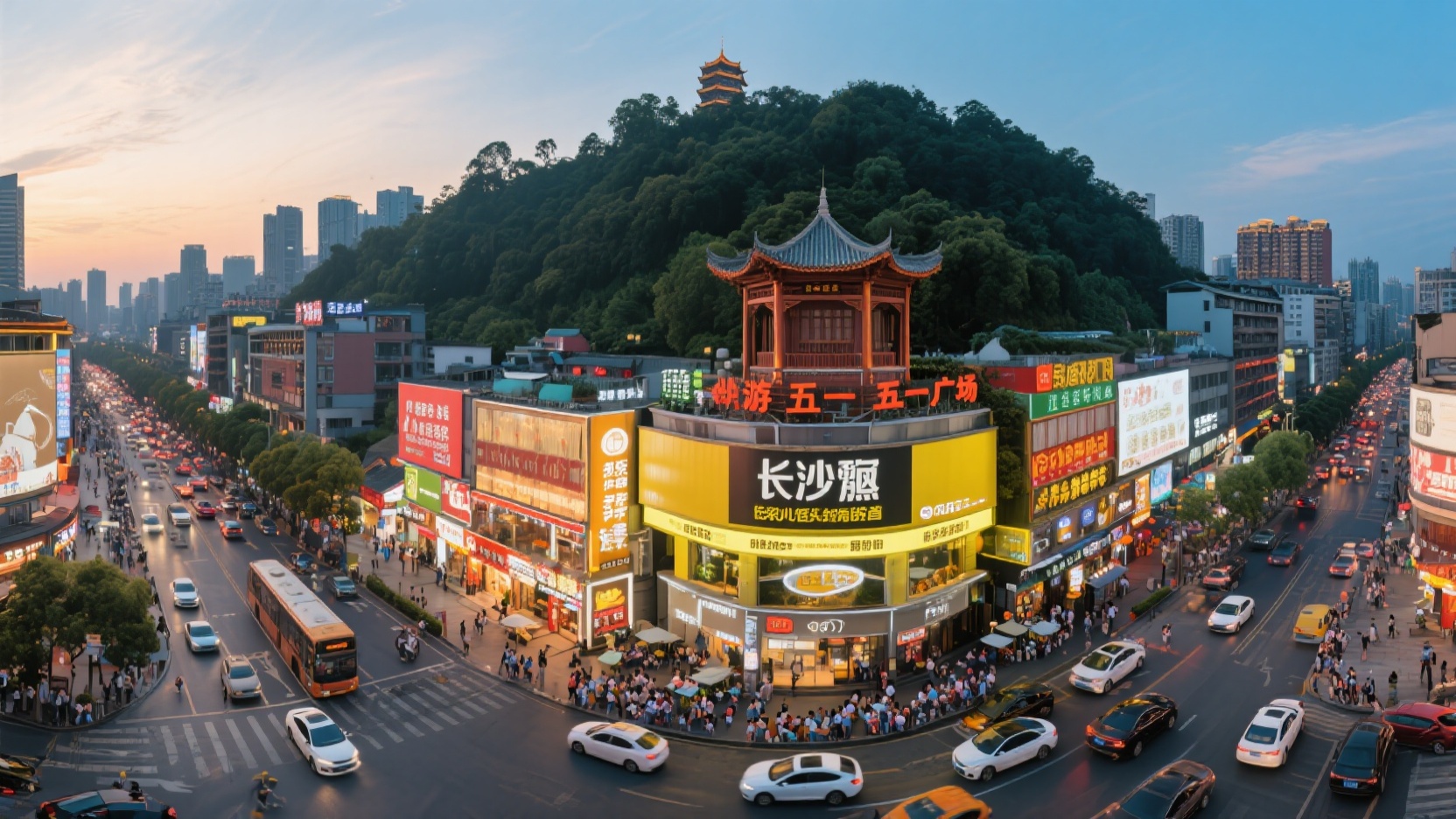
After spending one night at Wuyi Square, I never dared to recommend "city center hotels" to friends from other places again.
Many travel guides tout Wuyi Square, Taiping Street, and the foot of Yuelu Mountain as the "most convenient accommodation areas," but locals in Changsha rarely stay there. It's not that we're being picky; those places seem lively during the day, but at night they're too noisy to sleep, cars can't get in, and the people are a mixed bunch. Below, we'll thoroughly explain the three worst-hit areas, and then provide four truly suitable local areas for overnight stays.
1. Wuyi Square/Huangxing Road: Not convenient, but a noisy receiver at night.
Wuyi Square is repeatedly recommended because it resembles the center of Changsha on the map. However, precisely because it's so central, the pedestrian street is constantly filled with the sounds of loudspeakers, live streams, and bars closing up at 1 or 2 AM. Many guesthouses are located in old residential buildings with thin windows, and there are late-night food stalls right downstairs, so you can clearly hear guests ordering.
Transportation is also a false premise. During the day, taxis are stuck in traffic on Jiefang West Road; after 10 PM, the taxi queues are slower than the subway, and after the last subway train, getting back to the hotel means walking a long way through crowds. Parking is even more of a disaster; some hotels don't have private parking spaces, and dragging luggage through alleys to find a spot can take half an hour. Late at night, there are many drunkards and touts near Huangxing Road, so it's best to avoid backstreets and alleys when traveling alone.
2. Taiping Street/Pozi Street area: The old alley guesthouses look artistic, but are actually stuffy and noisy.
The guesthouses on Taiping Street and Pozi Street are often marketed as having "the authentic atmosphere of old Changsha," but that atmosphere really means: tourists crowding the area downstairs from morning till night, with electric bikes honking in the middle of the night. The houses in those old cobblestone alleys generally have poor sound insulation and limited natural light; some converted guesthouses don't even have windows.
The biggest pitfall is the illusion of being "close to the attractions." The walk from Taiping Street to Orange Isle Bridge seems like a few hundred meters, but in summer you'll be drenched in sweat, and taxis often take detours due to the one-way streets. While there are many food options, they're mostly tourist-priced; locals don't eat their daily meals on Pozi Street. After the tourists leave in the evening, some alleyways are dimly lit, the cobblestone streets are slippery, and parking is practically nonexistent.
3. Yuelu Mountain University Town/Orange Isle Bridgehead: It looks close to the scenic area, but it's deserted and difficult to get a taxi at night.
Many people think that staying in the University Town makes it convenient to climb Yuelu Mountain and visit Orange Isle, but in reality, these two attractions are separated by a river and are not in the same direction. If you stay in the University Town to get to Orange Isle, you have to cross a bridge, which is heavily congested during the morning rush hour; if you stay near the bridgehead of Orange Isle to get to Yuelu Mountain, you have to wait for a bus at the bridgehead.
The university town has many students, but few hotels suitable for tourists. Many accommodations are short-term rentals converted from old residential areas, with varying conditions. At night, some side streets on Lushan South Road are very quiet, and convenience stores close early, making it a bit unsettling to return home alone late. Getting a taxi when leaving is also awkward; during peak hours, drivers avoid side streets, making it difficult for outside vehicles to squeeze in and park.
4. Houjiatang/Dongtang: A midway station in old Changsha, with quick subway access to anywhere.
Suitable for most first-time visitors to Changsha, especially those who don't want to waste time on transportation. Houjiatang is an interchange station for Metro Lines 1 and 3, and Dongtang is also along Line 3. It's only two or three stops to Wuyi Square, and a transfer to Orange Isle or Yuelu Mountain takes about 20 minutes, with a taxi fare just over the starting price.
Eating nearby is very convenient. Dongtang and Houjiatang have many noodle shops and Hunan restaurants frequented by locals, where you can eat your fill for just a few dozen yuan per person. It's not as touristy as the area around scenic spots. Returning to the hotel late at night, the main road was well-lit, and the old residential area had access control, so the overall safety was good.
The downside is parking; street parking is hard to find in the old town, and hotel parking is usually scarce. If you're driving, it's best to check in advance or park in the underground parking garage of a nearby shopping mall. If you're arriving by subway, there are almost no major problems.
5. Yuhuating/Shazitang: High density of late-night snacks, suitable for foodies and those who come home late.
If your main focus in Changsha is food, Shazitang and Yuhuating are better for spending the night than Wuyi Square. This area is a local night market, still lively after 10 pm, offering barbecue, crayfish, and hot braised dishes. The price is only a few dozen to a hundred yuan per person, not just touristy prices.
In terms of transportation, Line 4 provides convenient access to the high-speed rail station, and it takes about 20 minutes to get to Wuyi Square. Dongtang is within walking or by shared electric bike. Returning to the hotel in the early morning, you don't need to worry about finding food; in fact, it's safer than the bustling city center because there are always locals on the streets.
Accommodation is mainly in mid-range hotels and established residential areas, offering good value for money. Parking is limited in older neighborhoods, so if you're driving, choose hotels with underground parking; otherwise, there's plenty of space by subway or taxi. It's especially suitable for groups of two or three people traveling together, focusing on food as the main activity.
6. Beichen Delta/Xiangjiang Century City: The top choice for family road trips and long-term stays, with quiet river views.
For those traveling with elderly people or children, or planning to stay in Changsha for three nights or more, I usually recommend looking at Beichen Delta or Xiangjiang Century City. These are relatively new residential areas, with new buildings, quiet environments, and river views. Unlike Wuyi Square, you won't be woken up in the middle of the night by noise. Metro Line 1 takes about fifteen minutes to reach Wuyi Square, and a taxi ride to Yuelu Mountain takes about twenty minutes.
The area is filled with shops, including supermarkets, noodle shops, and Hunan restaurants, with prices ranging from tens to hundreds of yuan per person, creating a vibrant local atmosphere. In the evenings, many residents stroll along the riverside promenade. The gated community has strict access control, offering a significantly higher level of security compared to the old town area.
Parking is the most convenient of these areas, with ample underground parking. If you're driving to Changsha and don't want to get stuck in traffic in the city center, this is a great place to land. The downside is that it's a few minutes away from traditional attractions, but it's worth it for the better sleep quality.
7. Wanjiali/Mawangdui: A transit point for catching flights and high-speed trains, offering both value for money and a lively atmosphere.
If you're just using Changsha as a transit point, or need to catch an early high-speed train or flight the next day, Wanjiali Square and Mawangdui are much more sensible options than the city center. Metro Lines 2 and 5 intersect here, making it quick to get to Changsha Railway Station and Changsha South Railway Station. For the airport, you can take the metro and then the Maglev train, and a taxi ride isn't too far either.
The Wanjiali commercial district itself is quite large, with many chain restaurants. Nearby, in the Mawangdui area, there are also old Changsha restaurants and a seafood market, with prices ranging from tens to hundreds of yuan per person. There are many accommodation options, with a high concentration of mid-range hotels, and prices are much more reasonable than those in Wuyi Square.
Returning to the hotel late at night, the area around Wanjiali is well-lit and crowded, so the safety level is acceptable. The older roads in the Mawangdui area are rather dark, so it's recommended to choose a hotel near a main road with a reception desk. Parking is much better than at Wuyi Square; the underground parking garages in the shopping district have ample spaces, suitable for car rentals or self-driving.
"In closing" Don't ask the locals if I didn't tell you:
1. Don't try to hail a taxi at Wuyi Square after 10 p.m. The queues are slower than for the subway. It's better to walk a bit further to a secondary road and then call a taxi.
2. If you are driving to Changsha, do not drive into the Wuyi Square business district. Traffic jams and the hassle of finding parking will ruin your trip. Prioritize Beichen or Wanjiali.
Third, if you want a river view but are afraid of noise, choose Xiangjiang Century City or Beichen. Don't be fooled by the "first-line river view" homestays in Taiping Street Old Alley.
Fourth, Changsha has a vibrant nightlife. If you stay near Yuhuating or Shazitang, you can get hot food when you return in the early morning. It's also safer than the bar streets in the city center.
5. During peak seasons, when visiting Yuelu Mountain and Orange Isle, take the subway across the river, not a taxi across the bridge. Traffic lights and traffic can cause you to miss your reservation time.