
Between the Rabbit God and Cloisonné: An In-Depth Experience of Beijing's Festivals, Folk Customs, and Intangible Cultural Heritage Crafts
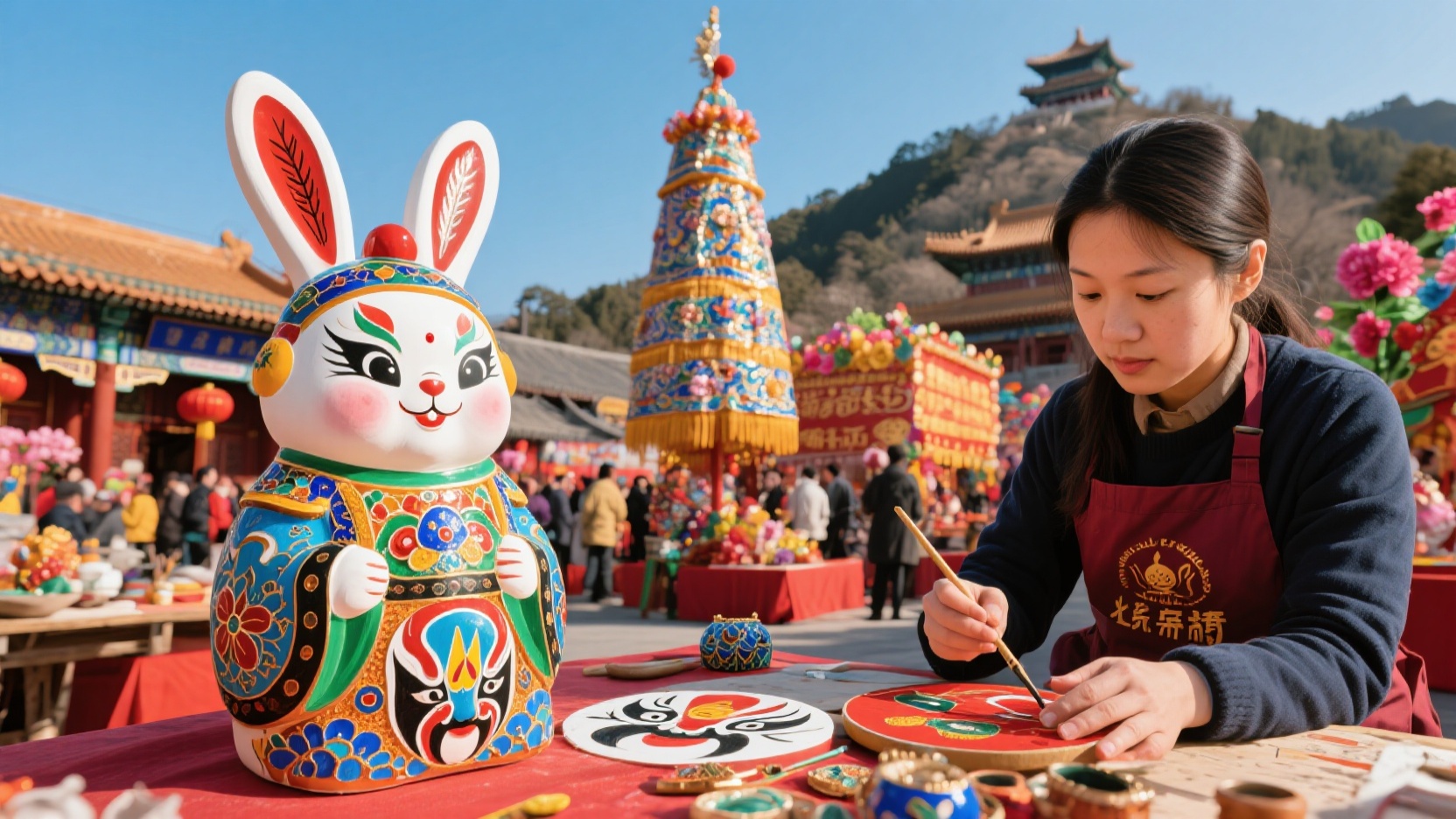
The cultural and artistic experience in Beijing doesn't have to be confined to museums and galleries. A more vibrant version can be found in the hawking cries at temple fairs, the drumbeats at flower shows, and the warmth of handicrafts in workshops. The following four experiences, if you set aside half a day for each, can help you switch from "just passing by" to "sitting down and experiencing half a day as a native Beijinger."
Liulichang Temple Fair | The original temple fair of Liulichang from the first to the fifth day of the Lunar New Year
From the first to the fifth day of the Lunar New Year each year, Liulichang East and West Streets transform into a bustling folk custom corridor. There's no entrance fee, and the main attractions are old Beijing toys and elegant stationery. The most worthwhile activity is painting a Rabbit God: sit in front of a blank white clay model, use a brush dipped in cinnabar to outline the eyebrows and eyes, fill in the back flag, and after half an hour, you can take your own "riding Rabbit God." Nearby, sugar-blowing vendors can blow out a proud rooster in three minutes, and inheritors of Beijing-style paper-cutting can cut out the character "福" (fortune) and zodiac animals on the spot. Rabbit Gods aren't just for the Mid-Autumn Festival; they're also commonly seen at Spring Festival temple fairs. Legend has it that the Jade Rabbit from the Moon Palace descended to earth to cure people's illnesses, and people sculpted Rabbit Gods in clay to express their gratitude. The image of a Rabbit God riding a tiger symbolizes "the tiger gone, the disease gone." Painting your own Rabbit God at a stall adds another layer of festive memory compared to buying a finished product.
Miaofeng Mountain Flower Festival | Mountain incense trails and flag-raising ceremonies from the first to the fifteenth day of the fourth lunar month
From the first to the fifteenth day of the fourth lunar month, Miaofeng Mountain in Mentougou District hosts the largest folk flower fair in North China. Along the ancient incense path, hundreds of flower fairs proceed in succession to the summit, with martial arts performances featuring the opening ceremony, flag-bearing, carrying boxes, and the Five Tiger Staff. Walking along the incense path from the foot of the mountain in the early morning, one can see flag-bearing performers twirling several-meter-high bamboo banners between their foreheads, shoulders, and arms, the words "Good Weather and Abundant Harvests" and "National Prosperity and Peace" fluttering loudly on the banners. The literary fair sets up tea stalls along the roadside, offering tea and porridge, allowing passersby to sit down and enjoy a bowl of hot tea, experiencing the incense fair's custom of "bring your own money and food, and don't disturb others with tea and water." The Miaofeng Mountain temple fair originated in the Ming Dynasty and is the core site of the folk "pilgrimage to the summit." The incense fair is strictly organized with a clear division of labor, and still retains the traditions of mutual assistance and etiquette. The flower fair is not a performance for tourists, but a mountain custom jointly performed by pilgrims and local villagers.
Cloisonné Workshop | Understanding the Eight Unique Skills of Beijing through the Enameling Process
To learn about imperial craftsmanship, one can directly visit a cloisonné workshop. Inside the workshop, six processes—body making, filigree work, enameling, firing, polishing, and gilding—are laid out in a row. The experience usually begins with a small copper plate or pendant: using tweezers, fine copper wires are bent into ruyi patterns or lotus scrolls and attached to the body; then, blue, green, and yellow glazes are used to fill the gaps in the pattern—this step is called "enameling." The craftsman will fire and polish it, and the finished product can be obtained in about two hours. Cloisonné, formally known as "copper-bodied filigree enamel," was introduced during the Yuan Dynasty and gained its name during the Ming Dynasty's Jingtai period due to the extensive use of blue glaze. It was once used exclusively by the imperial court and, along with lacquer carving, jade carving, and filigree inlay, was known as one of the "Eight Unique Skills of Beijing." A complete piece requires hundreds of processes; personally crafting a section of wire and applying a piece of enamel allows one to truly appreciate the meaning of "slow and meticulous work."
Peking Opera Mask Painting | Unlocking the Character Code of the Opera House with Red, Black, and White
In century-old theaters like the Huguang Guild Hall or in intangible cultural heritage classrooms, you can sit down and have a Peking Opera mask painted. On the table are plaster face molds, mineral pigments, and fine brushes. The inheritor first explains the symbolism of the colors and patterns: red represents loyalty and righteousness, like Guan Yu; black represents integrity, like Bao Zheng; white represents treachery, like Cao Cao; and blue is often used for brave characters. After choosing a character, start painting from the center line of the nose, outlining symmetrically on both sides, and then add gold powder to the eyes. The finished product can be displayed as a tabletop ornament. Peking Opera masks are not just random smears, but a visual language gradually formed after the Anhui opera troupes entered Beijing, integrating Kunqu, Bangzi, and other opera genres; it is called a "flowing history book." Painting masks amidst the carved beams and painted rafters of ancient theaters allows you to directly experience the character narrative of Peking Opera more directly than watching a performance.
The four experiences are best arranged seasonally: stroll through Changdian during the Spring Festival, climb Miaofeng Mountain in early summer, and book workshops on weekdays. Each experience requires quiet contemplation to truly understand the subtle nuances of Beijing culture through seasonal customs and hands-on activities.