
Spend half a day as a craftsman in the Hehuang region: Four correct ways to experience festivals and intangible cultural heritage in Xining.
If your cultural trip to Xining only stops at the pilgrimage route of Ta'er Monastery or the exterior of the Dongguan Great Mosque, you'll miss the most concentrated festive events in the Hehuang Valley. The following four festivals and intangible cultural heritage scenes are arranged according to the lunar calendar, making it a good idea to change your itinerary from "taking a quick look" to "sitting down and experiencing half a day as a local."
The Kumbum Monastery Butter Sculpture Exhibition on the 15th Day of the First Lunar Month: A Nighttime Exhibition in a Temple at Temperatures Below Zero Minus
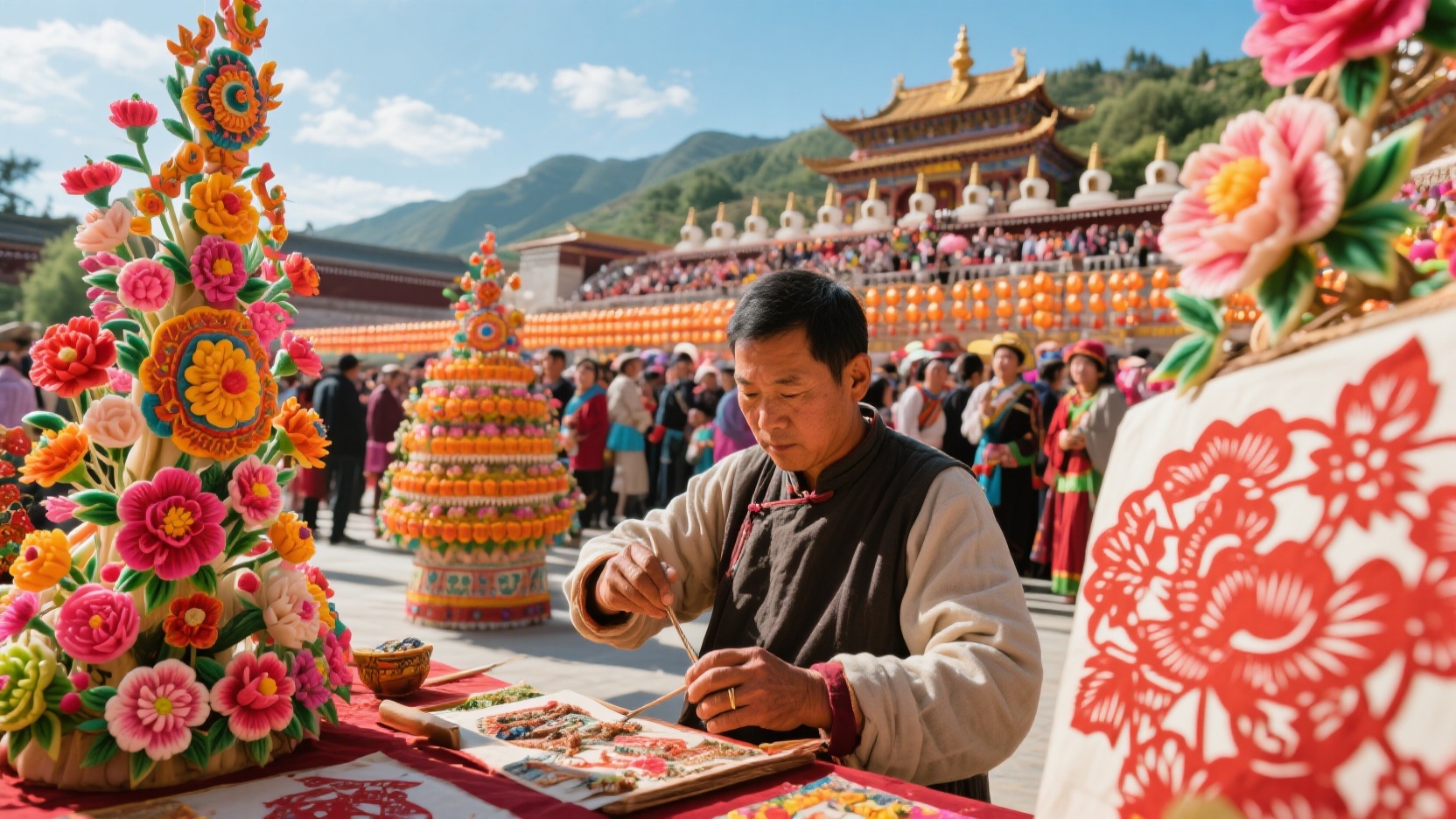
Every year on the evening of the fifteenth day of the first lunar month, several meters high butter sculpture stands are erected in front of the Nine-Room Hall of Kumbum Monastery, with butter lamps lit one by one along the steps. Visitors enter the monastery along the pilgrimage route, queuing slowly amidst the cold air and the sound of Buddhist music, to see up close the Buddha statues, flowers, birds, and pavilions sculpted from butter by the monks. The best vantage point is on the side of the sculpture stand, where the thinness of the petals and the folds of the figures' clothing can be clearly seen. Butter sculpture making is concentrated in winter, and the monks must repeatedly immerse their hands in ice water to cool them down and prevent their body heat from melting the butter before mixing it with mineral pigments to shape it. The Upper and Lower Flower Courtyards of Kumbum Monastery each secretly create their own sculptures each year, and the best ones are determined after the exhibition on the night of the fifteenth of the first lunar month. Legend has it that the butter sculptures offered to Buddha originated from a dream of Master Tsongkhapa in which thorns turned into lamps and weeds into flowers. Viewing the exhibition at night is extremely cold, so thick gloves must be worn, and the butter should not be touched with fingers; flash photography will damage the surface of the butter, and one should not linger in front of the sculpture stands for too long.
Lanterns in Huangyuan during the Lantern Festival: A Narrative of Light and Shadow in the Ancient City of Dangar
From the 12th to the 16th of the first lunar month, the old streets of Dangar Ancient Town in Huangyuan are adorned with rows of lanterns. These lanterns are rectangular wooden frames covered with gauze painted with comic strip-style stories such as *Journey to the West* and *Romance of the Three Kingdoms*, with the carved borders heavily influenced by Thangka line drawing. During the day, the wooden carvings and mineral pigment-painted gauze are beautiful to look at. In the evening, after the lanterns are lit, a leisurely stroll along the street allows the warm light from the lanterns to project the images onto the stone pavement. During the Qing Dynasty, Huangyuan was an important town for the tea-horse trade. Merchants from Shanxi and Shaanxi brought lantern-making customs, and local carpenters transformed palace lanterns into hanging and detachable lanterns. The images gradually shifted from literati paintings to folk tales. The production of these lanterns involves woodworking, painting, and mounting. In the past, after the lanterns were taken down on the 16th of the first lunar month, they were removed and preserved, repaired, and re-hung the following year. Visitors can participate in a lantern painting experience within the ancient town: using mineral pigments to outline and fill in the colors on the gauze, creating a small, portable painting. The entire process takes about two hours, coinciding with the time when all the streetlights are on.
The Sixth Day of the Sixth Lunar Month: The Mountain Flower Festival - An impromptu antiphonal singing contest in the Hehuang region.
On the sixth day of the sixth lunar month, countless "song stalls" spontaneously form from the foot to the halfway point of Laoye Mountain in Datong County. "Hua'er" is a type of folk song from the Hehuang region, often using tunes like "White Peony Order" and "Water Red Flower Order." The lyrics are improvised, often using flowers, plants, and birds to subtly express emotions. To experience it, first stand outside the stall and listen, identifying the "aiyo" interjections in the lead singer and harmonies, then ask the singer to teach you a couple of short lines. The stalls are usually surrounded by four or five people, with a pot of brewed tea in the center; when the lead singer hits a high note at the end, those around will softly add their interjections. "Hua'er" has strict occasional taboos; it is only sung at mountain temple fairs, not at home or in front of elders. The Laoye Mountain "Hua'er" festival combines with the June 6th Mountain Climbing Festival, featuring both folk antiphonal singing and mountain climbing for blessings. It's best to arrive in the morning, as the stalls are most lively in the afternoon; you don't need to know the whole song to participate in the antiphonal singing, just learning one line of harmonies will get you accepted by the stall.
Hehuang paper-cutting and pile embroidery: Sitting down and being a craftsperson for half a day
If you don't arrive in Xining during the peak season, you can experience paper cutting and appliqué embroidery at craft workshops in the Hehuang region year-round. Hehuang paper cutting differs from inland window decorations, often featuring highland animals, agricultural scenes, and symmetrical patterns such as the "Tree of Life" and "Hand-in-Hand Dolls." The experience begins with folding paper and tracing patterns. Cutting out a symmetrical Tree of Life isn't difficult; the challenge lies in creating fine, serrated lines. The "Hand-in-Hand Dolls" in Hehuang paper cutting are often used to pray for peace, and the key is to cut without breaking the paper. Appliqué embroidery is one of the three wonders of Kumbum Monastery. First, a design is traced on the fabric, then cotton or silk floss is stuffed into the satin, and finally, layers of appliqué are applied to create a shallow relief effect. The shallow relief effect of appliqué embroidery comes from the variations in the thickness of the stuffing. Artists usually cut first and then embroider, and a small piece takes half a day. Winter and spring, when farming is less busy, are peak learning seasons, and the patterns are more diverse at this time. The focus during the experience is not on the degree of completion, but on understanding how Hehuang women sew religious images and everyday patterns into the same piece of fabric. Most workshops provide tools and patterns, and visitors can take home small items they've made themselves.
These four sites form a cultural route in Xining that follows the lunar calendar: viewing butter sculptures on the fifteenth day of the first lunar month, painting lanterns for the Lantern Festival, listening to folk songs on the sixth day of the sixth lunar month, and spending the rest of the time in workshops making paper-cutting or embroidery. Their common feature is not viewing, but entering—entering the night exhibitions in temples where the temperature is below zero, entering the line drawings on lightbox paintings, entering the harmonies at the song stalls, and entering the rhythm of scissors and needles.