
Half-day craftsmanship in Heyang Tune | Slow travel route of Zhangjiagang festivals, folk customs and intangible cultural heritage
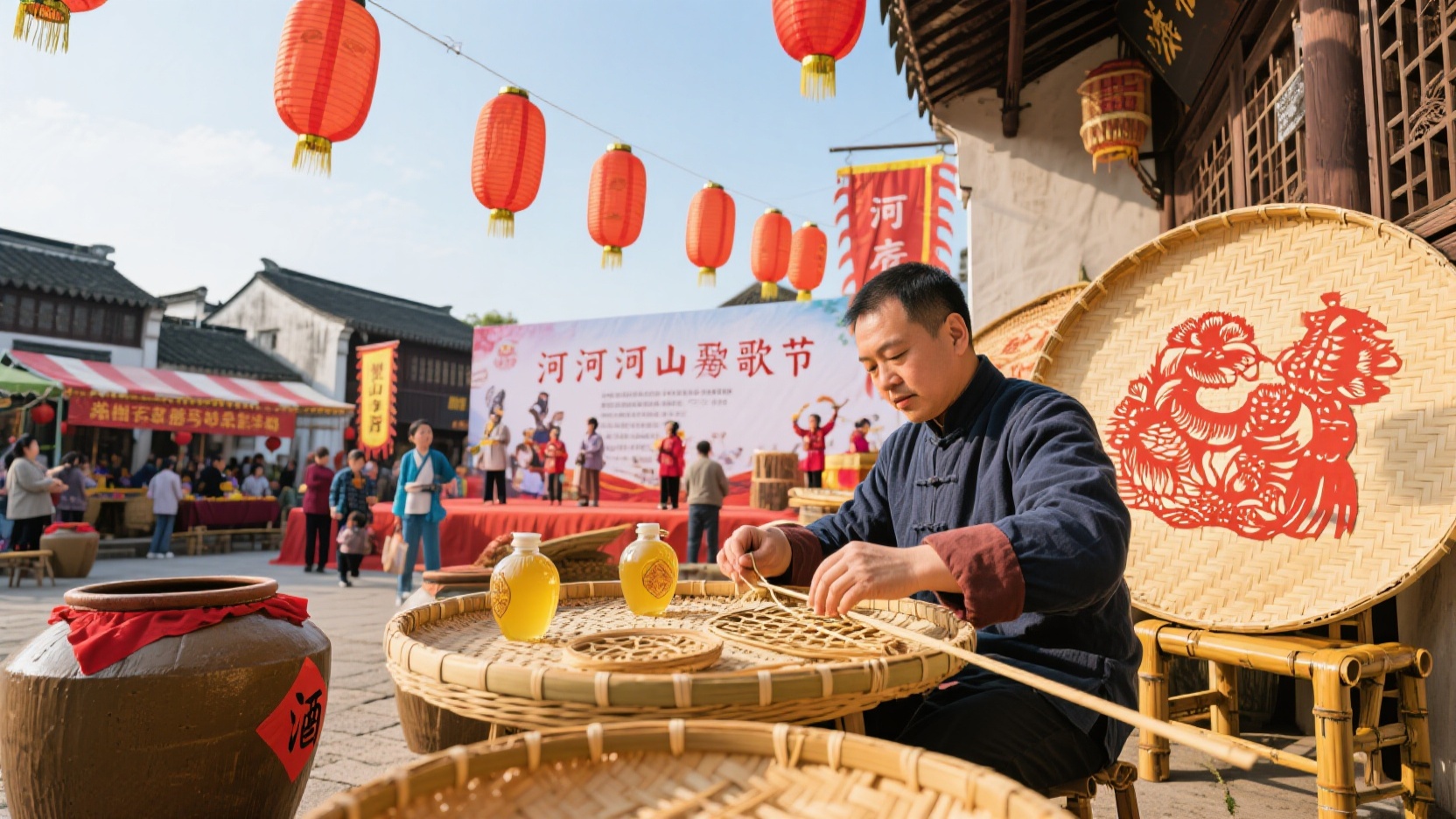
In Zhangjiagang, culture and art are not specimens locked in display cases, but rather the gongs and drums in the streets and alleys of Jincun during the third month of the lunar calendar, the Wu dialect lingering in the throats of Heyang singers, the bamboo strips being spun by craftsmen in Houcheng, and the subtle sounds from the fermentation vats of Youhuang tea in Shazhou. This route for experiencing festival customs and intangible cultural heritage minimizes the "seeing" aspect and maximizes the opportunity to "sit down and feel like a local for half a day."
Heyang Folk Song Festival: Learn a thousand-year-old Wu song
Every year from April to May, the Heyang Folk Song Festival in Fenghuang Town serves as an entry point into the sonic memory of Zhangjiagang. The event typically centers around the Heyang Folk Song Hall, extending outwards to Fenghuang Lake and surrounding villages. Heyang folk songs are an important branch of Wu folk songs, sung in the Heyang dialect, characterized by short, concise phrases and numerous interjections. The content revolves around rice-growing activities such as rice planting, boating, water chestnut harvesting, and silkworm rearing. The focus of the experience isn't watching the stage performance, but rather sitting in the teaching area under the eaves and learning a few lines of the "Bamboo-Cutting Song" from a local inheritor. This song retains the ancient rhythm of "cutting bamboo, continuing bamboo, flying soil, chasing game," and is considered a living fossil of Jiangnan folk songs by researchers. When learning to sing, first master the entering tone ending and the sustained notes; don't strive for a complete rendition. Being able to join in a line during a duet is more memorable than attending ten performances.
Jincun Temple Fair: Stepping into the Memories of the Anti-Japanese War with the Parade
The Jin Village Temple Fair, held annually around the 28th day of the third lunar month, is one of the most representative folk temple fairs in Zhangjiagang. Starting early in the morning from Jin Village Old Street, the fair begins with drums and gongs, followed by dragon dances, boat rides, flower basket carrying, stilt walking, and other performances. The highlight is the parade of "Lord Jin Qi." Legend has it that Jin Qi was a Ming Dynasty hero who fought against Japanese pirates, sacrificing himself to protect the people. Villagers built a temple to worship him, and the temple fair evolved from a religious ceremony into a community event. The best way for visitors to participate is to slowly walk alongside the incense-burning crowd. The procession forms a loop along the old street, field ridges, and riverbank, interspersed with the sounds of incense, drumbeats, and prayers in the Wu dialect. Avoid chasing after the procession for photos; maintain a slow pace and quiet. When villagers offer you tea or steamed cakes, accepting them is the most direct form of local social interaction. After the ceremony, the temple fair market continues, with stalls selling bamboo and wooden farm tools, handmade cakes, and paper-cut window decorations scattered throughout the alleyways, perfect for leisurely browsing.
Houcheng bamboo weaving and Heyang paper cutting: Being a half-day craftsperson
If you want to transform from an observer into a maker, Houcheng bamboo weaving and Heyang paper-cutting offer an accessible yet immersive entry point. Located in the Shashang area, Houcheng used to be a family sideline during the off-season for farming. Bamboo baskets, trays, mats, and fishing gear were once distributed from here to various parts of Jiangnan. The experience begins with selecting bamboo strips. The artisan will teach you how to use a bamboo knife to split bamboo into strips of uniform width, then weave a coaster or small basket using "herringbone" or "twisted" patterns. At first, you might feel the strips slipping on your fingertips, but repeated pressing and twisting gradually creates the texture—this tactile experience is more intuitive than any explanation. Heyang paper-cutting focuses on waterside bridges, lotus roots, fish patterns, and wedding window decorations. The process involves drawing, folding, and cutting, with a focus on practicing "serrated" and "crescent" patterns. When a sheet of red paper is unfolded, the relationship between the white space and the lines reflects the aesthetic logic of Jiangnan folk art. Both experiences are best enjoyed with half a day; only by calming your mind can you understand that "craftsmanship" is not just a product, but also a rhythm.
Shazhou Youhuang Brewing: From a Grain of Rice to a Cup of Wine
Shazhou Youhuang is an important representative of Suzhou-style yellow rice wine, and the brewing techniques of Houcheng have been listed as intangible cultural heritage. Autumn and winter are the brewing seasons, and the cultural park offers the most complete demonstration: soaking rice, steaming rice, placing it in fermentation vats, rinsing the vats, stirring, pressing, and boiling the wine—each step corresponds to changes in temperature and time. During the experience, visitors can approach the fermentation room and smell the aroma of the yeast, malt, and new wine mixed together. The most worthwhile part is the "stirring" stage, where experienced brewers judge the timing of stirring by listening to the bubbles and watching the mash churn; a difference of one or two hours can alter the style of the wine. Visitors can participate in simulating the stirring action and then compare the color and aftertaste of wines from different years using small cups. It's recommended to save shopping for last and first stand by the fermentation vats for a while to understand how a grain of local glutinous rice, after winter fermentation, transforms into a mild yet flavorful Jiangnan-style wine.
This set of experiences can be broken down and combined according to the festival season. Late spring is suitable for visiting the Heyang Folk Song Festival and Jincun Temple Fair, while autumn and winter are more suitable for bamboo weaving, paper cutting, and yellow wine brewing. No matter which part you choose, Zhangjiagang does not provide a checklist-style answer, but rather a "readable folk history" composed of a bamboo knife, a melodious tune, and a cup of warm wine.