
Yantai Night Walk Map | A Route from Coastal Lights to the Old Opera House Tested Over Three Nights (A Checklist to Avoid for Summer Night Walkers)
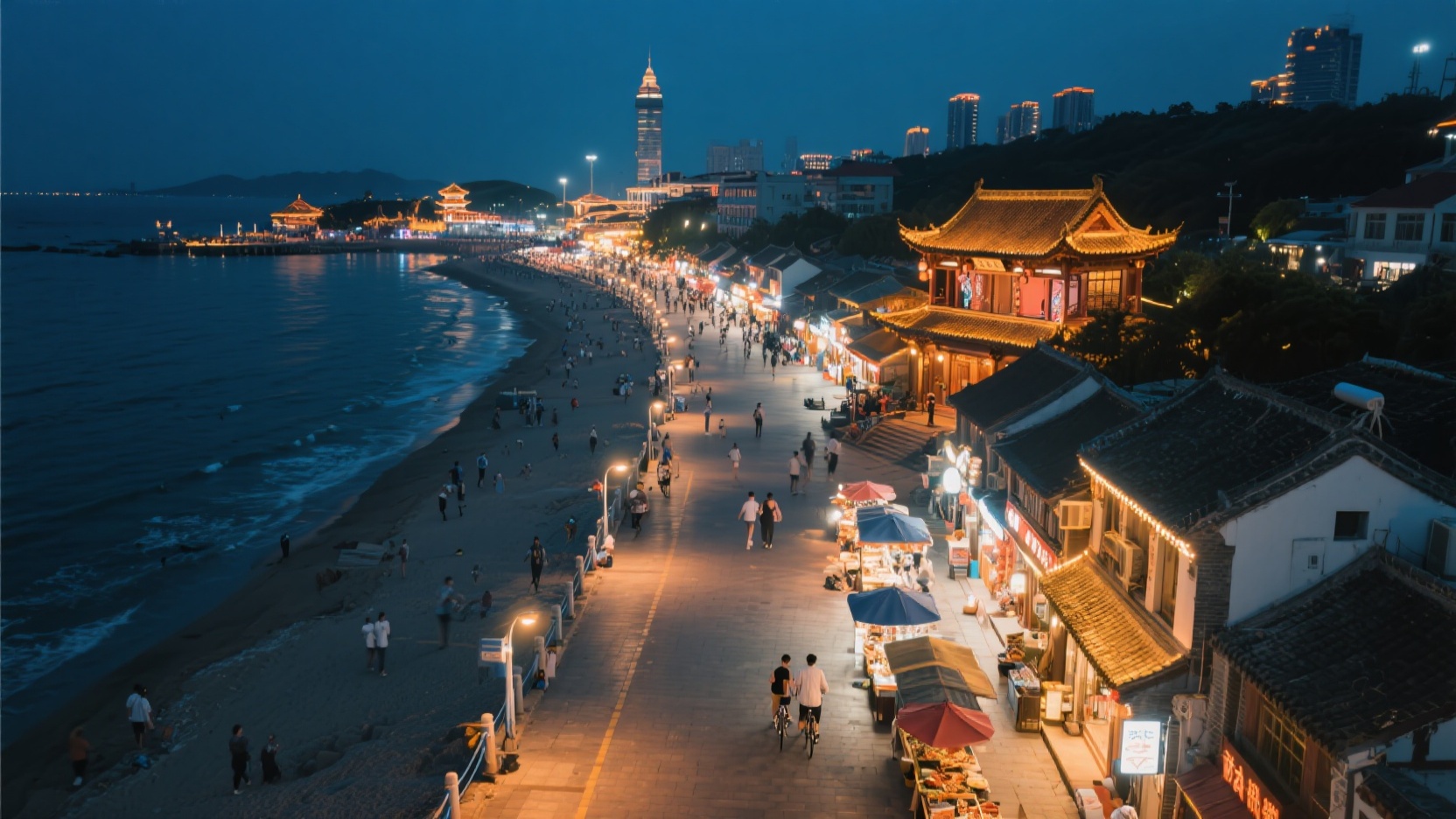
This was my third overnight stay in Yantai, and it wasn't until then that I truly mastered the nighttime tour route from the coastline to the old opera house. The first two times, I either found myself crammed into crowds at the seaside square waiting for the lights to come on, or I went to a night market that wasn't open and ended up empty-handed, and I almost couldn't find a shared bike late at night. Many online guides break down the attractions into too many fragments; a true nighttime tour is one where the routes can be connected at night. The most enjoyable part of a nighttime tour in Yantai isn't about checking off tourist spots, but about experiencing the local pace, connecting the lights, the sea breeze, the snacks, and a short opera performance.
18:00 Binhai Square and Yantai Mountain: Don't wait until dark to reserve a spot.
In Yantai, the summer sunset is around 7 PM, but the lights at the seaside plaza usually start to come on before sunset. Based on my personal experience, the best time to arrive is 6 PM. Start by walking slowly along the seaside path from the north entrance towards the lighthouse. At this time, there are fewer people, and you can capture the "blue hour" when the sky isn't completely dark but the lights are already on. Don't head directly into the Yantai Mountain scenic area entrance; there are many tour groups there. The empty platform on the east side of the path is actually cleaner.
The Yantaishan Lighthouse serves as a visual anchor point along this stretch, appearing suspended against a deep blue backdrop when illuminated from the sea. The European-style buildings of the seaside plaza glow with warm light, their reflections particularly clear when the ground is slightly damp. This section is free and takes about forty minutes to walk at a leisurely pace, enough time to witness both the sunset and the changing lights.
19:10 Cycling along the coastline: Fisherman's Wharf is even more photogenic than I expected.
From the seaside plaza to Fisherman's Wharf, it took me about 15 to 20 minutes by shared bike, passing Moon Bay and East Fortress along the way. There weren't many cars on the road in the evening, but some sections of the seaside road don't have dedicated bike lanes, so I recommend riding slowly close to the waterfront for safety and to easily stop whenever you want. The sea breeze can be a bit sticky, so remember to put your phone strap on.
The lighting at Fisherman's Wharf isn't the kind of large-scale colored lighting, but rather a warmer, more European-style yellow and white. At the corners of the wooden boardwalk, you can capture the reflections of the buildings and the distant sea in the frame. You don't need to get close to photograph the Yellow Sea Pearl; taking photos from a distance on the east side of Fisherman's Wharf offers more depth and dimension. Half an hour here is enough; don't stay too late, the night market is the main attraction.
20:00 Nanhong Street Night Market: Empty your stomach before entering the alley.
It takes about 20 minutes to ride a shared bike back to the vicinity of Nan Hong Street from Fisherman's Wharf. The safest option is to park the bike at the street entrance and walk in. Nan Hong Street isn't a neatly organized food court; it's more like an alleyway where locals grab a bite after get off work. Based on my experience, the most complete selection of stalls is after 7:30 PM; going too early might lead to confusion. Don't buy from the first stall you visit; browse around halfway before returning to choose.
The soul of Yantai's night markets lies in local seafood snacks like braised pork belly, grilled squid, and steamed sea urchin with egg. The prices are generally affordable; you can try three or four different kinds for just a few dozen yuan per person. My mistake was going into a storefront with a "long-established" sign, only to find the food wasn't as good as the mobile stalls in the middle of the alley. I reserved some room in my stomach, because at the next stop, I could enjoy some tea while listening to opera to aid digestion.
21:30 Suochengli Old Theater: Listen to a piece of Yantai people's "Peking Opera Wharf".
It only takes ten to fifteen minutes to walk from Nan Hong Street to Suochengli. The old street is quieter at night than during the day, but it has a completely different atmosphere when the lanterns are lit. Yantai has always been known as the "Peking Opera Hub," and the opera teahouses in Suochengli offer excerpts from operas or a cappella performances. Seating is limited, and evening performances usually start around 9:30 pm. I personally found that Tuesdays are usually closed, so it's best to check with the door before you go to see if there are any performances that evening.
If you're not a fan of Peking Opera, you can head to a small bar on Chaoyang Street, but since you're in Yantai, it's harder to replicate the atmosphere of locals supporting a performer. The tea and ticket price together cost less than 100 yuan per person, and choosing a back row made for a more relaxed experience. We left around 10:30 PM, just in time for the late-night coastal show.
22:40 Late night return trip along the coast: One last photo taken of the moonlit sea.
It takes about ten minutes by shared bike from Suocheng to get back to Binhai Square, or about twenty minutes on foot. Binhai Road is quiet late at night, with few cars and people. The lights near the First Bathing Beach are still on, and the sea reflects the moonlight and city lights in subtle ways. I suggest allowing ten minutes for slow shutter speed photography, using your phone's professional mode with a low ISO; the resulting sea surface will have a frosted look.
Note that there will be fewer shared bikes available during this time, so try swiping your bike several times at the return point beforehand. Finishing before 11:30 PM is sufficient; there's no need to plan any new destinations. A good night tour of Yantai should end with a leisurely walk back in the sea breeze, not rushing to catch the last bus.
Blogger's Summary: 5 Camera Positions and Safety Tips for Night Shooting
It took me three nights to get into the rhythm of this route: 6 PM to see the blue lights at the seaside plaza, 7:10 PM to cycle along the coast to Fisherman's Wharf, 8 PM to enter the Nanhong Street Night Market, 9:30 PM to listen to Peking Opera at the Suochengli Old Theater, and 10:40 PM to return to the coast to photograph the moonlit sea. The entire route can be completed on foot and by shared bicycle, without needing to take a taxi, and the pace is just right without being rushed.
Five shooting positions for night photography: the open platform on the east side of Binhai Square to capture the Yantaishan Lighthouse and its reflection on the sea; the corner of the cycling path between Moon Bay and Dongpaotai to capture the depth of the coastline; the corner of the wooden boardwalk at Fisherman's Wharf to capture European-style buildings and the sea in the same frame; the middle section of Nanhong Street to capture the lively atmosphere of the night market; and the First Bathing Beach late at night to capture the moonlit sea with a slow shutter speed.
Four safety tips: When riding at night, always stay on the well-lit coastal road and do not take shortcuts to unfamiliar beaches; night markets are crowded, so do not put your phone or camera in your outer pocket; do not record videos while watching operas in the city, and respect the actors; shared bicycles are less available late at night, so confirm the return point in advance and allow 20 minutes for the return trip.