
Yantai in the form of fishing lanterns and dough figurines | Four intangible cultural heritage events worth spending half a day experiencing as a local
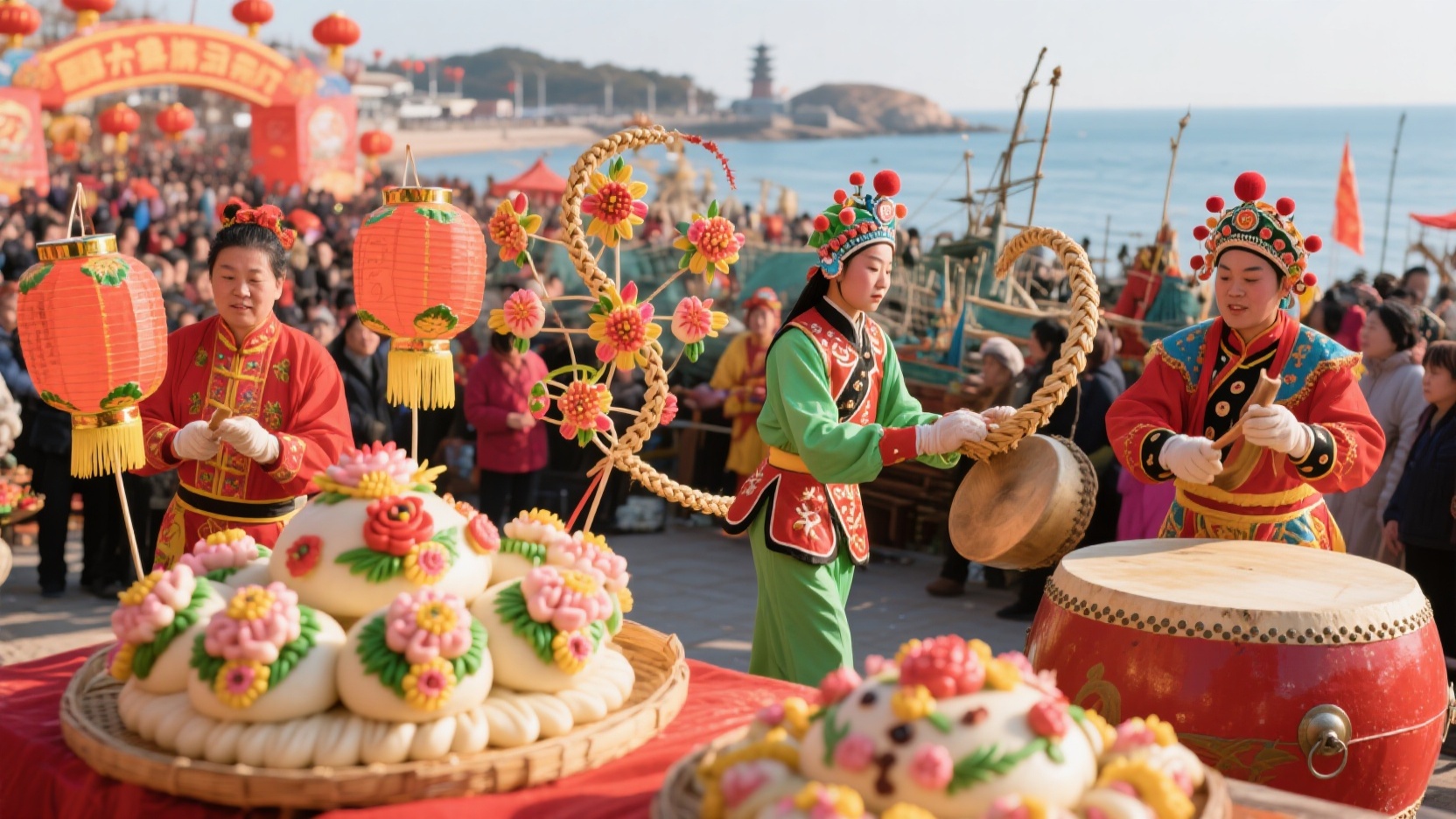
Yantai's intangible cultural heritage experiences have specific time windows: the Fishing Lantern Festival on the 13th day of the first lunar month, the Jiaodong Flower Buns from the 12th to the 1st month, the Laizhou Straw Braids after the wheat harvest, and the Haiyang Yangko Dance in the first lunar month. The focus of these four events is not on "watching," but on sitting down and reaching out.
January Fishing Lantern Festival: Deliver a handmade fishing lantern to the fishing port
The festival takes place around the 13th and 14th of the first lunar month in fishing villages around Penglai, Changdao, and Zhifu Island, with preparations beginning as early as the 12th. The core of the Fishing Lantern Festival is not the performances, but the "sending off the lanterns." Traditional fishing lanterns use radish, cabbage roots, or wooden pieces as a base, insert a candle in the center, and cover the outside with colored paper, emphasizing a stable base and a bright surface. Visitors can follow the villagers to cut red paper, make bamboo lantern frames, cut out the character "福" (fortune) from gold paper, and paste it on, along with phrases like "风调雨顺" (favorable weather for crops) and "鱼虾满船" (abundant fish and shrimp). After dark, they follow the lantern-sending procession to the pier, where the lanterns are placed in the sea or on the bow of the boat, a process that takes about two hours. The underlying belief is that the lanterns illuminate the way for the Sea Goddess and the Dragon King, and also light the way for their own boats throughout the year; the lanterns drifting downstream symbolize bad luck being carried away by the sea, so they cannot look back when releasing them. After the lantern-sending ceremony, the village often plays gongs and drums and fishermen's chants, perfect for listening and watching from the pier. Before setting off, you can learn to make a simple boat lantern from the village elders, and be careful not to cross the offering table on the shore.
Jiaodong Flower Buns: Dough is kneaded into shapes that symbolize etiquette and festivals.
From the 23rd day of the twelfth lunar month to the 15th day of the first lunar month, it's the peak season for steaming flower-shaped buns in Jiaodong. In flower-shaped bun workshops in the countryside of Yantai, the craftsmen repeatedly knead the fermented dough until smooth, then use scissors to cut out spikes, use a comb to press out patterns, and use peppercorns or black beans to dot the eyes. The dough should be slightly firmer than ordinary steamed buns to make it easier to shape. The easiest buns for tourists to make are the "Sacred Insect" and the "Date Bun": the former is made by rolling the dough into a coiled snake shape and pressing out scales with the back of a knife; the latter has a nose bridge carved out on the top of the round bun and a date inserted. After steaming, the lid should not be opened immediately; it should be left to steam for a few minutes to prevent it from collapsing—a detail known to all Jiaodong housewives. Flower-shaped buns in Jiaodong are not just ordinary pasta, but a "language of dough sculpting": the date buns for the New Year should be steamed until they crack open with a "smiling mouth," symbolizing early prosperity; the "Sacred Insect" should be placed in the grain jar to pray for a full granary. Learning to make flower-shaped steamed buns takes about an afternoon, from kneading the dough and shaping to steaming, allowing you to fully understand the New Year's rituals of the Jiaodong people. Beginners can start with single-color buns and try adding colors and patterns after they have become proficient.
Laizhou Straw Braids: A Glimpse into Farming Memories from Wheat Straw
The season for experiencing straw braiding in Laizhou is from after the wheat harvest to before the autumn harvest, and during the winter off-season. The material is wheat straw; the middle section should be selected, with uniform thickness and no mold spots. It's soaked to soften before being combed. Beginners start with a three-strand braid: three straws are alternately braided and pressed together, pinched tightly with the fingers, producing a slight friction sound. Local elders often say, "Three strands for the base, seven strands for the edges." Well-braided straw can be coiled into coasters, tea mats, and with practice, even straw hats and baskets. The uses of straw braids vary depending on the number of strands; three strands are suitable for coiling small items, while five or seven strands are more structured. Straw braiding was once an important sideline in rural Jiaodong. Women braided straw in the fields and on their heated brick beds to earn money; there was a saying, "The sound of straw braiding brings oil, salt, soy sauce, and vinegar." By the late Ming and early Qing dynasties, straw braiding in Laizhou had become an industry, later becoming a major export. Even today, in the countryside of Laizhou, you can still see elderly people braiding straw while basking in the sun. Visitors can sit down and pinch off a piece of coaster, experiencing both the craft and the agricultural time of Jiaodong. Beginners can usually complete a coaster about ten centimeters in diameter in an afternoon.
Haiyang Yangko Dance: Stepping to the drumbeats and holding an umbrella, you can be a "musical doctor" for a day.
During the first month of the lunar calendar, a visit to the villages of Haiyang often reveals scenes of "every village performing Yangko." Haiyang Yangko is known for its lively and boisterous style, featuring roles such as the Music Master, Flower Drummer, Overlord Whip, Cuihua, Peddler, and Ugly Woman. The Music Master, who holds the umbrella and directs the performance, is the soul of the entire troupe. The Music Master typically wears a dark robe and a red-tasseled hat, and his movements are characterized by "shaking the umbrella" and "flicking the sleeves." Before watching a complete Yangko performance, listen to the Music Master sing the "Invitation to the Gods" song, and then learn the basic steps of "stepping to the drumbeat": leaning forward, swinging the arms widely, and walking in a cross-shaped pattern to the drumbeat. Tourists can follow along at the edge of the troupe, holding an umbrella or fan, to learn a section, but should not join the main group. Half a day is sufficient to learn a basic set of steps. The bold movements of Haiyang Yangko originate from the ritual traditions of sea worship, temple visits, and celebrations of a bountiful harvest; it is not simply square dancing. When participating, focus on feeling the relationship between the drumbeats and the steps, especially the rhythm of the Music Master's "shaking the umbrella" and "flicking the sleeves." Afterwards, listen to a fisherman's chant or Jiaodong drum ballad; the nuances of folk vocal styles will become clearer.
What these four things have in common is that they are "easy to do." In Yantai, the entry point for folk customs is usually a pair of scissors, a straw, a lump of dough, or an umbrella. As long as you are willing to sit down for half a day, the festival is not someone else's performance, but your own time.