
Spend half a day as a Wuxi artisan: A slow-paced experience of Taibo Temple Fair, Huishan clay figurines, and Zisha pottery tables.
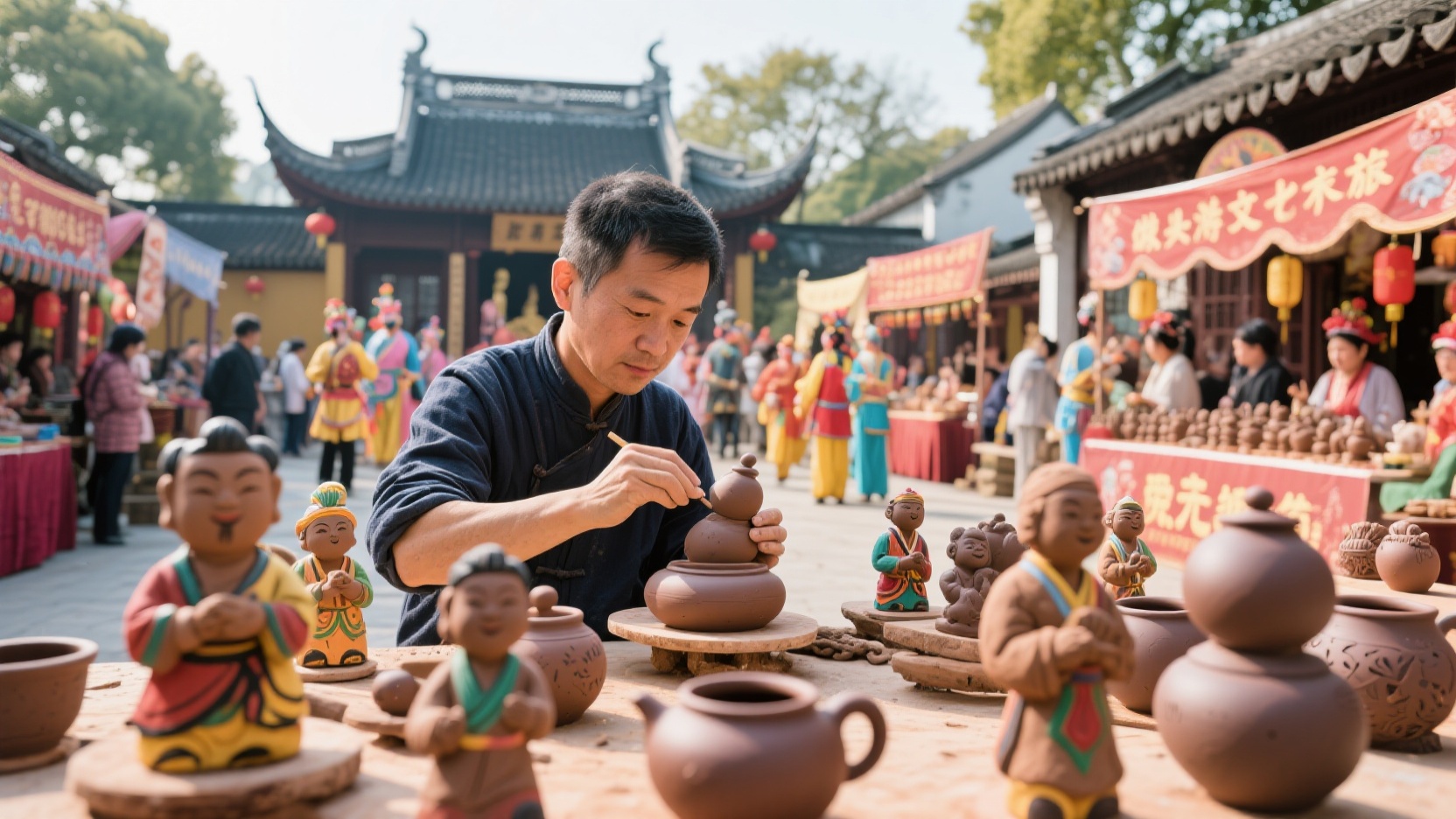
The cultural and artistic experience in Wuxi can be approached from two main angles: one is through temple fairs and opera stages during the lunar calendar festivals, and the other is through the clay and earth in handicraft workshops. The former provides a sense of ritual and collective memory, while the latter allows people to sit down and spend half a day getting a feel for the basics of an intangible cultural heritage.
Taibo Temple Fair: On the ninth day of the first lunar month, witness a "living" Wu culture parade in Meicun.
In terms of timing, the Taibo Temple Fair is held annually around the ninth day of the first lunar month, with the main venue at the Taibo Temple in Meicun and along the Bodou River. As one of the best-preserved temple fairs in the Jiangnan region, it is not just about stalls and incense, but also a mobile folk performance. If you arrive in Meicun before nine o'clock in the morning, you can see the "Lord's Procession" parade slowly walking along the street, with dragon dances, boat rides, lotus flower performances, and gong and drum teams passing by in turn. Wuxi opera enthusiasts often perform excerpts from operas in the square in front of the temple.
Beyond the parade, visitors can participate in various activities. Along the Bodou River, Wu folk song inheritors often teach short phrases, their melodies straightforward and their pronunciation rich in entering tones, unlike the soft, melodious Suzhou Pingtan, possessing a more robust, folk-song-like quality. Stopping at the stalls allows you to see artisans making Huishan clay figurines, sugar paintings, and bamboo weaving, but the best experience is to visit the actual workshops. The cultural story behind the Taibo Temple Fair is "Taibo's Flight to Wu." Taibo, the eldest son of King Tai of Zhou, fled south to abdicate the throne, settling in Meili, where he dredged the Bodou River, bringing Central Plains customs and traditions, thus forming an early settlement in the Wu region. Therefore, attending the temple fair in Meicun is essentially witnessing how the narrative of Wu culture, from "abdication of the throne" to "dredging the river," has been preserved in folk memory.
Huishan clay figurines: three parts sculpting, seven parts coloring; sit down and paint your own Da Afu (a type of clay figurine).
The Huishan clay figurine experience is best arranged outside of temple fairs and can be held year-round, with venues concentrated in clay figurine workshops around Huishan Ancient Town. Unlike assembly-line molding, the experience usually begins with learning about Huishan black clay. This clay is fine, highly adhesive, and does not easily crack after drying, making it the foundation of local clay sculpture. The craftsman will first demonstrate the four basic movements of "kneading, rubbing, pinching, and pressing," and then allow participants to choose to make a traditional large Afu (a type of auspicious animal) or a small zodiac animal figurine.
The truly time-consuming part is the painting. Huishan clay figurines emphasize "three parts sculpting, seven parts painting." Sculpting only forms the base; the expression is determined by the facial features, outlining, and coloring. Using a fine brush dipped in mineral pigments, one first outlines the eyebrows and eyes, then paints the clothing folds and patterns, requiring a steady hand and thin layers of paint. The round face, short nose, and head-to-body proportions of Da Afu, seemingly naive, actually require careful observation with each stroke. Completing a single unpainted clay figurine takes about two hours; the process is quiet but very rewarding. The prototype of Da Afu is related to folk beliefs about warding off evil and bringing good fortune, and some say its image comes from children around Huishan Temple. Regardless of the version, it retains the most simple aesthetic of Jiangnan folk culture: not seeking realism, but rather fullness, kindness, and joy.
Yixing Zisha: Understanding the tactile experience of "tea and soil symbiosis" by making clay strips and shaping the body of the teapot in Dingshu Town.
The focus of the Zisha (purple clay) experience is not on "making the perfect teapot," but on understanding the tools, the properties of the clay, and the rhythm. Zisha workshops in Dingshu Town typically offer half-day basic courses, starting with shaping clay strips. The clay strips must be shaped to a uniform thickness, then bonded together with clay slip to form the body, and finally tapped inwards with a wooden paddle to seal the rim. Zisha clay has a distinct granular texture, and there will be slight resistance when tapping it; this is the biggest difference between Zisha and ordinary pottery clay.
The experience includes using tools like the "polishing needle" to refine the surface of the teapot and bring out its shine. If time is limited, you can make cups, lid holders, or small tea pets instead, which involves a shorter process but still includes beating clay strips, shaping, and finishing. The cultural story of Zisha (purple clay) is closely related to tea. Yixing produces tea and also clay suitable for brewing tea. The double-pore structure of Zisha allows air to pass through but not water, and it absorbs the aroma of tea with long-term use. Yixing still retains the tradition of wood-fired dragon kilns. If you happen to be there during a kiln opening, you can see the saggars and the kiln fire—a more authentic experience than the finished product. Sitting in the workshop beating clay slabs, you naturally slow down, because Zisha doesn't rely on decoration to win over customers, but on proportion, lines, and the changes that occur after use.
Xiju Opera Excerpts and Night Tours: Incorporating Daytime "Handicrafts" into a Wu Dialect Singing Performance
If the daytime is dominated by hand-drawn performances, then the evening is suitable for concluding with Wuxi opera. Along the ancient canal near Qingming Bridge, stages and small indoor theaters frequently host excerpts of Wuxi opera, often selections from plays such as "The Pearl Tower," "Double Millstones," and "The Jade Dragonfly." Wuxi opera's singing style is based on the Tanhuang style, and its language is close to the Wuxi dialect. Even if one cannot fully understand it, one can still feel the down-to-earth atmosphere of this Jiangnan folk opera through its melodies and gestures. Unlike the refined Kunqu opera, Wuxi opera is closer to the emotions of ordinary people, depicting interpersonal relationships and the joys and sorrows of life.
Before watching the opera, you can take a walk along the ancient canal and see the riverside houses and cultural spaces transformed from old factories. The most captivating aspect of the Qingming Bridge section is the proportion between the bridge and the water, as well as the curved surfaces worn into the stone steps. If you visit during the first month of the lunar calendar or the Mid-Autumn Festival, you can also see the lantern festival, but the small theater performances on weekdays are quieter and suitable as a buffer after a hands-on experience.
This route doesn't focus on the number of places to visit, but rather uses a temple fair, a clay figurine, a purple clay teapot, and a piece of Wuxi opera to break down the "Wu-style handcrafted feel" into four tangible and audible segments. If you truly sit down and experience life as a local for half a day, what you gain is not souvenirs, but the rhythm of craftsmanship left in your hands.